One should always only screw the drywall into the studs so that the drywall is not affected by the movements of the OSB. This is to avoid the drywall cracking.
Honestly, I don't believe that.
Moreover, OSB doesn't move if it is correctly installed (i.e., with an air gap around it) but only changes size according to the humidity.
Moreover, OSB doesn't move if it's properly installed (i.e., with an air gap around it), it only changes size according to humidity levels.
Since the OSB has greater moisture movements than gypsum, the panels can crack, and the walls can warp. There's a reason why drywall manufacturers don't approve OSB, Plywood, etc., in their wall types. The company I work for has huge problems with walls built with OSB and gypsum; for example, most of the walls at the police station in Karlstad warped so much that the gypsum had to be removed, and the OSB had to be tracked.
can agree that "one should" screw the drywall into the studs, with long drywall screws.... not that I do it, but correctly speaking, one probably should anyway...
What size staples are suitable for plastic (and weather barrier)? Is it okay to use type 13/8, or do I need a new gun that can handle slightly wider staples?
What staple size is suitable for plastic (and windbreak)? Does it work to use something like 13/8? Or do I need a new gun that can handle slightly wider staples?
It works well. I think I've mostly used Rapid 13/6. The plastic/windbreak usually tears before the staple comes out, so I don't think longer than 6mm staples are of any use. But hardly any harm either, possibly a bit harder to pull out if you need to.
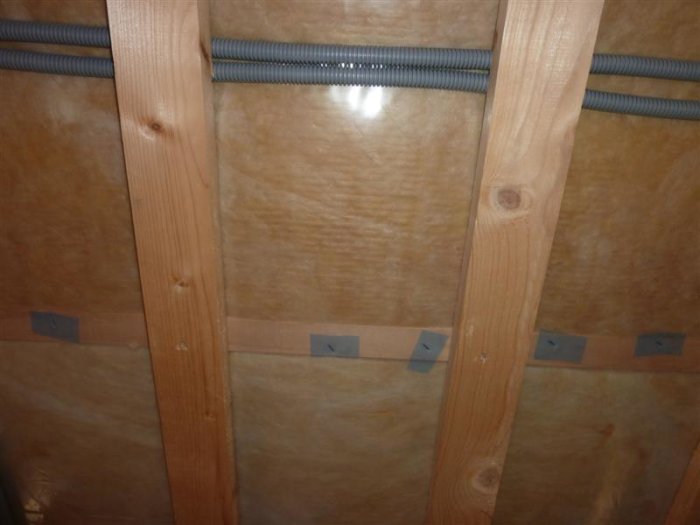
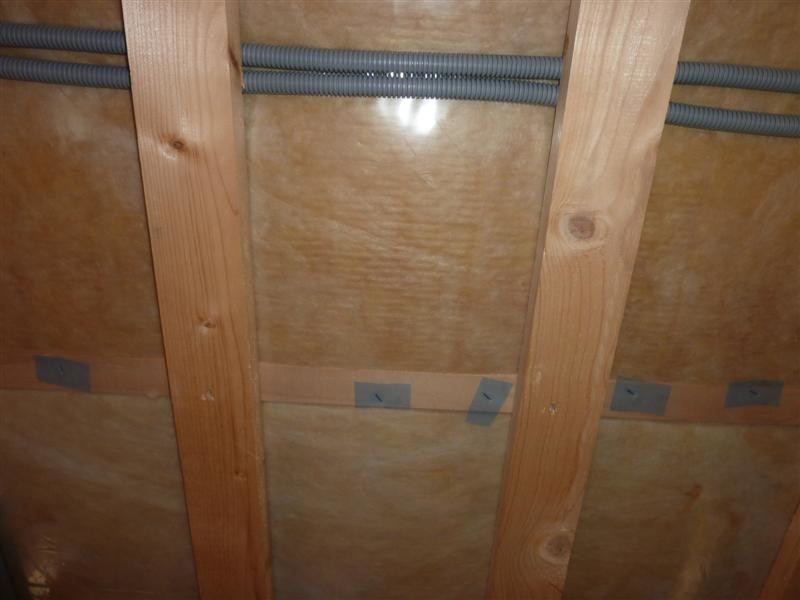
This is what my ceiling looks like.
The staples are close together; otherwise, the sheet would immediately tear due to its weight during installation.
And over each staple, there is a piece of tape as a sealant (the blue squares).
There is nothing pressing the sheet against the sparse paneling above.
If I've sometimes had a bit of trouble with the foil holding, where the staple doesn't just go through, I've first placed a small piece of ÅB-tape on the foil and then stapled it with the staple gun, then it holds up much better.
If I've sometimes had a bit of trouble with the foil holding, that the staple doesn't just go through, I've first put a small piece of ÅB-tape on the foil and then stapled it with the stapler, then it holds much more.
Here it's definitely the opposite:
The tape pieces are applied after stapling.
Incidentally, it was skilled Polish carpenters who did the job (employed by a Swedish contractor).
Here it is definitely the opposite: The pieces of tape are applied after the stapling.
Yes, that too.
I just meant where, in a few specific instances, it is difficult to get the foil to hold for special reasons. It can be, for example, where insulation weighs it down or in some corner. And at the beginning of a rollout when it's easy to accidentally tear down the whole sheet. - Then it's nice if the plastic holds a little more firmly = a little tape before the staple.
I was probably a bit overambitious and cut small squares of ice cream lids that I stapled over the plastic (instead of tape). Worked great and the plastic didn't tear at all...
Click here to reply
Vi vill skicka notiser för ämnen du bevakar och händelser som berör dig.