It started with me preparing a simple temporary workspace (like an old door), but the ambition has grown, and it seems fun to try to make an MFT workbench instead. I have limited practical experience and few tools, but I have read about things like the "Parf guide system," which seems to be a suitable method.
This is how I broadly planned to do it. I am particularly curious about step four, which I haven't seen anyone do? Is it perhaps because it's not necessary? It should be good if the entire tabletop and its edges are perpendicular to the holes, right?
1. Mark holes in a straight line along the straightest side of the tabletop. The straight line is obtained using a relatively long metal ruler or aluminum rod.
2. Use the Pythagorean theorem (according to Parf) and extend the number of marked holes on the table according to 3,4,5 (or a corresponding multiple). Here, I also use a metal ruler or aluminum rod.
3. Drill the holes to 20 mm. Make a small chamfer on the top and underside. (I am still evaluating exactly how this should be done and what tools, materials, and accessories need to be acquired.)
4. Finish by making the sides of the tabletop perpendicular compared to the holes. Insert "bench dogs" and use a saw guide, cutting one outer side at a time.
Step 4 is really just done so that a sense of order doesn't turn into chaos. I've done it but I think it's a bit whatever.
Thought that you might also want to measure/control from the edges sometimes? Or attach to the table edge in a way that interacts with the holes and bench dogs?
I unfortunately didn't succeed well enough in creating holes with perfect spacing in both height and length on two steel rulers. The result was subpar in terms of perpendicularity.
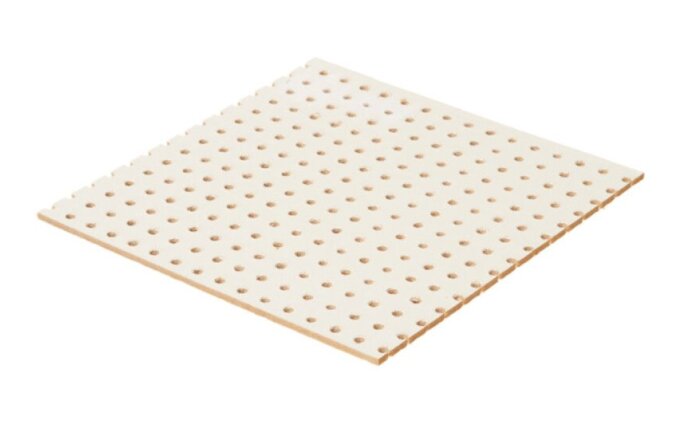
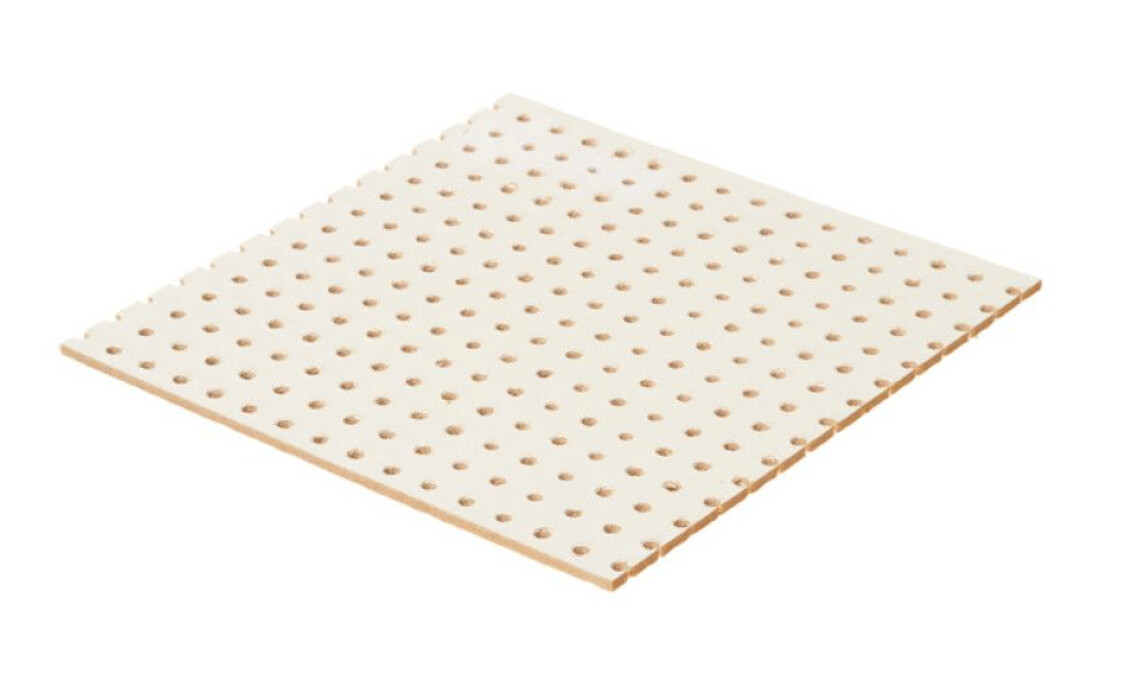
Can one instead use a perforated board as a template? The holes there should be evenly distributed, made with solid machinery. Is the precision there sufficient to achieve perpendicular MTF holes for sawing, etc.?
I was thinking of clamping the perforated board as a template and making the MTF holes with a 20 mm router bit.
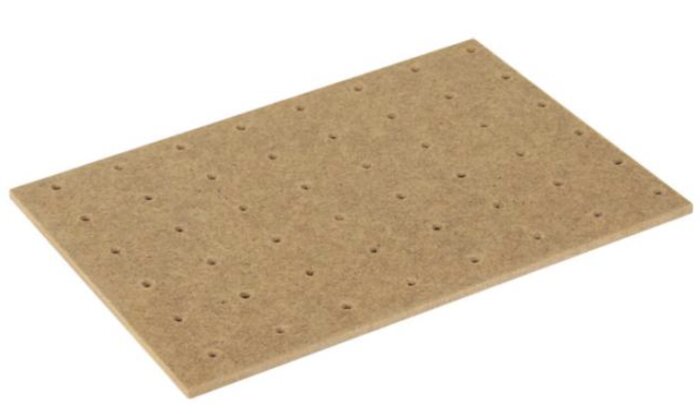
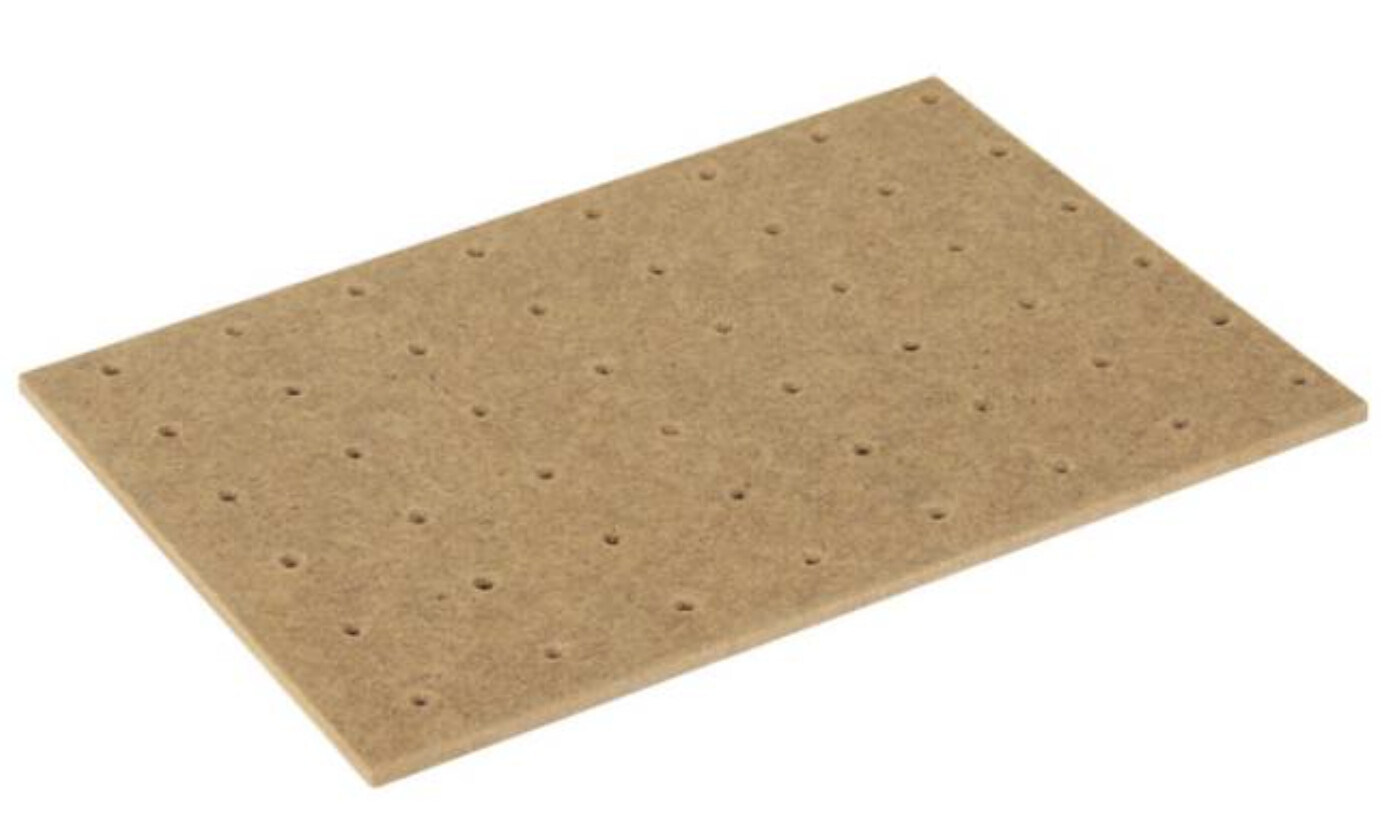
This one would be more affordable (if it works with perforated board) but is not in stock where I live currently. I don't know if it is being phased out completely?
I would probably print out a drilling template on A3 and glue it onto a piece of board if I can't find someone who already has a template or if a new one becomes too expensive.
I would probably print a drilling template on A3 and glue it to a piece of board if I can't find someone who already has a template or if a new one becomes too expensive.
Rulers along with the Pythagorean theorem is an established system that becomes very precise if you get the holes in the right places, or buy rulers with pre-made holes. However, I haven't seen anyone use a set square.
Does anyone know if the holes in a pegboard have sufficient precision across the entire board?
Click here to reply
Vi vill skicka notiser för ämnen du bevakar och händelser som berör dig.