

Hello!
Soon, maybe this weekend, I will be smoothing the bathroom with Weber's Designputs.
Since the only plastering work I've done is slamming our foundation wall, which was simple and didn't require any aesthetic demands, I am seeking tips and advice
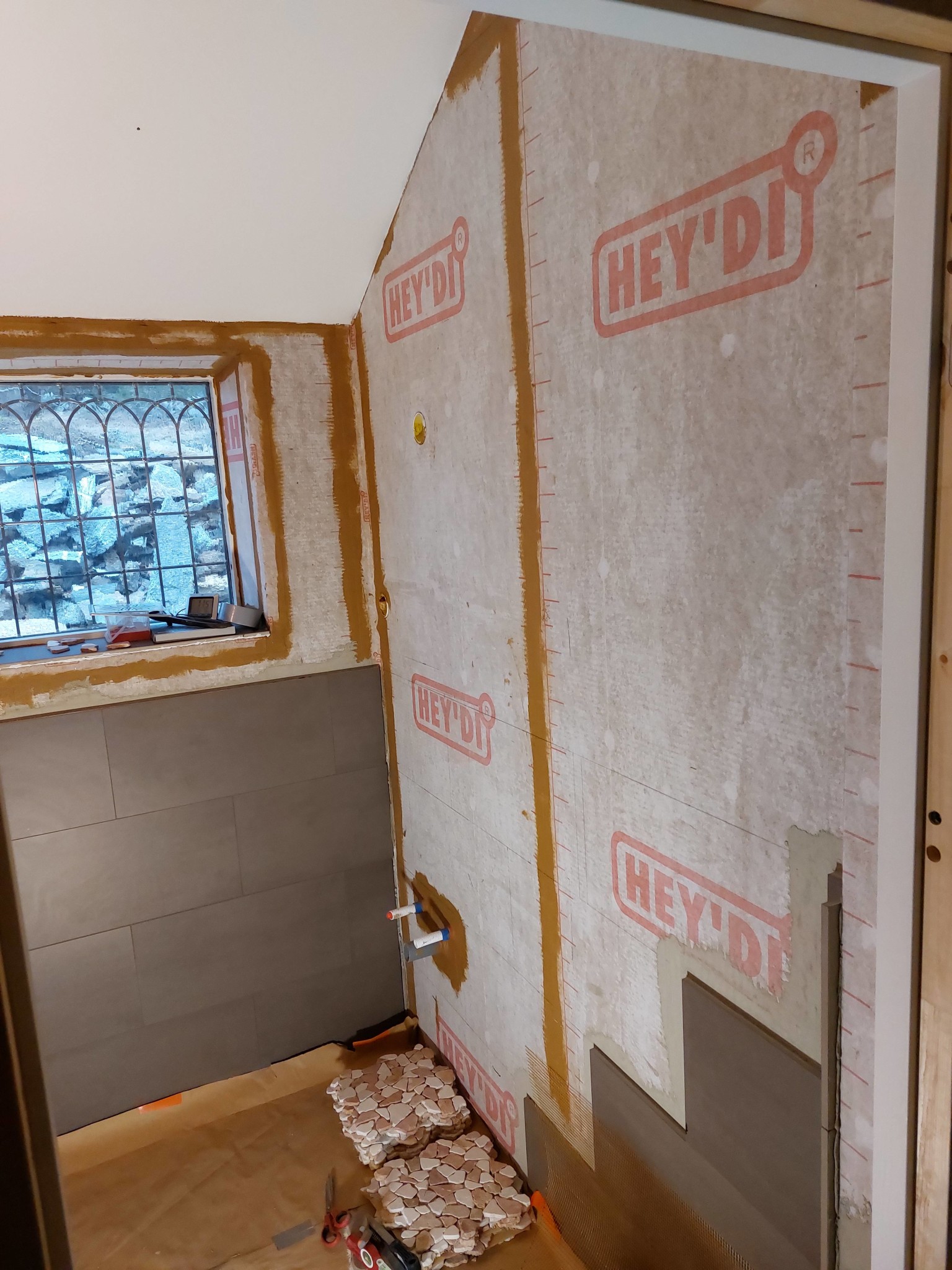
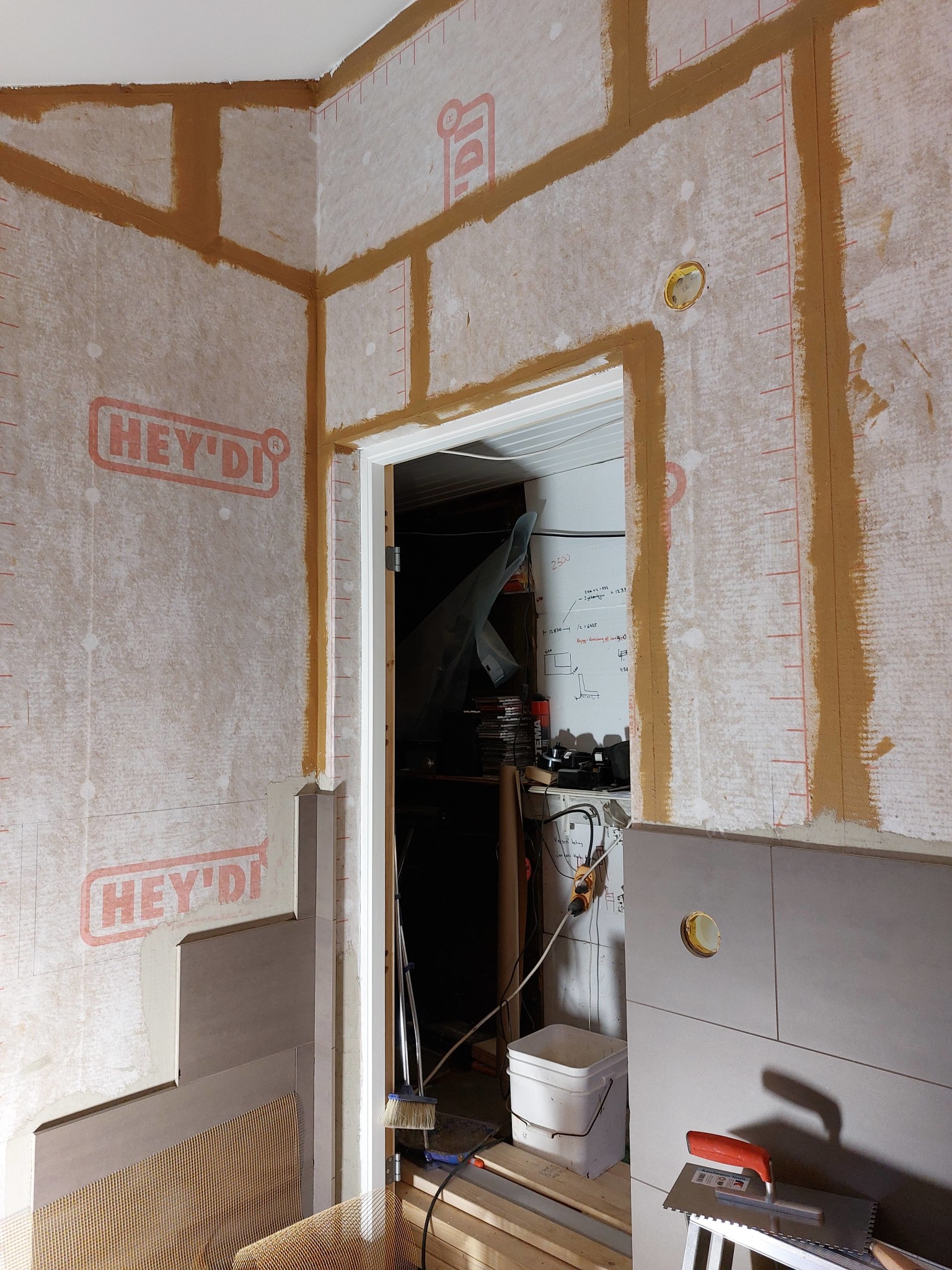
The substrate consists of wet room boards with a waterproofing membrane, so it should be straight and smooth, except for the joints in the membrane that might stick out a bit.
This is what they write in the description:
1. On the finished waterproofing membrane, apply a layer of weber rex fix with a 6-8 mm notched trowel, which after smoothing with the flat side of the trowel, results in a full coverage layer of about 2–3 mm.
2. While the weber rex fix is still wet and no later than within an hour, apply a 5-7 mm layer of Weber Designputs, smoothing it out with a flat steel trowel.
3. While the applied mortar is wet, apply the webertherm 397 EF mesh, embedding it so that the entire mesh is enclosed by the mortar and a smooth, flat surface is achieved. Internal and external corners, as well as window and door reveals, should be supplemented with webertherm 391 corner bead applied simultaneously with the webertherm 397 EF mesh.
4. Once the first layer has dried, apply an additional 4-5 mm of Weber Designputs at the earliest after one day, then float or whisk to achieve the desired texture.
https://www.se.weber/files/se/2020-02/weber-designputssystem-for-vatrum.pdf
My most important question, which I can't find an answer to via Google, is whether I need to plaster the entire room in one go. Or if I can do one surface at a time. Like one wall. Then let it dry, and maybe the next day, plaster another wall. Or do I risk the corners cracking?
Each corner will, of course, be meshed according to the description.
Another question I have is whether I should use guides. I assume it's not necessary since the substrate is straight
What tools do you recommend?
Soon, maybe this weekend, I will be smoothing the bathroom with Weber's Designputs.
Since the only plastering work I've done is slamming our foundation wall, which was simple and didn't require any aesthetic demands, I am seeking tips and advice
The substrate consists of wet room boards with a waterproofing membrane, so it should be straight and smooth, except for the joints in the membrane that might stick out a bit.
This is what they write in the description:
1. On the finished waterproofing membrane, apply a layer of weber rex fix with a 6-8 mm notched trowel, which after smoothing with the flat side of the trowel, results in a full coverage layer of about 2–3 mm.
2. While the weber rex fix is still wet and no later than within an hour, apply a 5-7 mm layer of Weber Designputs, smoothing it out with a flat steel trowel.
3. While the applied mortar is wet, apply the webertherm 397 EF mesh, embedding it so that the entire mesh is enclosed by the mortar and a smooth, flat surface is achieved. Internal and external corners, as well as window and door reveals, should be supplemented with webertherm 391 corner bead applied simultaneously with the webertherm 397 EF mesh.
4. Once the first layer has dried, apply an additional 4-5 mm of Weber Designputs at the earliest after one day, then float or whisk to achieve the desired texture.
https://www.se.weber/files/se/2020-02/weber-designputssystem-for-vatrum.pdf
My most important question, which I can't find an answer to via Google, is whether I need to plaster the entire room in one go. Or if I can do one surface at a time. Like one wall. Then let it dry, and maybe the next day, plaster another wall. Or do I risk the corners cracking?
Each corner will, of course, be meshed according to the description.
Another question I have is whether I should use guides. I assume it's not necessary since the substrate is straight
What tools do you recommend?
Last edited:


I have plastered parts, like 1 wall. It works, but it doesn't look as good (nice) as doing it all in one go. So if possible, I would try to get everything done, or at least get as few seams as possible.
I have used both with and without guide rails. It results in more even thickness with guide rails at least when I plaster. The guide rail is meant to ensure even thickness, not to level the wall. But that should be in the instructions, right?
I usually use a float, kanitz, sword, and appropriately shaped trowel.
I have used both with and without guide rails. It results in more even thickness with guide rails at least when I plaster. The guide rail is meant to ensure even thickness, not to level the wall. But that should be in the instructions, right?
I usually use a float, kanitz, sword, and appropriately shaped trowel.
The reason you're not getting a sensible answer is that this isn't about traditional plastering.
This is more like microcement/tadelakt, and you should follow the manufacturer's instructions, as there isn't really a common practice since this surface layer isn't particularly widespread in Sweden (yet).
The critical part, as I see it, is how to handle the corner beads if you're dividing it up wall by wall.
And still get a good starting point when the adjacent wall is to be done.
You should probably contact the supplier to discuss the matter; after all, it's their product and they are the ones who should provide the guarantees in the end.
This is more like microcement/tadelakt, and you should follow the manufacturer's instructions, as there isn't really a common practice since this surface layer isn't particularly widespread in Sweden (yet).
The critical part, as I see it, is how to handle the corner beads if you're dividing it up wall by wall.
And still get a good starting point when the adjacent wall is to be done.
You should probably contact the supplier to discuss the matter; after all, it's their product and they are the ones who should provide the guarantees in the end.
Thank you for your reply
Weber's instructions are the ones I wrote & linked.
Nothing more is said about the procedure. Therefore, I thought the same should apply as with traditional plastering.
But I wrote to Weber yesterday morning. Their response was unclear, but roughly the same as yours. That it's preferable to plaster the entire room at once, but that you can do one wall at a time.
Weber's instructions are the ones I wrote & linked.
Nothing more is said about the procedure. Therefore, I thought the same should apply as with traditional plastering.
But I wrote to Weber yesterday morning. Their response was unclear, but roughly the same as yours. That it's preferable to plaster the entire room at once, but that you can do one wall at a time.

Float, kanitz, sword, and a suitably shaped trowel are what I usually use.[/QUOTE]
What do you use the sword for?[/QUOTE]
To level the surface with.
What do you use the sword for?[/QUOTE]
To level the surface with.
Click here to reply