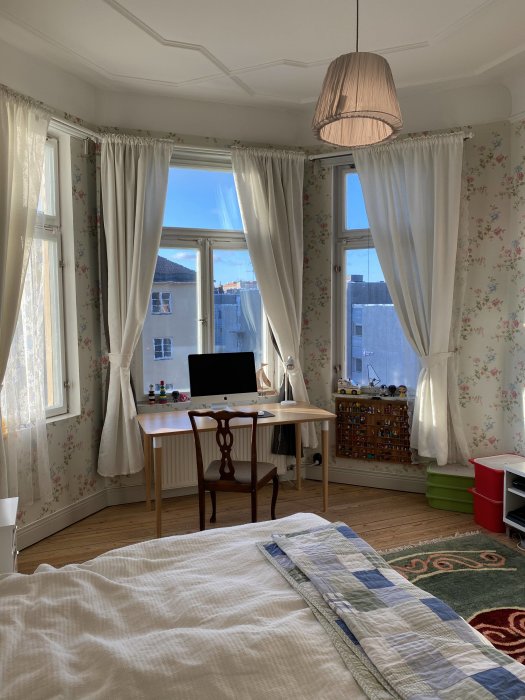
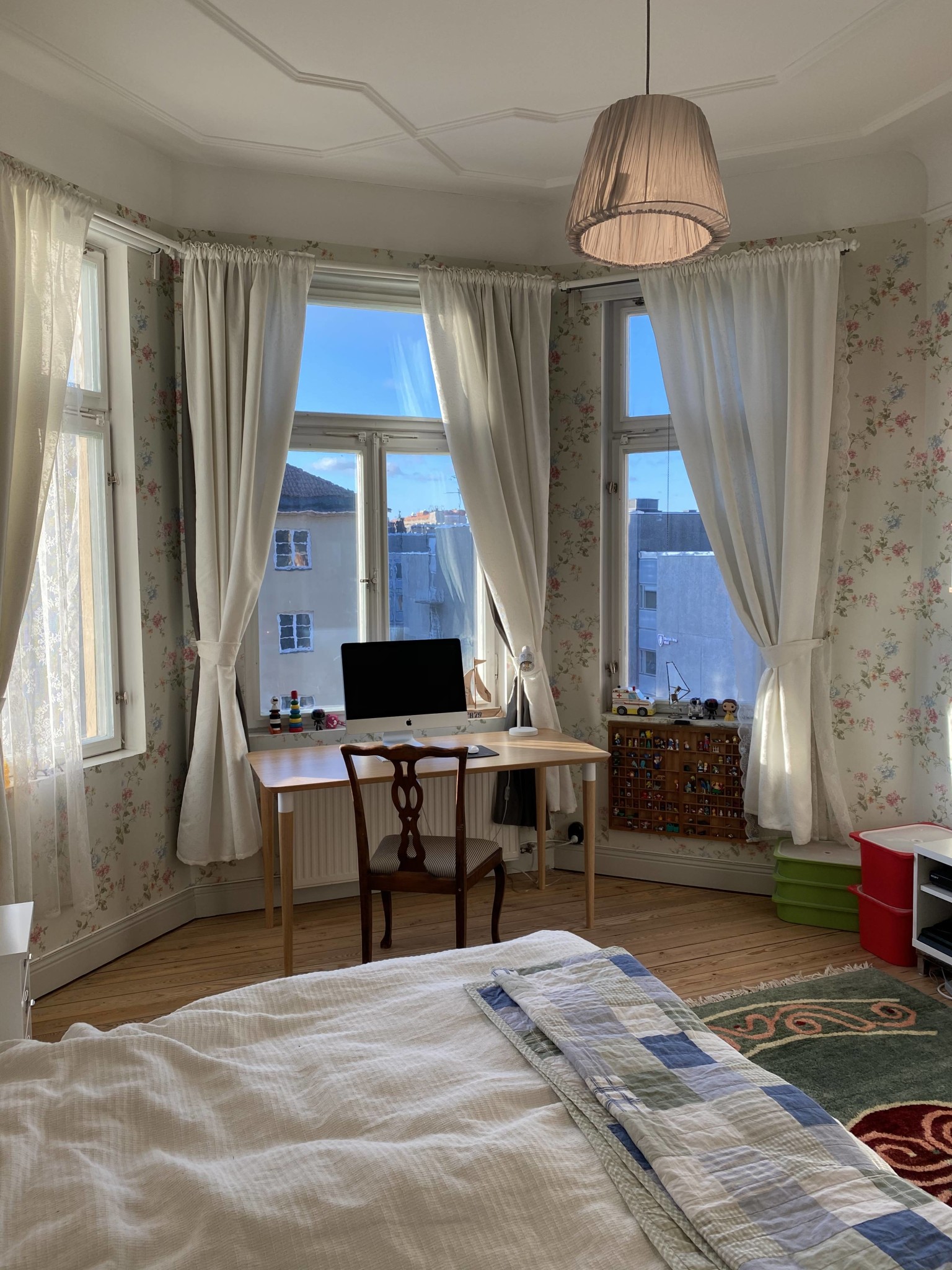
One of our rooms in the apartment lets in a lot of noise from the street traffic. It's the bay window that seems thin. The building was constructed in 1913 and is on the top floor. The neighbors below and further back in the building don't have our problem. We seem to have a different construction. Possibly, our bay window was supposed to be a balcony but was built in. Such facade drawings exist as an option at the City Planning Office. The window frames are original with mouth-blown glass and should not be replaced. On the inside, there is an extra sheet of noise-reducing glass. The question thus concerns the wall. I plan to tear down the inside of the wall and rebuild it with noise reduction as the goal. Does anyone have tips, advice, ideas, or thoughts on how it should be constructed to be the quietest? I like building conservation. So older techniques are appreciated, but I want to hear everyone's suggestions.
I would have started with a thermal camera where it is coldest and sealed it with caulking, like baseboards. Possibly built up with an insulated wall on the inside. If the floor is cold, sprayed in insulation. But I'm no sound expert.
A bass absorber in one or some of the room's corners would shorten the decay time and lower the level of the most low-frequency part of the noise, which both provides the most experience of disturbance and is the hardest to isolate.
We replaced the inner glass of our windows with laminated glass, which made a big difference. The old hand-blown glass remains in the outer pane. It's important to request clear glass and not solar radiation-repellent to avoid a green tint.
When it comes to sound, it's important to distinguish between isolation and absorption. Isolation prevents sound from coming in or going out, while absorption reduces echoes against walls and ceilings, resulting in a shorter reverberation in the room. Absorption doesn't prevent sound from coming in and doesn't really reduce the original sound, but since it absorbs echoes, it eliminates the feeling that the sound is amplified by hard walls like in, for example, a bathroom. A simple fix to slightly reduce perceived noise can be to use thick fluffy carpets, fabric sofas with fiber cushions instead of closed foam, thick curtains, and so on.
When it comes to isolation, it's all about mass, damping, and sealing, and it's always about addressing the weakest link first. It doesn't matter if you build walls of solid concrete if you have rattling single-glazed windows. You achieve mass simply by using heavy materials like sand, MDF, plasterboard, laminated glass, concrete, etc. Damping is achieved by using dampened materials. A solid wooden panel has a certain ring when you knock on it, so it's not very dampened. If you knock on an MDF board or hardboard instead, it's considerably deader and therefore conducts sound less well, providing better isolation. Not using too many screws between, for example, plasterboards also provides better damping. Every solid connection, like a screw, provides an initial path for sound. It's better to glue boards together with a viscous glue, such as acoustic adhesive. Three glued-together plasterboards provide much mass and good damping and usually give very good isolation, assuming sound doesn't come in elsewhere. Laminated windows are another example of when a damping layer removes the transfer between two panes. So, that brings us to sealing.
If there are holes and gaps, sound will come in there. If the hole is big enough for air to come in, sound will also enter. So, before doing anything else, ensure that walls, floors, ceilings, windows, etc., are completely sealed. But unlike air sealing, it's not enough to just seal with, for example, a thin plastic film or the like. Sound is not an airflow but vibrations, so if the plastic film is light enough to vibrate, it also lets sound through. Seals should preferably be made with heavier dampened materials, but depending on the size of the gaps, regular acrylic sealant or foam sealant usually works well.
Now, I might not have had any good examples of products that go hand in hand with building conservation, but if you just follow the principles above, you can use almost any materials; I don't think it's too hard to come up with examples yourself. However, one problem is that older houses are rarely particularly tight and therefore have quite poor sound insulation.
One last tip might be to just download a dB-SPL meter app for your phone, then you can go with it close to the wall and see where it leaks through the most. This works well directly with your ears too. However, it's important to be close to the area you're measuring. If you have reasonably hard walls, you have a lot of reflections in the room, so if you're just 10-20 cm from the wall, you're measuring more or less an average value for the room; you need to have the mic almost against the wall to see any local difference. Good luck!
Agree with everything jonathanGubbe said. Assuming everything is sealed and the facade wall is simply too weak, and you're going to tear it down and rebuild it as you mentioned, I want to add that having as weak a connection as possible between the inner and outer layers of the wall is important. The best option is a free-standing inner stud frame, secondly to mount boards on resilient channels (known as acoustic profiles), and thirdly to have horizontal 45-studs on the inside, where the gypsum is screwed into the part of the stud that lies between (i.e., not on) the "crosses" with the vertical stud. As Jonathan mentioned, it's heavy boards that are needed, aim for 2x15 mm fire-rated gypsum or equivalent weight.
If there's room for an extra seal somewhere, it might be beneficial. For comparison, all sound-rated doors worth their salt have at least double seals to keep noise out. They may have a pocket of sound-absorbing material between the seals to further reduce what gets through.
Offhand, I find it hard to believe that the walls are the weak link (or weak enough compared to the windows and their gaps) that any major reconstruction would be worth it, but that's just my uninformed guess.
Click here to reply
Vi vill skicka notiser för ämnen du bevakar och händelser som berör dig.



AXS said:
