
5,280 views ·
11 replies
5k views
11 replies
Yet another thread - vapor barrier or not when insulating in roof trusses?
I know there are many threads on the topic of vapor barriers or not, but I can't figure out what to do. So I am in great need of help...
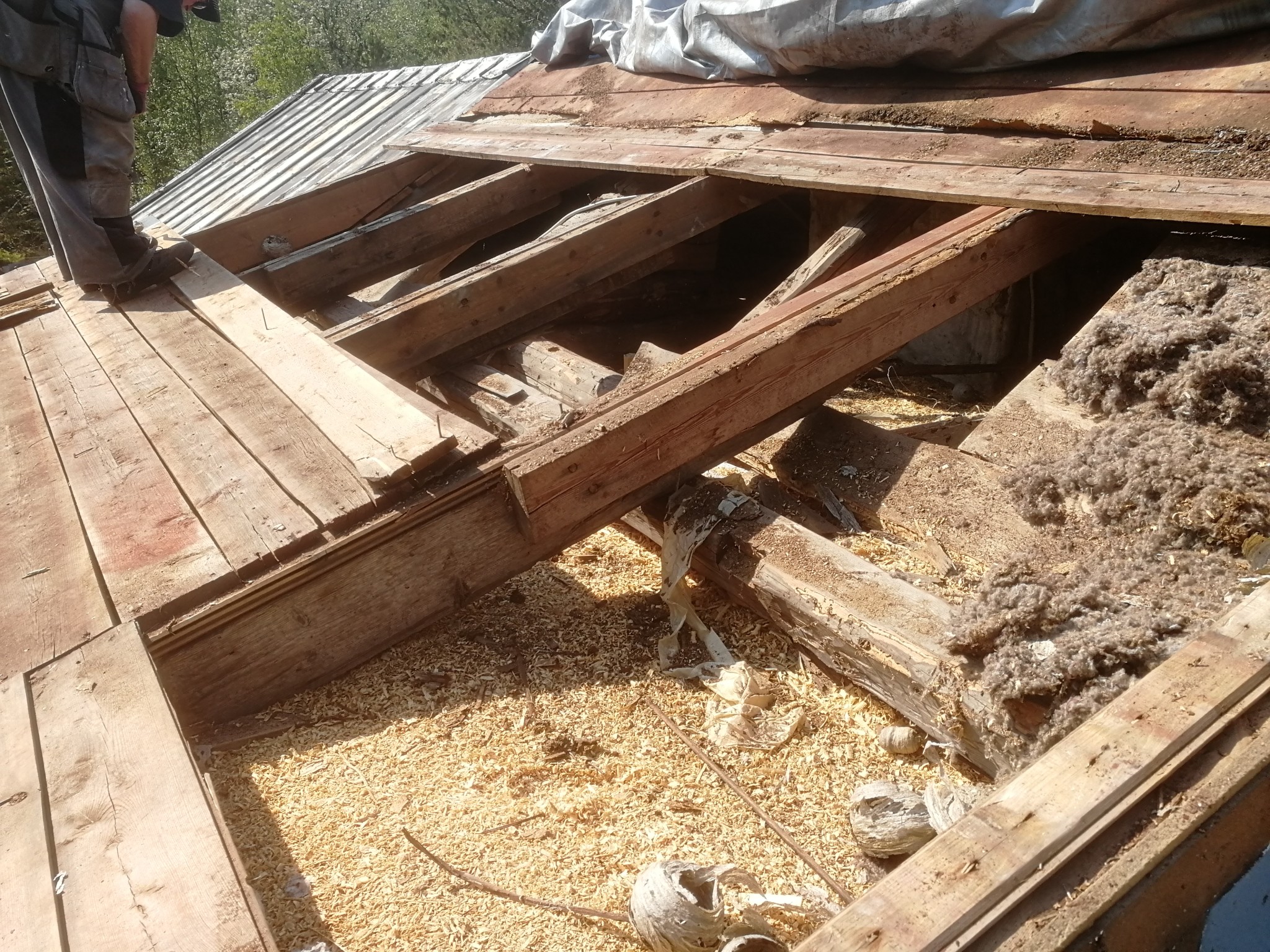
The premise is, an old house. Timber frame, gable roof with an extended stairwell with a lean-to roof. I dare say it isn't done professionally - or maybe that's how they built back in the day.
Insulation is sawdust, poorly insulated, there's no wind barrier or anything similar.
Inside the upper floor, there's a sloped ceiling...
Now I'm renovating the roof, and the plan is to clear away the sawdust and insulate with stone wool boards... but the question then becomes... should I install a vapor barrier or not?
If I choose cellulose-based insulation boards, vapor barrier or not?
If I spray cellulose-based loose-fill?
If I choose something other than mineral fiber, can I then leave the old sawdust and just fill it in?
The premise is, an old house. Timber frame, gable roof with an extended stairwell with a lean-to roof. I dare say it isn't done professionally - or maybe that's how they built back in the day.
Insulation is sawdust, poorly insulated, there's no wind barrier or anything similar.
Inside the upper floor, there's a sloped ceiling...
Now I'm renovating the roof, and the plan is to clear away the sawdust and insulate with stone wool boards... but the question then becomes... should I install a vapor barrier or not?
If I choose cellulose-based insulation boards, vapor barrier or not?
If I spray cellulose-based loose-fill?
If I choose something other than mineral fiber, can I then leave the old sawdust and just fill it in?
Lifting the thread again, hoping for answers...
From what I've read here, and after talking to the building supply store, I've understood that a vapor retarder is what I should install - and that it's important for it to be sealed. It is forgiving... good in houses that aren't used year-round, etc.
Well, that's good... but now when I'm reading about vapor retarders (manufacturer's site), it says they should not be used against cold attics.
I'm confused about this... those who "know" say vapor retarder... vapor retarder says vapor barrier.
I might soon say matchstick...
From what I've read here, and after talking to the building supply store, I've understood that a vapor retarder is what I should install - and that it's important for it to be sealed. It is forgiving... good in houses that aren't used year-round, etc.
Well, that's good... but now when I'm reading about vapor retarders (manufacturer's site), it says they should not be used against cold attics.
I'm confused about this... those who "know" say vapor retarder... vapor retarder says vapor barrier.
I might soon say matchstick...
Since a steam brake allows some water vapor to pass up to the attic and a vapor barrier does not, combined with the understanding that all moisture content in a cold attic almost inevitably condenses on the roof sheathing during cold winter nights, the answer should be clear.
A vapor barrier on the underside of the roof and roofing felt on the top side of the roof is a poor construction - it traps moisture between these two layers. However, a vapor brake can allow moisture to migrate.
My advice is to visit, for example, the Rockwool or Isover website and check their lists of approved solutions. If you don’t find anything that matches their constructions, you can send an email, attach a drawing, and often get a good response within a few hours.
My advice is to visit, for example, the Rockwool or Isover website and check their lists of approved solutions. If you don’t find anything that matches their constructions, you can send an email, attach a drawing, and often get a good response within a few hours.
Well. The traditional method, as you described, is a vapor barrier on the inside and tight roofing felt on the top side. But there is a ventilated gap under the sheathing. That way, no moisture gets trapped.N Nicke_S said:Vapor barrier on the underside of the roof and roofing felt on the top side of the roof is a poor construction - it traps moisture between these two layers. A vapor retarder, on the other hand, can allow the moisture to migrate.
My tip is to go to, for example, Rockwool or Isover's website and look at their lists of approved solutions. If you find nothing that matches their constructions, you send an email, attach a drawing, and often get a good response within a few hours.
Or you can go without a gap and with a vapor brake and get an additional 30-50mm of insulation. But then the right products must be used, otherwise, it becomes problematic.V vectrex said:
This is not relevant for cold attics but applies to parallel roofs.N Nicke_S said:A vapor barrier on the underside of the roof and roofing felt on the top side of the roof is a poor construction - it traps moisture between these two layers. However, a vapor brake can allow the moisture to migrate.
My tip is to visit websites like Rockwool or Isover and look at their lists of approved solutions. If you don't find anything that matches their constructions, you can send an email, attach a drawing, and often receive a good response within a few hours.


Old straw-insulated roofs last a long time, partly due to poor insulation effect. That is, the moisture content is kept low through residual heat from inside. With more effective insulation, the temperature drops and RH increases.
It probably also depends a bit on what kind of spaces are underneath. Kitchens and bathrooms are likely more moisture-generating than a living room.
If the house is permanently heated and the insulation is improved, a vapor barrier is recommended.
It probably also depends a bit on what kind of spaces are underneath. Kitchens and bathrooms are likely more moisture-generating than a living room.
If the house is permanently heated and the insulation is improved, a vapor barrier is recommended.
Thank you for the response.
I have probably decided to use spärr - but I am wavering in my decision. Much because I don't know if it will seal properly. At the same time, it doesn't feel right not to put anything at all...
I have probably decided to use spärr - but I am wavering in my decision. Much because I don't know if it will seal properly. At the same time, it doesn't feel right not to put anything at all...
Even though it won't be perfect because of the old house, it significantly reduces the moisture load. There won't be extremely high moisture concentration at any transitions to non-plastic, as long as it is wind-/draft-proof.
Click here to reply