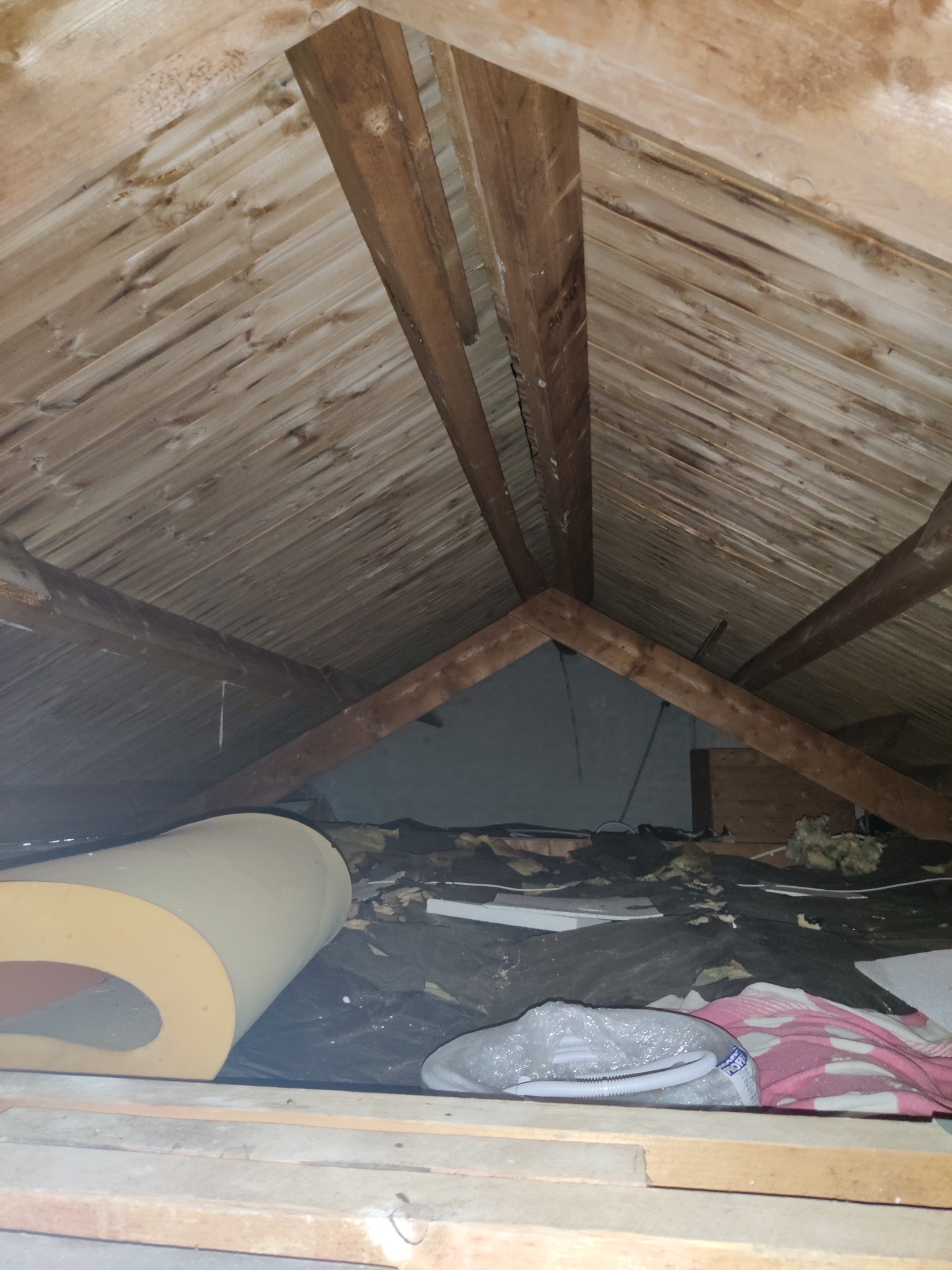
It was original with ridges. That cannot be seen in the section. What is the distance between the rafters and what dimensions do the ridges have? You can see how much more substantial the inch-dimensioned timber is. 50x200 is much better than 45x195. Your measurement shows that the heart wall in bv or its replacement is best left in its original position.
It was original with beams. You can't see that in the section. What is the distance between the roof trusses and what are the dimensions of the beams? You can see how much sturdier the dimensioned timber is. 50x200 is much better than 45x195. Your measurement shows that the partition wall in the ground floor or its substitute, does best to remain in its original position.
Let's see if I'm following the terms correctly; otherwise, it's good to learn! And yes, it's a truly original construction!
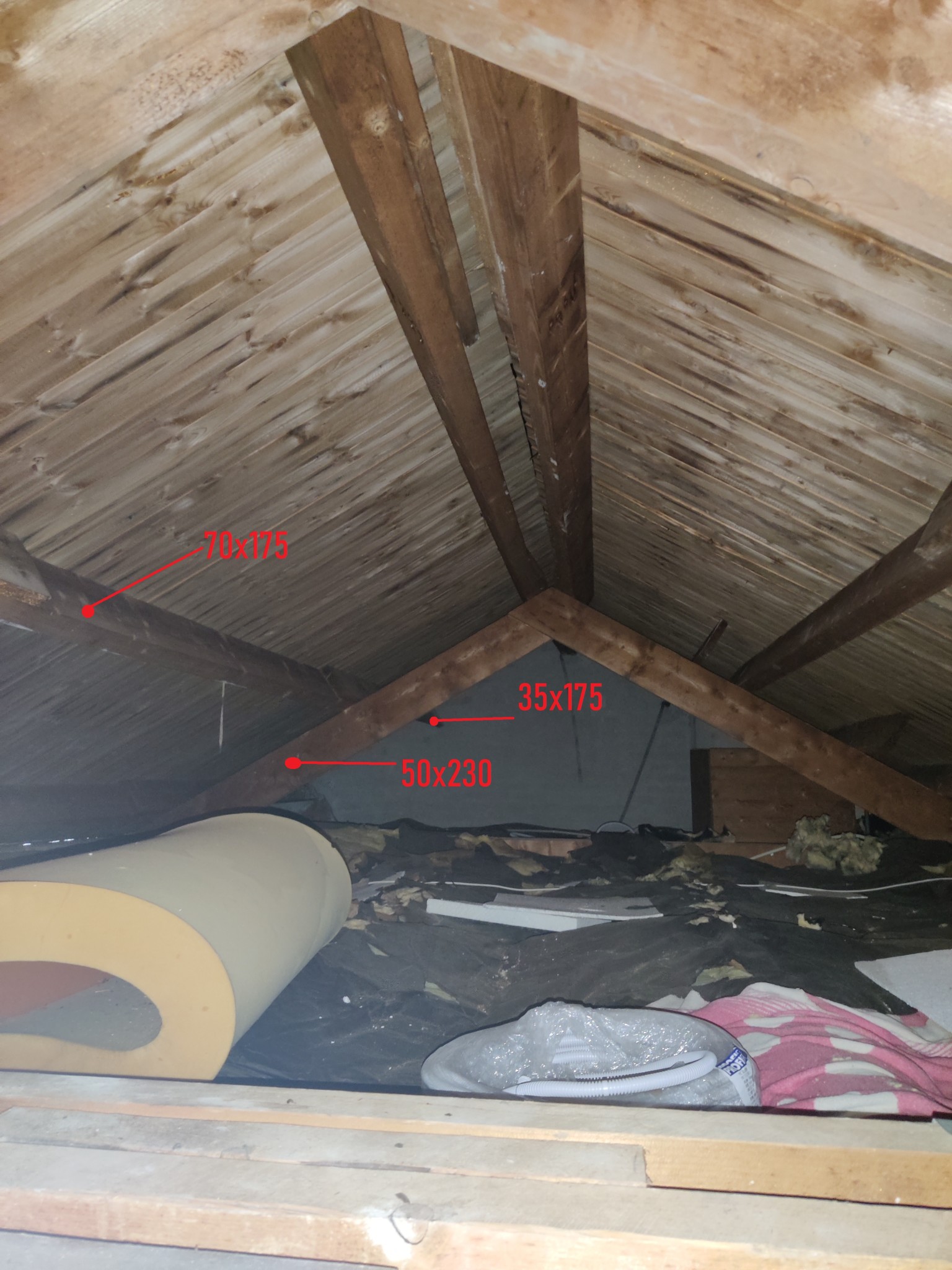
I've drawn the measurements on the image, but if I'm not completely off track, it's the following. The roof trusses are 50x230.
The measurements are Wall ----- 2300mm ------- truss ---------3900mm----------truss---------2500mm-----wall
So the beam (meaning those that go between the trusses and look like a sort of purlin?) is on the long span 70x175 and on the short spans 35x175.
When you say beams, does it imply that it's a secondary load-bearing structure?
Addition:
The pillars going down, meaning the load-bearing part on the upper floor, are 90x115 if I remember correctly
The longitudinal beams resting on the rafters and forming a secondary supporting part of the roof are called åsar. This was the common roof construction in old timber houses. They rested on timbered partition walls. Rafters were only found in castles and manors. It may be that this solution was chosen here to facilitate the construction of the roof terraces.
Unfortunately, one must observe how the entire supporting framework functions to calculate the impact of the roof loads on a potential transfer beam. It's quite an interesting house. Definitely not a dime a dozen.
Rafters are the longitudinal beams that rest on the roof trusses and serve as a secondary load-bearing part of the roof. It was the common roof construction in old log houses. They rested on timbered partitions. Roof trusses were only found in castles and manors. It might be that they chose this solution here to facilitate the construction of roof terraces.
Unfortunately, one must see how the entire load-bearing framework functions in order to calculate the impact of the roof loads on any potential cross beam. It's quite an interesting house. Absolutely not a run-of-the-mill item.
I understand!
Regarding the roof terraces, they do not exist; a neighbor once applied to build one but was probably denied, so they built a dormer instead (as I don't have my own plans, I've tried to get a hold of the neighbors' old ones and make copies of them)
But yes, they are quite different and exciting row houses, actually. They would have been even more unique originally, for instance, there would be a cold pantry under the landing steps, half a flight down. However, it was (unfortunately) never put into production
As you say, it seems there's a lot to calculate, but tearing it down still doesn't seem like a super complicated measure based on the brainstorming with you
I see no principal obstacles, as long as it is not a matter of changing position. You must arrange for column support in the ground floor and gather all the necessary facts to size the transfer beam. In some parts of Skåne, the snow loads are not so large. On the other hand, it can be very windy. Nowhere in Sweden have I been as cold as in Skåne...
I, being originally from the west coast, think the weather here is tropical
I checked it now and you are right, snow zone 1.5 and highest wind zone (26).
I will have to dig a bit into the foundation floor, if you place the beam where the supporting wall is today, the conditions are obviously better, I guess. I also think that the support towards the hall will be about 60 cm, where part of the stove side will also act as support. In the utility room, I'm considering whether the beam should go almost all the way to the neighbor, in order to open up towards the boiler room (since in that case it becomes a "passage" to the laundry from the kitchen).
I am also from the west coast. I could never imagine trading the climate of Blekinge's archipelago for anything else in Sweden. Unbeatable warm autumns.
Now another question has arisen, perhaps not indirectly related to the structural work, but it's in those regions causing trouble...
The floor in the current living room is elevated, where there is a (probably thinner) slab at the bottom, about 15-20cm down. In conjunction with moving the kitchen, with water pipes and drainage, I'm thinking of completely removing that slab, insulating, and installing underfloor heating instead. This is partly for convenience, partly because a radiator needs to be removed to achieve the layout we want, and finally because we've had issues with the elevated floor before, and it's still not perfect.
The question then is, should we be ambitious enough to also break up the kitchen and hall?
One advantage of doing this is that we can take the opportunity to replace the pipe to the guest WC and install new water pipes to it in the floor.
But in terms of work and costs, it feels like quite a bit of extra work?
The pipe to the WC could simply be rerouted to the same pipe as the kitchen and simply "kill" the old pipe?
Water pipes should be able to be routed in the ceiling?
Yes, you may understand my thoughts on whether the extra work is really worth it.
How would you have done it?
And what do you think the additional cost would land at? In terms of area, it's about an additional 30m².
My big question is really whether it's worth breaking up the entire slab more or less on the ground floor to be able to install underfloor heating, or if it's enough to just have underfloor heating in the kitchen/dining room.
I lean towards it being enough, partly because it's a significantly smaller job work-wise, as the floor needs to be addressed there anyway, so it's not extra work in itself. Then it's also significantly less of an investment I would think, but since I've never broken up a slab before, I don't know how much work it requires.
I don't have any drawings of my own, so I have to rely on my neighbors'.
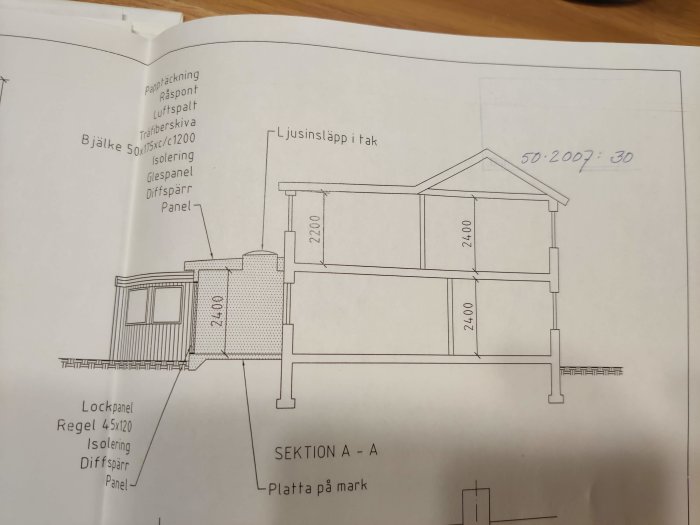
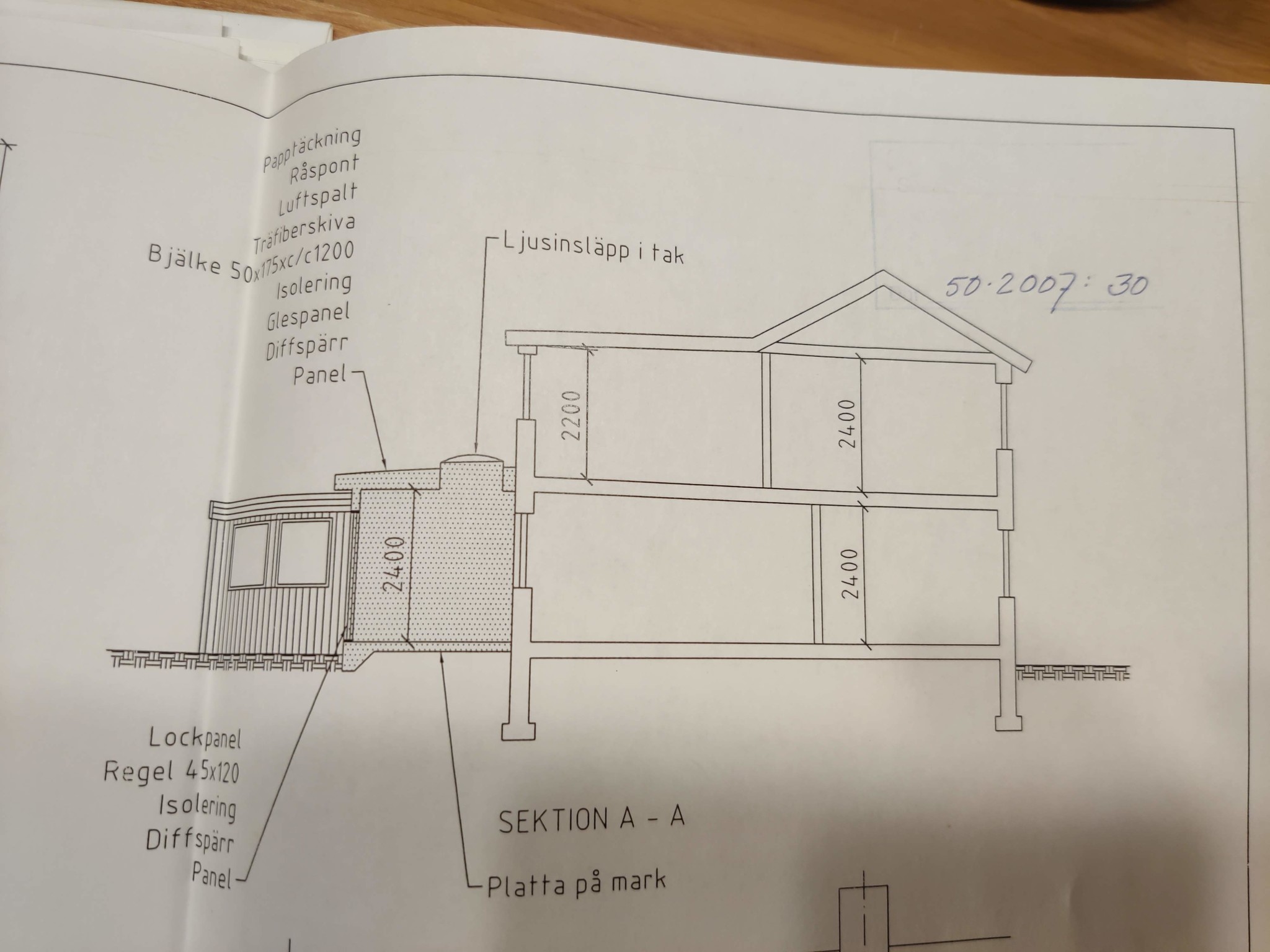
One neighbor's is in post #1. The neighbor next to them has also applied for a building permit, and their section looks like this:
Unfortunately, that's the best I have to go on. I could, of course, talk to my wall-to-wall neighbors tomorrow since I know they have the original drawings, but these are not the ones used during construction, rather an earlier version, proposal drawings.
What I can measure on the drawing I attached here is that the slab would be 25cm thick.
In the image in post #1, I measure that there is instead 20cm of insulation, 10cm of slab, and then a 10cm raised floor. However, I know that the floor is not raised throughout the whole house, only in the living room.
No, original drawings are best. Slab on grade can mean different things. One needs to understand the foundation method to be able to speak with any certainty.
Vi vill skicka notiser för ämnen du bevakar och händelser som berör dig.