

Hello there happy forum members.
Happy New Year to you.
Can anyone recommend a wood material with a thickness of about 19 mm that remains absolutely flat?
I am going to make a jig for routing the edges of acoustic guitars, and the base of my jig must always be flat.
Kristian
Happy New Year to you.
Can anyone recommend a wood material with a thickness of about 19 mm that remains absolutely flat?
I am going to make a jig for routing the edges of acoustic guitars, and the base of my jig must always be flat.
Kristian
MDF or HDF is available in 19 mm thick boards and is relatively flat. Personally, I use a 45 mm thick MDF board as a fixture board, and it seems to stay within the MDF tolerances even over time (problems arise in late summer/fall with high humidity if the jig is stored in an unheated space, but if you dry the material, it regains its shape)
Thanks Ring
In the meantime, I've been on some construction sites in the USA, and there they recommend plywood of high quality. However, what they mean by "high quality" is not clear. Do you have any tips on high quality plywood?
Kristian
In the meantime, I've been on some construction sites in the USA, and there they recommend plywood of high quality. However, what they mean by "high quality" is not clear. Do you have any tips on high quality plywood?
Kristian
How do you define "absolute plane"? When it comes to "workshop tolerances," there is no material based on wood fiber that maintains the dimensions sufficiently. You need something made of surface-ground metal or perhaps stone to make it flat.

There is plywood that is incredibly dimensionally stable and used in model and special manufacturing, and can also be used as router templates. Unfortunately, I don't know what it's called but it looks like formplywood, though it appears to have a shinier surface with a better finish. I'll get back if I find out what it's called or if someone else on the forum knows what I mean. I have seen a relative use that type to make various templates in a specialized workshop where they make church organs.
Last edited:


Here is a link to the e-version of the article.
http://www.taunton.com/finewoodworking/Workshop/WorkshopPDF.aspx?id=30588
http://www.taunton.com/finewoodworking/Workshop/WorkshopPDF.aspx?id=30588
How to attach an image to the forum page.
I was going to show what the jig looks like and why flatness is so important
Kristian
I was going to show what the jig looks like and why flatness is so important
Kristian
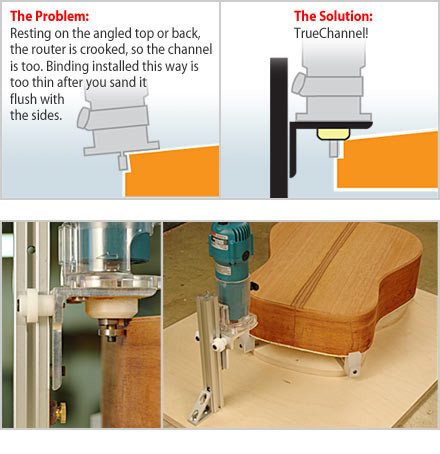


I'm afraid I don't quite understand how the routing is done... but is it completely impossible to do this on a regular router table, without a guide and with a ball-bearing router bit?Gitarrbyggaren said:
Unfortunately Daniel,
it is not possible to route on a regular router table.
You route in 2 special strips as decoration on the edge of the guitar body.
If the guitar body is perfectly flat, you might be able to do it on a router table, but very carefully.
But as you might know (I think), guitar bodies are often not flat on the underside, they are usually curved from side to side, and this means it doesn't work on a router table, believe me, I've tried.
I have always previously routed with a special tool that follows the surface, but since the bottoms of the guitars are now slightly arched, it doesn't work well.
Therefore, I bought this special jig from the USA.
I hope it wasn't too complicated.
Kristian
it is not possible to route on a regular router table.
You route in 2 special strips as decoration on the edge of the guitar body.
If the guitar body is perfectly flat, you might be able to do it on a router table, but very carefully.
But as you might know (I think), guitar bodies are often not flat on the underside, they are usually curved from side to side, and this means it doesn't work on a router table, believe me, I've tried.
I have always previously routed with a special tool that follows the surface, but since the bottoms of the guitars are now slightly arched, it doesn't work well.
Therefore, I bought this special jig from the USA.
I hope it wasn't too complicated.
Kristian
Aha, now I get it, I didn't consider that they were arched on the backside.Gitarrbyggaren said:Unfortunately Daniel,
it's not possible to rout on a regular router table.
You rout in 2 special strips as decoration on the edge of the guitar body.
If the guitar body is completely flat in itself, then you might
be able to do it on a router table, but very carefully.
But as you might know (I think) guitar bodies are usually not flat on the underside,
instead, they are often curved from side to side, and that means it's not possible on a
router table, trust me I've tried.
I have always previously used a special tool that follows the surface, but since
the backs of guitars are now slightly arched, it's not good.
That's why I've bought this special jig from the USA.
Hope it wasn't too complicated.
Kristian
Click here to reply