
Hello!
I have just installed a pocketkarm (95mm frame depth) in my wall of the same thickness. I have covered the frame with 12mm chipboard and screwed into the cross "ribs" as well as into the studs at the top and "back" of the frame. My problem now is that the entire wall is "wobbly" and gives a bit. The flex is greatest next to the door opening where the board practically lacks attachment to the stud, but it is almost rigid inside at the studs behind the frame.
I am considering whether I should opt to replace the chipboard with something else, for example, 12mm MDF or if I should continue with an additional layer of renovation plasterboard/chipboard.
The house is a Borohus from '89 with wooden studs and masonite boards in the walls.
Grateful for any answers/tips I can get!
I have just installed a pocketkarm (95mm frame depth) in my wall of the same thickness. I have covered the frame with 12mm chipboard and screwed into the cross "ribs" as well as into the studs at the top and "back" of the frame. My problem now is that the entire wall is "wobbly" and gives a bit. The flex is greatest next to the door opening where the board practically lacks attachment to the stud, but it is almost rigid inside at the studs behind the frame.
I am considering whether I should opt to replace the chipboard with something else, for example, 12mm MDF or if I should continue with an additional layer of renovation plasterboard/chipboard.
The house is a Borohus from '89 with wooden studs and masonite boards in the walls.
Grateful for any answers/tips I can get!
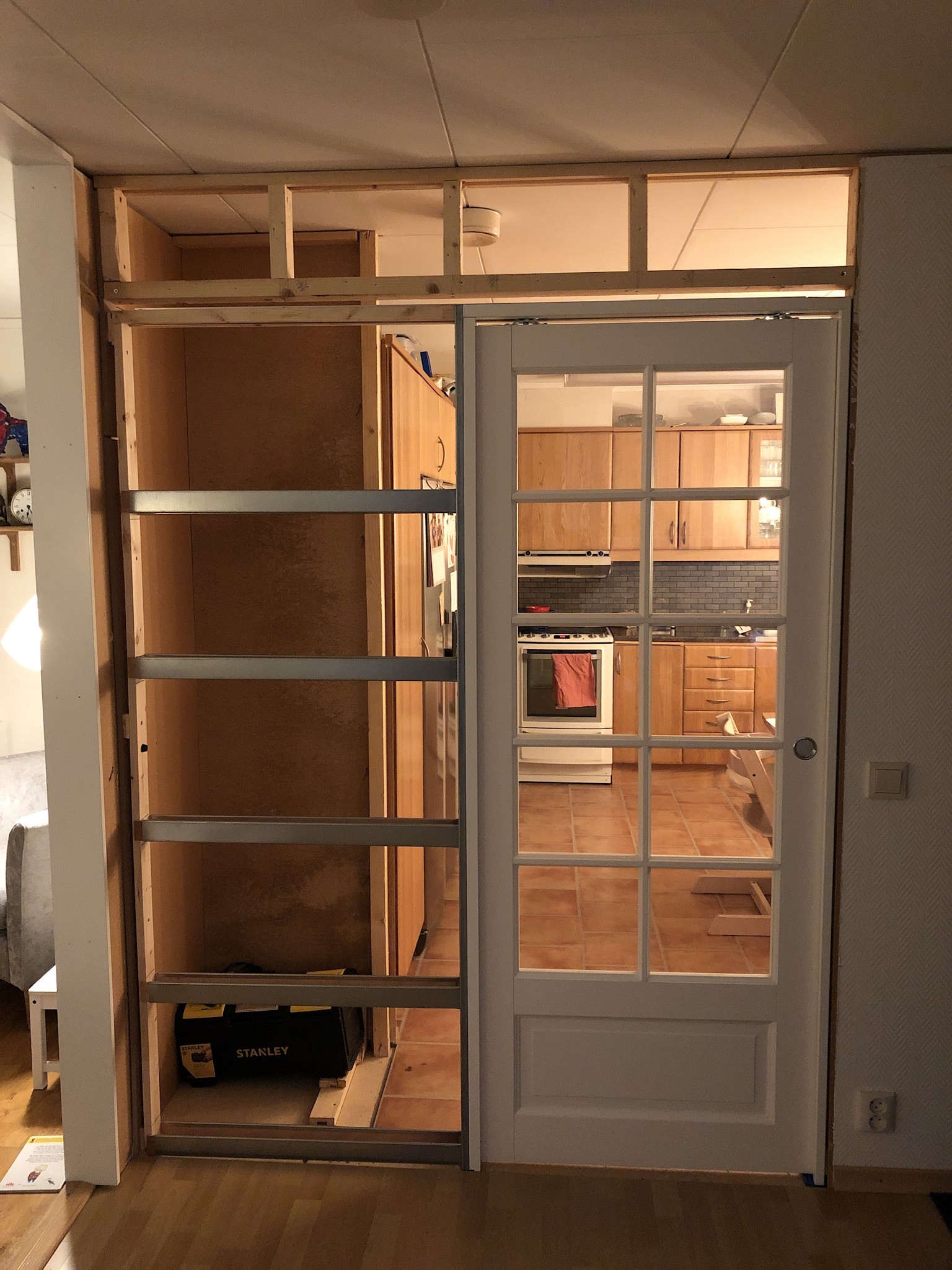
For those interested, I chose to stud with 45x70 and build an exterior wall on the pocket frame's chipboard. I opened up the pocket frame from the back and fastened the pocket frame's chipboard to the new studs to stabilize the frame itself as well. The back of the frame will have kitchen cabinets against it, so no major concern with the sway there.
Now, at least the kids can use the wall as a stop when they run, without tearing down half the house.
Now, at least the kids can use the wall as a stop when they run, without tearing down half the house.

Welcome to the forum.
Why chipboard in the walls? To be a bit harsh, hasn't that been out of style since the Berlin Wall fell...
I installed a similar pocket frame a few years ago, and I mounted 15mm plywood in the frame and then added 13mm drywall. The result was quite okay. Of course, it’s not as stable as a real stud wall, but it doesn't feel flimsy at all. I also have two small children who are more like wild hyenas than normal kids, and they haven't managed to damage the wall in the 6 years it has been up.
Why chipboard in the walls? To be a bit harsh, hasn't that been out of style since the Berlin Wall fell...
I installed a similar pocket frame a few years ago, and I mounted 15mm plywood in the frame and then added 13mm drywall. The result was quite okay. Of course, it’s not as stable as a real stud wall, but it doesn't feel flimsy at all. I also have two small children who are more like wild hyenas than normal kids, and they haven't managed to damage the wall in the 6 years it has been up.
I thought masonite was abandoned around the Wall's fall.Janus82 said:
Welcome to the forum.
Why chipboard in the walls? If I may be a bit harsh, no one has used it since the Berlin Wall fell...
I installed the same pocket frame a few years ago and I mounted 15mm plywood in the frame and then put on 13mm gypsum. The result was quite okay. Of course, it's not as stable as a properly framed wall, but it doesn't feel flimsy at least. I also have two small children who are more like wild hyenas than normal kids, and they haven't managed to damage the wall in the 6 years it has been up.
The chipboard idea comes from the fact that I have 12mm masonite in the walls which I, in my innocence, believed were chipboards for 2 years. I didn't want to build thicker than the existing walls and thought chipboard should be fine. But I was wrong.The next wall to be torn down will be replaced with plywood and gypsum. You learn as long as you live!
Correct. The door section is designed to attach at the back and front edges, as well as at the floor in the middle. There's nothing above to attach to because of the track for the door. The idea is likely that the wall cladding goes from floor to ceiling to stabilize it further, and there's a solid steel track at the top that keeps it rigid.Anna_H said:
Click here to reply