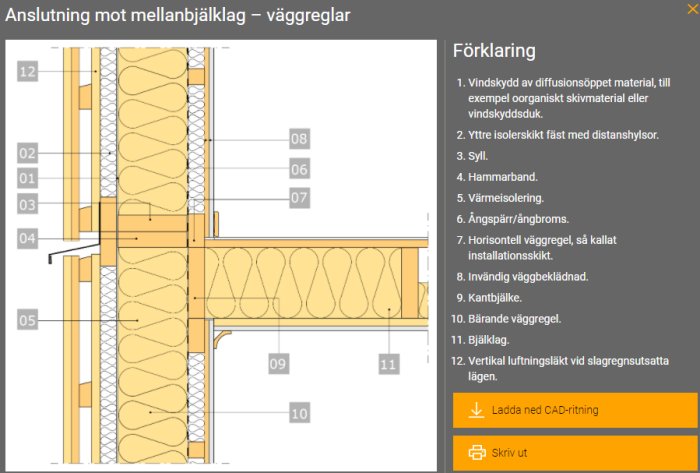
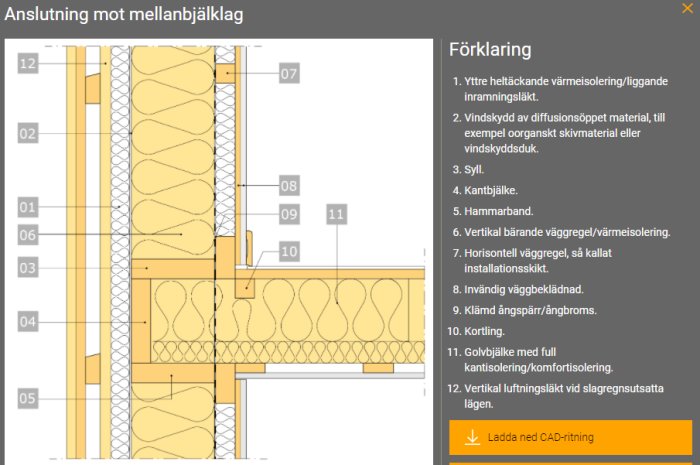
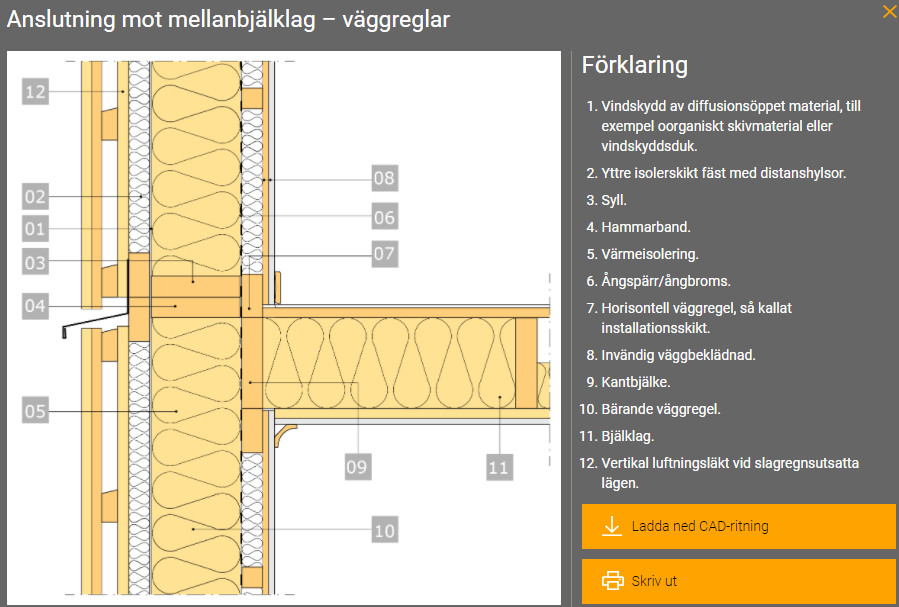
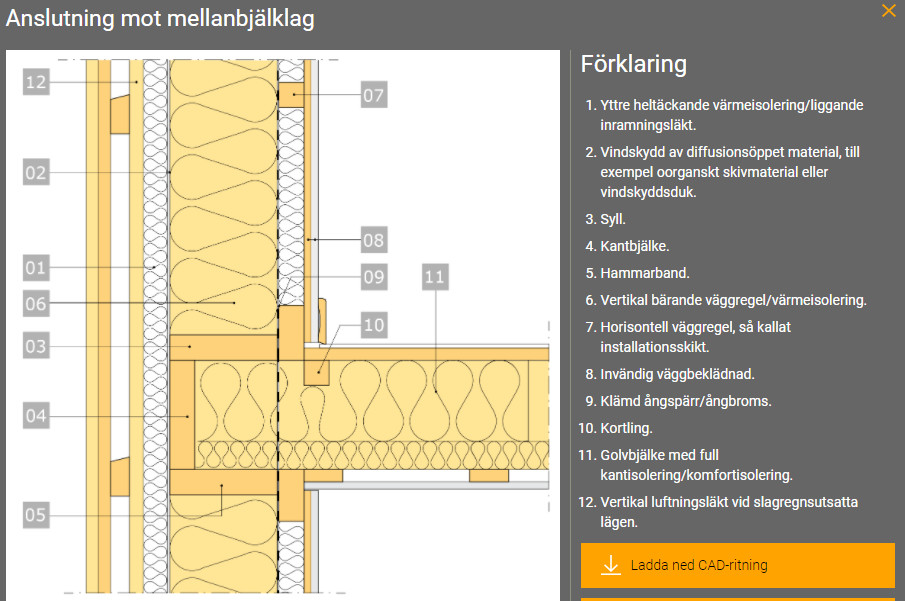
I am looking at TräGuiden regarding connections to intermediate floors to make construction drawings. From what I can see, the text does not specify the difference, but looking at the images, I assume the first is on what can be called the short side wall, and the second is on the long side.
But is there any reason to extend the lower floor wall all the way up to the top of the intermediate floor? Could you just as easily make all walls on the lower floor the same height? When I then build the intermediate floor (before the second floor), there is admittedly no wall for the floor beam (referred to as edge beam in image 2) to "rest" against.
But is that the only disadvantage? Does it matter how you do it otherwise?
Yes, it's probably convenient if you're familiar with it, but I'm not, so I'll stick to traditional methods.
No one can answer if it matters how you make the gavel? Since the other wall is made of lecablock or similar, it would be best in my opinion to allow the walls of the upper floor to start at the bottom edge of the intermediate floor.
I will try to explain a bit more about my dreams, regarding the more perfect house. I live in a house built in 2008 with 1.5 floors. Everything that happens on the ground floor can be heard upstairs; if someone walks on the floor or talks, it can be heard on the floor above.
The house is built on a 15 cm thick concrete slab, with a load-bearing wall in the middle of the ground floor directly on the concrete. Roof trusses with underarms rest directly on the outer walls and the load-bearing wall. On the underside of the underarms is 1 layer of gypsum - sparse paneling, with the intermediate floor filled 90% with insulation, and on the upper floor, the floor chipboard is screwed/glued. In our bedroom, there is 5 mm impact sound insulation laid plus 15 mm wooden flooring. Yet, I think the sound comfort could be MUCH better.
So if you're getting ready to build a new house, I just want to give you a tip
Click here to reply
Vi vill skicka notiser för ämnen du bevakar och händelser som berör dig.