
5,366 views ·
8 replies
5k views
8 replies
What type of plaster should I use?
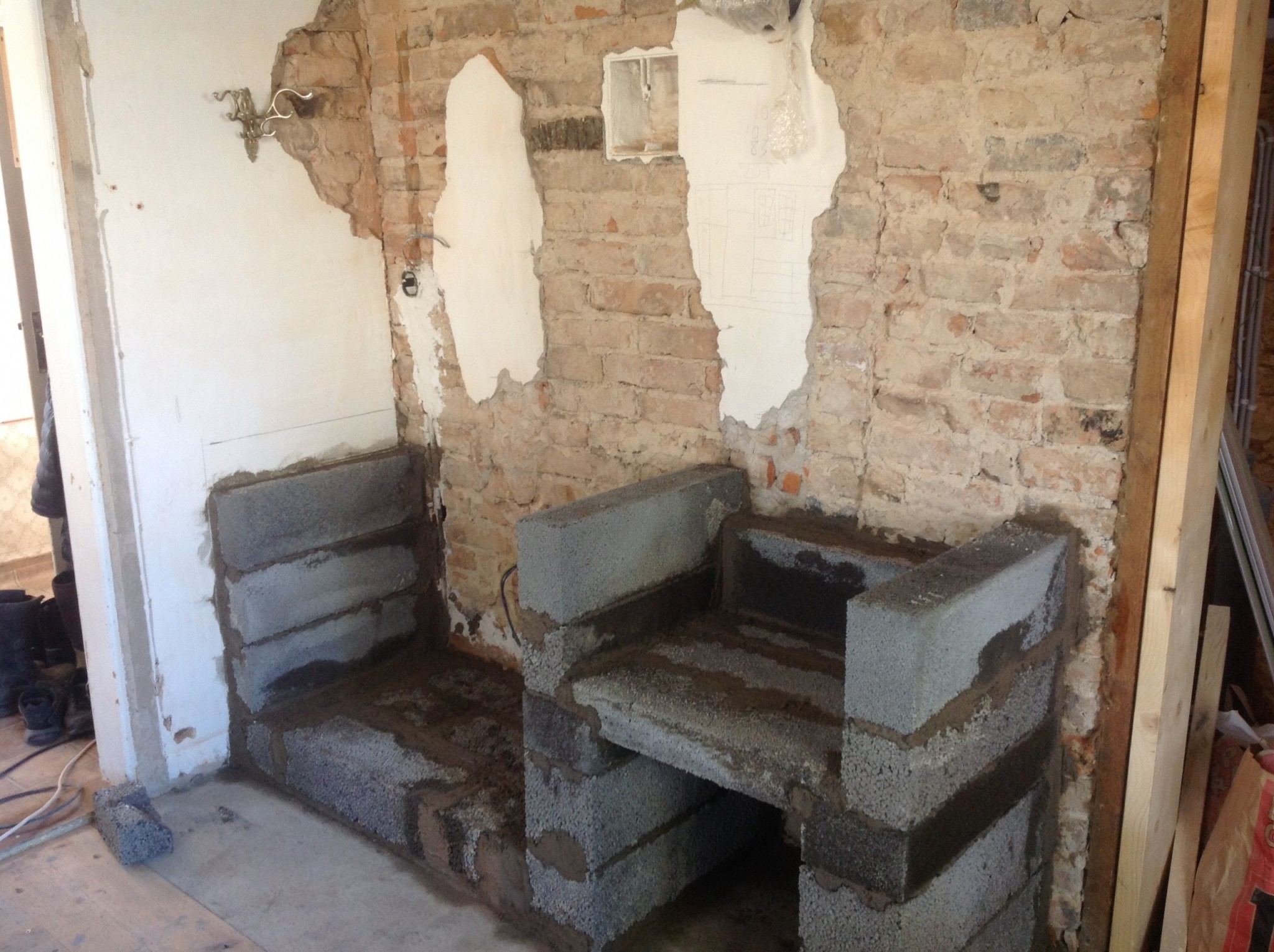
I have built a fireplace base with Leca and have knocked down the plaster on the wall behind as it was completely loose. What type of plaster should I use on the wall and the fireplace base? The mortar between the bricks is currently very porous and can be crumbled with fingers, I assume it's some type of lime mortar. Will not tile on top but paint the plastered surface white. Grateful for help

Old churches and castles built with lime mortar were in a period (50s-80s?) repaired with cement. It turned out to be almost a disaster.
I think you have to use what was there before, or softer materials - like for example clay.
I think you have to use what was there before, or softer materials - like for example clay.
When was the house built? Before the 1940s? You can almost assume that it's a lime-rich mortar used in the joints, alternatively, if you live near the coast, they might have used sea sand as ballast. Lime mortar can "always" be used. (weak mortar)ChrisseE said:I have built a stove foundation out of Leca and have knocked off the plaster on the wall behind it as it was completely loose. What type of plaster should I use on the wall and the stove foundation? The mortar between the bricks is very porous today and can be crumbled with fingers, I assume it is some type of lime mortar. I'm not planning to tile over it but to paint the plastered surface white.
grateful for help
Regardless of what you choose, start from a system thinking. A-, B-, C-mortar....etc where A is the strongest. A+B works, but not B+A. (B+B works fine) The strongest on the inside. In your case, you probably shouldn't use an A-mortar as a base but a B-mortar.
Weber's Rödgrund 103 for even suction and then apply Putsbruk B 133, alternatively, you can replace 103 with Vitgrund 105 as it is suitable for weaker materials such as lightweight concrete. 103 is made for Leca, which fits your stove. But you can always use 105 on Leca, though it is a bit more expensive than 103.
But if you are uncertain, you should use a lime mortar, a hydraulic one.
Check out Målarkalk's stuff
You can certainly use plaster (Weber Gypsum or Knauf MP75 or Ardex 828). In your case, I would probably go to the library and borrow one of the books available there about old houses (there is much about the 17th-18th century) or that the staff can help you order.
If you don't find the answer to your question in the literature, you should contact the city planning office and ask them to help you get in touch with a building conservator or similar.
A property from the 1700s should be treated with respect, and you should always use the materials that were used in the past wherever possible. If the building has stood since then, it indicates good stuff from the beginning.
Give Målarkalk a call; they help you every day of the week and have what you need.
Good luck
If you don't find the answer to your question in the literature, you should contact the city planning office and ask them to help you get in touch with a building conservator or similar.
A property from the 1700s should be treated with respect, and you should always use the materials that were used in the past wherever possible. If the building has stood since then, it indicates good stuff from the beginning.
Give Målarkalk a call; they help you every day of the week and have what you need.
Good luck
I have worked a lot with old houses in my job as a carpenter and know quite a bit but I'm bad at plastering 😂.
Unfortunately, there isn’t much left except for the foundation, timber frame, and the saw-edged floors from the 1700s. Most of it was redone in the late 1800s and when the house was raised with an extra floor in the 1920s, the chimney and ceiling height on the ground floor were also raised.
We try to preserve as much of the old as possible within reasonable limits. The chimney has been redone three times so there's not much left of the original; it probably doesn't matter much what I plaster with. I want something that is relatively easy to work with and doesn't crack everywhere later. Also good if it has a bit of an old-fashioned look to it.
Unfortunately, there isn’t much left except for the foundation, timber frame, and the saw-edged floors from the 1700s. Most of it was redone in the late 1800s and when the house was raised with an extra floor in the 1920s, the chimney and ceiling height on the ground floor were also raised.
We try to preserve as much of the old as possible within reasonable limits. The chimney has been redone three times so there's not much left of the original; it probably doesn't matter much what I plaster with. I want something that is relatively easy to work with and doesn't crack everywhere later. Also good if it has a bit of an old-fashioned look to it.
Click here to reply