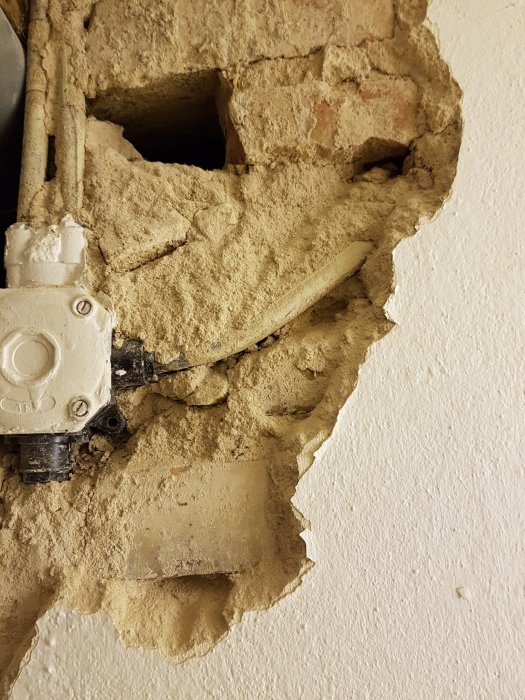
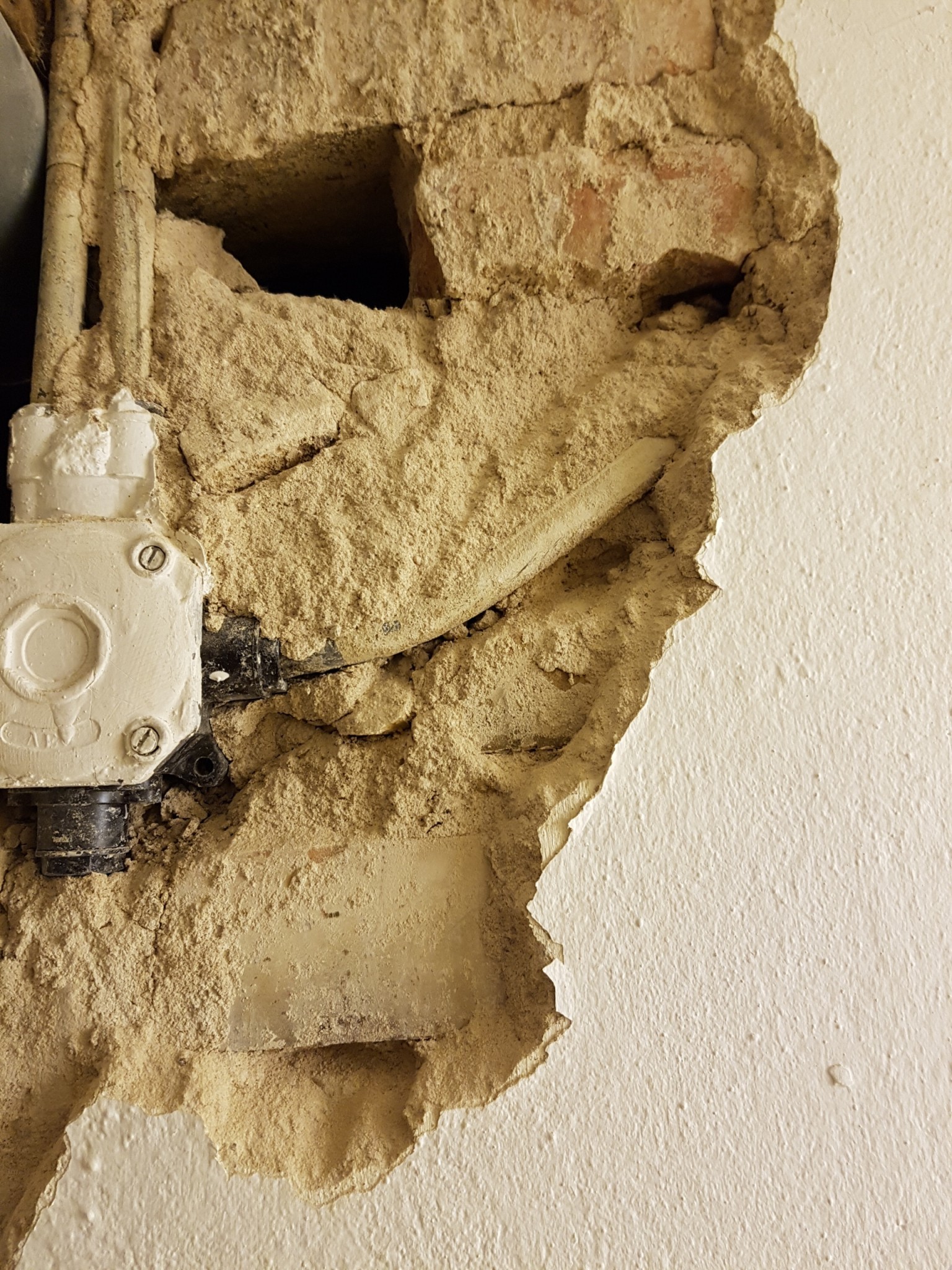
I was down in the basement and chipped away some loose plaster from a wall, but I don't know what type of plaster it might be, so I thought I’d ask the forum for help.
The plaster that comes off is dried, probably from 1939 when the house was built, feels like sand, and is very porous. The bricks in the wall have been laid with the same material.
So, bit by bit, the plaster is coming off. But should I tear down all the plaster on just this wall and redo the whole thing since the material is the same throughout, or is it better to let what still holds stay and just touch it up? Because you can hammer all the plaster down as it crumbles into powder. Obviously, an incorrect paint has been used on the wall, so I'm planning to sand down the paint with a concrete grinder at some point to remove it.
So... I want to fix my wall, and it depends on what kind of plaster it is...
It looks like a variant of lime plaster or lime-cement plaster, which fits quite well with the time period of your house.
However, there are some clues to assess the type of plaster; a plaster with a lot of cement has a darker gray color compared to pure lime mortar, but if the cement content is low, it can still be hard to see the difference. You can try to crumble a piece of plaster between your fingers. If it crumbles easily, the plaster consists of lime mortar (k-mortar) or a mixture with cement and lime (kc-mortar). However, this test only gives a hint of what has been used.
Repair by:
Remove loose plaster; I usually scrub off the last bits with a steel brush.
Moisten the substrate, and clean it with a steel brush.
Prime cavities with a thin diluted plaster mix.
When the priming is dry, apply plenty of plaster (apply with a trowel) and level off with a screed or similar tool.
Let it dry enough so that you can remove excess plaster with a float. Try to achieve the same surface texture as the surrounding facade.
Let it dry well, paint with a suitable paint, silicate or lime paint. There are probably more options.
This has worked for me, but good groundwork provides a good and durable result. I would have removed everything that has air behind it to prevent future plaster loosening.
Thank you for your response. It was a detailed answer
The plaster I've chipped off can indeed be crumbled between the fingers and feels essentially like sand/gravel, and it is noticeable that it is old plaster with a bit of cement since it can be broken and crumbled between the fingers.
What type of mortar should be used if the cement content is that low? Based on your description, I guess it might be K-mortar that's been used since it's very light and all.
It is recommended that the new plaster should have the same properties as the previous mortar, so if the house moves, the new plaster moves with it. A harder plaster moves less and can lead to cracks, it is said.
However, I don't practice what I preach; I plastered my entire basement (4 rooms, 3-4 walls) with Plaster/manual mortar C. Partly because there were such large sections, partly because I really wanted firmness in the walls. I had no cracks before, and today, 2 years later, I still don't have any cracks.
If I were to do it again today, I can honestly say I would have used hydraulic kc mortar, actually from Weber or Combimix, as I was in a bit of a hurry back then.
I was explained that hydraulic lime mortar is used in the renovation of older buildings where higher strength is required than when plastering with common air lime mortar. Therefore, I myself consider that the mortar I should have used is H lime mortar instead of c mortar, which is significantly harder, as my house is from -27 and my plaster crumbles as easily as yours between fingers.
In fact, it seems impossible to learn what a hydraulic mortar really is without definitions, as restoration and use on older buildings are more popular to use instead of directly stating what hydraulic means.
But it sounds like hydraulic is what I should use when it's time to tackle the wall.
Click here to reply
Vi vill skicka notiser för ämnen du bevakar och händelser som berör dig.