
26,529 views ·
64 replies
27k views
64 replies
Water damage due to incorrectly mounted balcony
Hello
We have created an Attefall extension by building out from an existing dormer. The new dormer section was supposed to have a small balcony on the south side. The builder suggested that the balcony (which is only 70 cm wide) should be supported by the dormer's support beam at the outer end and attached to the house's roof structure where it meets the house wall.
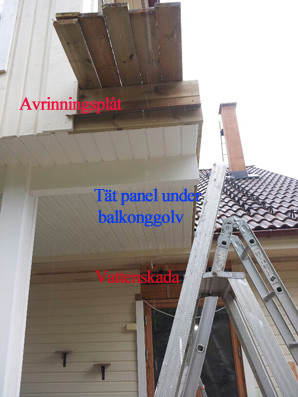
However, this resulted in a water damage where rainwater from the roof ran straight down the house wall under the balcony and poured onto the wooden floor inside the house. Fortunately, there is not an entire wall section under the balcony, but a pair of doors, yet the ecofiber above the pair of doors got wet and the upper door recess inside became water damaged.
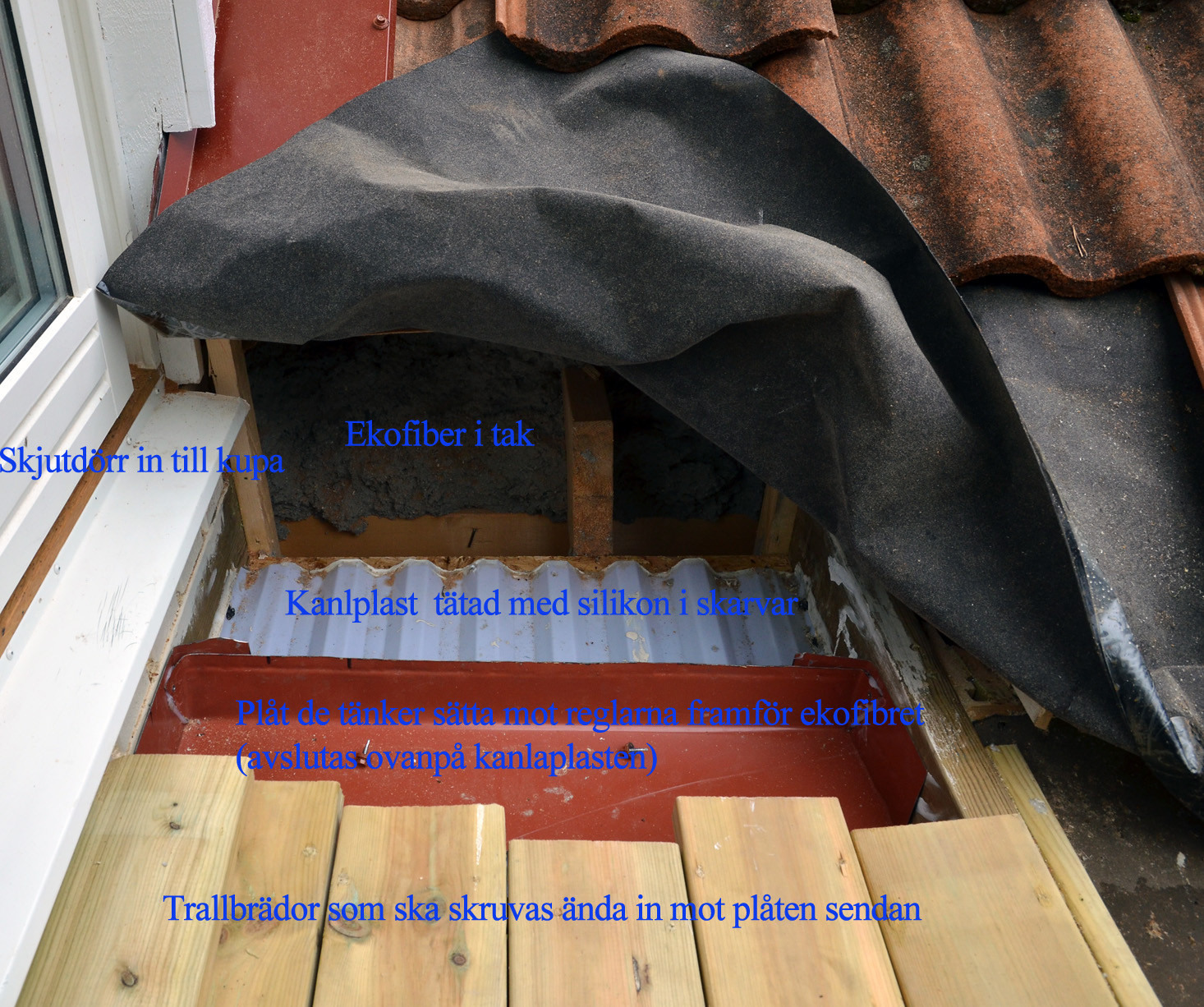
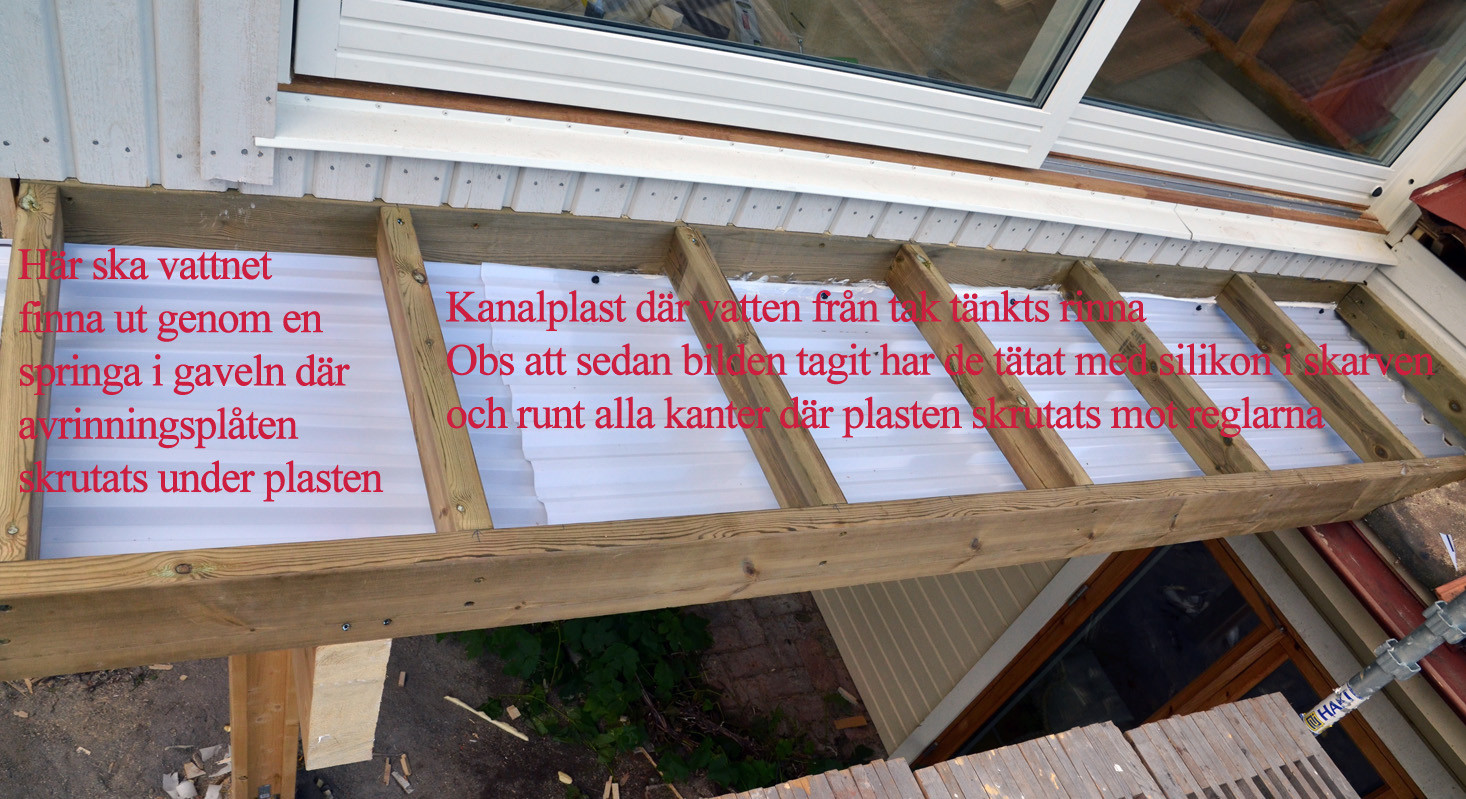
It turned out that they had created an insane construction (as the pictures reveal). Drainage from the roof tiles at the balcony attachment was supposed to run directly onto the balcony decking, through the gaps, and onto a corrugated plastic they had installed along the entire length of the balcony (with a slight slope), and run out through a gap at the other end of the balcony.
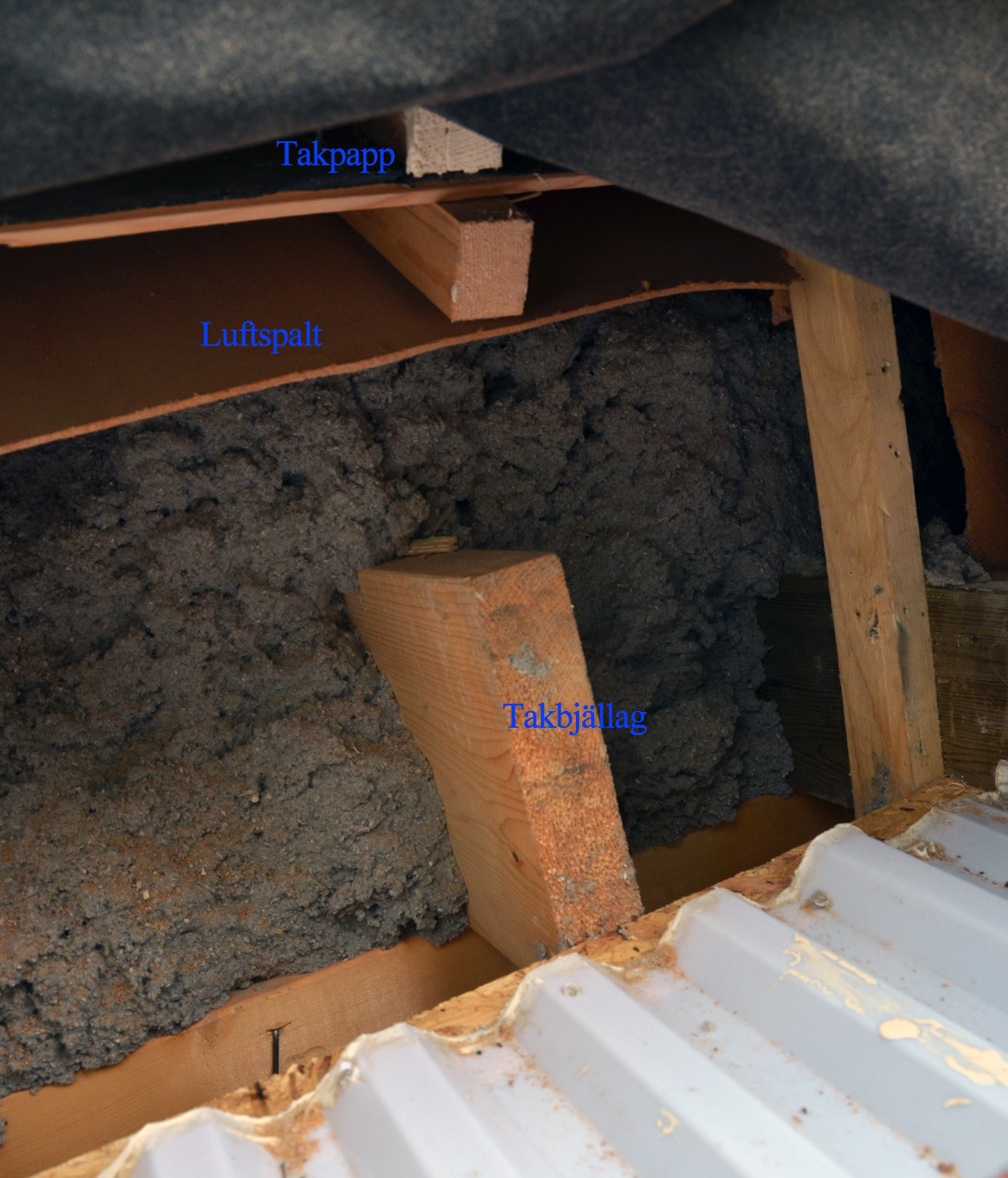
Only that the water instead ran backward and rushed straight into the open unprotected wall into the ecofiber (they had inserted the balcony and decking into the house's load-bearing wall about 12 cm (with 3 of these going straight into the insulation).
The big question now is how to fix it, if it's even possible...the builder doesn't seem to have any acceptable proposal.
As I see it, there are 2 problems:
1. How to ensure secure drainage from the roof when the entire eave has been removed and gone 12 cm into the load-bearing wall?
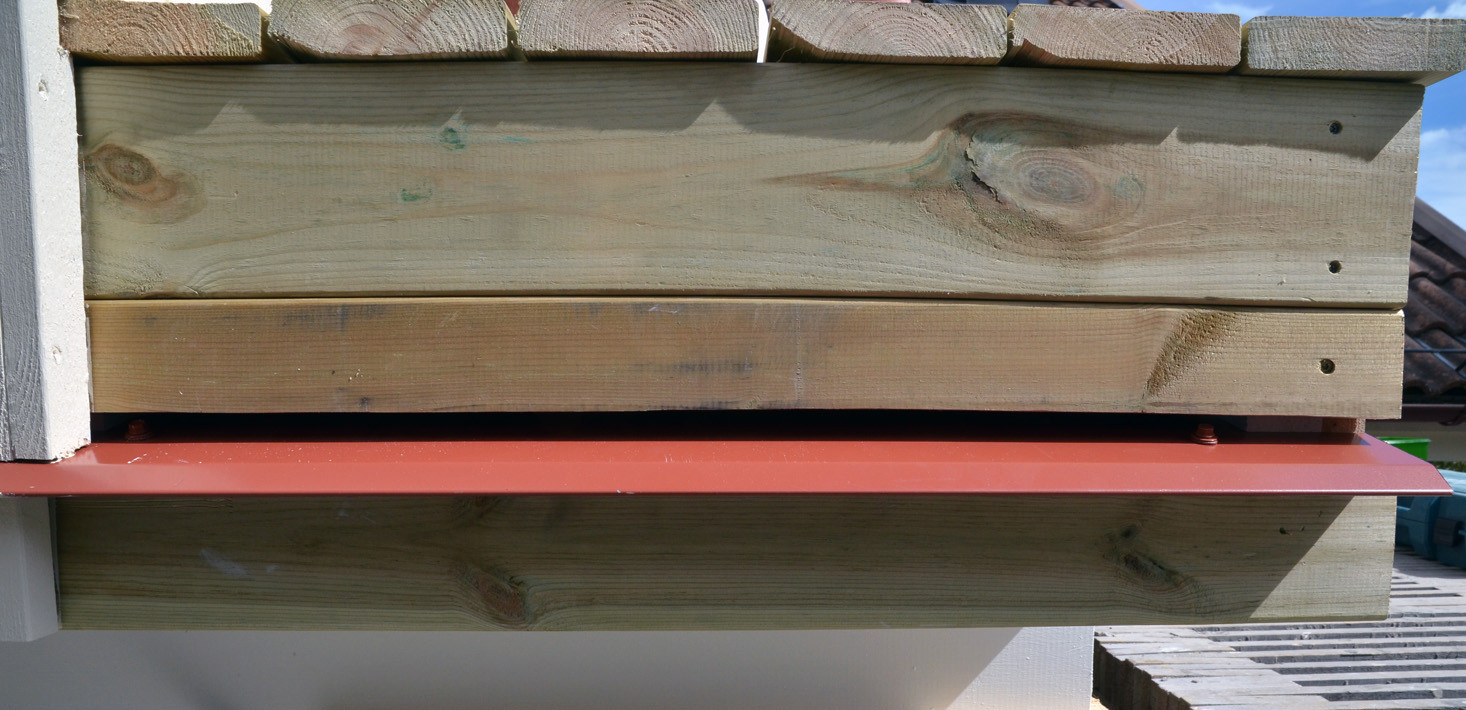
2. They have, as the pictures show, sealed under the balcony with facade boards, so even rain and snow on the balcony must be securely drained through their special solution (the corrugated plastic) which they screwed into the edges of the balcony joists and sealed with a lot of silicone. As you can see, it's also spliced at one point and sealed only with silicone. There's an obvious risk that in 2 years, rain, moisture, and ice will crack the silicone and the under-roof boards will rot, as there’s no ventilation or drainage since they screwed the corrugated plastic directly to the balcony joists.
My little brain says the entire solution is insane - is there a fix for these 2 problems?
We have created an Attefall extension by building out from an existing dormer. The new dormer section was supposed to have a small balcony on the south side. The builder suggested that the balcony (which is only 70 cm wide) should be supported by the dormer's support beam at the outer end and attached to the house's roof structure where it meets the house wall.
However, this resulted in a water damage where rainwater from the roof ran straight down the house wall under the balcony and poured onto the wooden floor inside the house. Fortunately, there is not an entire wall section under the balcony, but a pair of doors, yet the ecofiber above the pair of doors got wet and the upper door recess inside became water damaged.
It turned out that they had created an insane construction (as the pictures reveal). Drainage from the roof tiles at the balcony attachment was supposed to run directly onto the balcony decking, through the gaps, and onto a corrugated plastic they had installed along the entire length of the balcony (with a slight slope), and run out through a gap at the other end of the balcony.
Only that the water instead ran backward and rushed straight into the open unprotected wall into the ecofiber (they had inserted the balcony and decking into the house's load-bearing wall about 12 cm (with 3 of these going straight into the insulation).
The big question now is how to fix it, if it's even possible...the builder doesn't seem to have any acceptable proposal.
As I see it, there are 2 problems:
1. How to ensure secure drainage from the roof when the entire eave has been removed and gone 12 cm into the load-bearing wall?
2. They have, as the pictures show, sealed under the balcony with facade boards, so even rain and snow on the balcony must be securely drained through their special solution (the corrugated plastic) which they screwed into the edges of the balcony joists and sealed with a lot of silicone. As you can see, it's also spliced at one point and sealed only with silicone. There's an obvious risk that in 2 years, rain, moisture, and ice will crack the silicone and the under-roof boards will rot, as there’s no ventilation or drainage since they screwed the corrugated plastic directly to the balcony joists.
My little brain says the entire solution is insane - is there a fix for these 2 problems?




Yes, it definitely needs redoing, but the question is how... both the builder and we have been scratching our heads for several days but no acceptable solution has come to light...L Liteavvarje said:

It's hard to tell from the pictures how best to address this.
But I don't really understand how this happened. In the previous thread about your construction, it was clear that your builder is happily free from most knowledge, both about building techniques and general common sense. But the balcony wasn't built then. How has he now been allowed to continue with a new disaster?
But I don't really understand how this happened. In the previous thread about your construction, it was clear that your builder is happily free from most knowledge, both about building techniques and general common sense. But the balcony wasn't built then. How has he now been allowed to continue with a new disaster?
Well, that's true, one might wonder, but the balcony was included from the beginning, and we had written an agreement and contract with this construction company for the entire job. Additionally, they have redone and fixed the other disasters - posts and roof trusses - according to our demands, which we were able to set with the help of wise advice from the previous thread, so it was "just" the balcony left to do. It was probably naive to think "how hard can it be to build a small balcony"!H hempularen said:It's hard to see from the pictures how best to fix it.
But I don't really understand how this happened. In the previous thread about your construction, it was clear that your builder is happily free from most knowledge, both of building techniques and general common sense. But then the balcony wasn't built. How could he now have been allowed to continue with a new disaster?
But it's also not so easy to break a contract - we don't want any legal process with the construction company, just want to get it finished. Due to all the errors and redos, the construction is now 3 weeks delayed.
Nail raw wood paneling and lay welded waterproofing with substantial upturns in all directions on it
That may be the worst construction I have ever seen.
It's not the first terrace to be built in the world and standard solutions therefore exist.
It's not the first terrace to be built in the world and standard solutions therefore exist.
Member
· Västra Götaland
· 3 648 posts
Get scared of the dark. What's wrong with some regular roof drainage, like gutters, downpipes, etc.?
Your guy is not a craftsman, maybe a bungler in overalls, but then I'm being kind.
Your guy is not a craftsman, maybe a bungler in overalls, but then I'm being kind.
A balcony attached to the facade is a classic risk. Doing it with zero knowledge can only go wrong.
One idea we have is to remove the corrugated white plastic and all the disgusting silicone, screw on supports on the inside of the balcony's long sides with the right incline, place a rubber strip on top. Then order a custom-sized metal sheet to replace the plastic, not corrugated but flat (a type of roofing sheet). It should then be folded 2 cm at the edges, then screwed onto the supports and sealed against the rubber strip. The sheet should have a slight V-shape along its entire length so water runs down toward the middle of it. The sheet should also be bent up a few decimeters on the short side at the attachment to the façade, forming a sloped plane (approximately 20-45-degree angle, whichever fits in the space) to safely catch the water from the roof tiles.
Where they have torn up the façade must, of course, be covered with wind barrier tgen and also roofing felt on top of it, then you can connect the new sheet there somehow. And cover from the outside with raw wood or façade boards.
The balcony's decking boards should rest against the sheet towards the façade, so that it becomes waterproof and all water both from the roof and the decking boards runs down onto the sheet.
This should address both the problem of water running backward into the wall and the issue of water leaking onto the sub-roof boards under the balcony.
Am I thinking wrong, or could such a solution work? Any pitfalls?
Where they have torn up the façade must, of course, be covered with wind barrier tgen and also roofing felt on top of it, then you can connect the new sheet there somehow. And cover from the outside with raw wood or façade boards.
The balcony's decking boards should rest against the sheet towards the façade, so that it becomes waterproof and all water both from the roof and the decking boards runs down onto the sheet.
This should address both the problem of water running backward into the wall and the issue of water leaking onto the sub-roof boards under the balcony.
Am I thinking wrong, or could such a solution work? Any pitfalls?
Last edited:
I find it difficult to visualize the situation, but the thing with metal sounds more right than the current solution with plastic. But let a REAL tinsmith look at it and perform the work. A tinsmith can assess what is needed. Or bring in a constructor who can look at what needs to be done.
Balconies attached to facades often leak sooner or later. It's a science how to get it just right. It's not just about making it waterproof against rainwater, melting snow, etc. There can easily be thermal bridges that can create condensation problems inside the floor structure, and probably even more possible problems (I am definitely not an expert, and I would never attempt to come up with my own construction on such a difficult structure).
I believe I have understood that the balcony is connected to the wall on two sides? If so, you need to have a sheet that goes up on both walls, and it must be seamed together at the corner. The connection under the balcony door is also critical.
Balconies attached to facades often leak sooner or later. It's a science how to get it just right. It's not just about making it waterproof against rainwater, melting snow, etc. There can easily be thermal bridges that can create condensation problems inside the floor structure, and probably even more possible problems (I am definitely not an expert, and I would never attempt to come up with my own construction on such a difficult structure).
I believe I have understood that the balcony is connected to the wall on two sides? If so, you need to have a sheet that goes up on both walls, and it must be seamed together at the corner. The connection under the balcony door is also critical.
Member
· Västernorrland
· 12 082 posts
Although I don't really understand the point of the balcony? Sliding windows and all for a half-meter protrusion? A lot of hassle for something that will probably never be used. In any case, you have to see those kinds of protrusions as part of the roof construction. That is, you make a roof according to all the rules of the art. If you then want a balcony or decking on the roof, you do that afterwards. You can't go halfway and skip the roof and think you can create some clever water catcher under the decking. It never works.
In response to your question, I can tell you that there will also be stairs down from the balcony to the garden so that you can go in and out that way from the garden. The new room in the extension is to be used, among other things, for plants and growth during the spring, and maybe a little as a winter garden in the fall.S Stefan1972 said:But I don't really understand the point of the balcony? Sliding windows and all for a protrusion of half a meter? A lot of hassle for something that will probably never be used.
In any case, such protrusions must be seen as part of the roof construction. That is, you make a roof according to all the rules of the art. If you then want a balcony or decking on the roof, you do that afterwards. You can't go halfway and skip the roof and think you can make some ingenious water catcher under the decking. It never works.
So instead of just a safety railing and a stepping platform to the stairs, it became a balcony along the entire side, it is 70 wide so you can also have a couple of mini chairs there and enjoy the evening sun and the view over Mälaren which is 300 m to the south.
A balcony railing made of tempered glass will be installed...if there will be any order in the mess.
I'm not a builder, but it seems like the attachment under the sliding window is done without any modifications to the finished outer wall except for a stud resting on a protruding glulam beam nailed to the wall. The entire wall was completed with paneling and everything before they attached the balcony there. The idea of building the balcony all the way into the roof truss was the builder's way of solving the load problem without needing a pillar to the ground on that side - mostly because that pillar would have ended up right in front of an existing exterior door on the lower floor.H hempularen said: