I am currently building a timber-framed house in the countryside. The façade is almost completely finished, and soon it will be time to start with insulation and the vapor barrier. Upstairs, I will have a bathroom adjacent to the sloping ceiling. The sloping ceiling will, of course, be insulated as usual, and the vapor barrier will be outside of the insulation.
The bathroom, in turn, will obviously have waterproofing according to all the rules.
This means that we suddenly have two parallel waterproof layers, which doesn't seem optimal considering trapped moisture, etc. How do you usually handle these situations...?
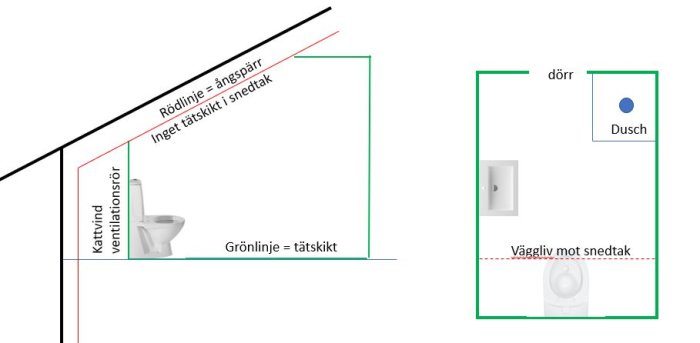
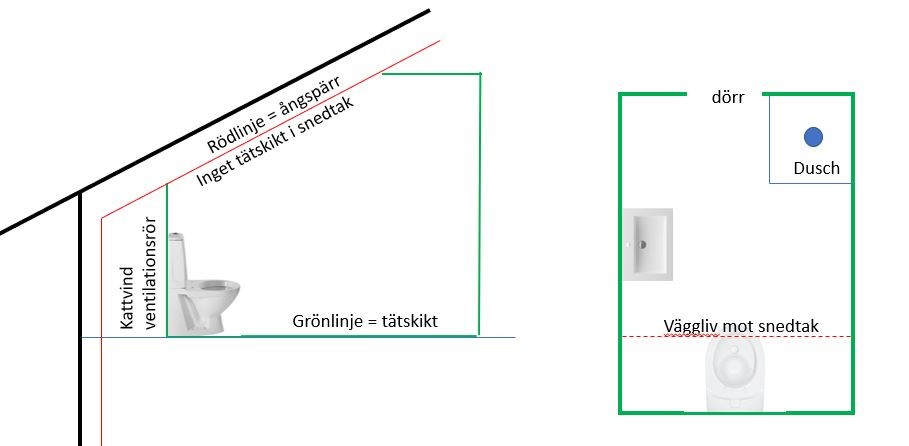
It should be noted that there is an attic behind the bathroom. The shower will be in the opposite corner. Do you only install the waterproofing up to the wall line and disregard the sloping ceiling facing the vapor barrier...? See the attached sketch to understand what I mean.
From what I understand, it's okay these days to place a vapor barrier behind the waterproof layer, but if you want to be completely sure that any moisture can escape, you can replace the vapor barrier with a vapor retarder behind the walls/ceiling specifically in the bathroom, so it doesn't become completely sealed. But I'm just a hobby builder, so I could be wrong. However, I have exactly what you describe with a vapor barrier and then 45cm of insulation+boards before the waterproof layer in my own bathroom, and so far I haven't had any problems.
As far as I know, it's not okay to have a tight vapor barrier behind the wet room's waterproofing layer.
[link]
clear from Säker Vatten that it should be a vapor brake. Missed that and my contractor said that the waterproofing in modern bathrooms (waterproofing of the plastic mat variant) is pressure tested in all seams and is even tighter than the plastic, and that it's not a problem. We'll see what holds true in the future.
if the thread creator hasn't set the plastic yet, I would still recommend a vapor brake. I just installed it in an entire Attefall house I'm building, and I found the vapor brake much easier to work with, and the thought that the house still breathes a bit feels better than wrapping everything in plastic. I have a feeling that building with plastic is not the future...
You must base your approach on the actual conditions. If the crawl space is unheated, it is most appropriate for the bathroom wall's moisture barrier to also serve as a vapor barrier. If it is heated, it must be ventilated so you can apply a vapor barrier to the outer wall. The Swedish National Board of Housing, Building and Planning's building regulations (BBR), which are the ones that apply, not different industry rules, have two requirements for wet rooms: 1 Water must not be able to enter adjacent rooms and 2 Surrounding structures must be protected from moisture damage.
The main reason the säkervatten-wall advocates for a vapor brake behind the wet room wall is so that you can splice into the house's existing vapor barrier on something. If you just stop the vapor barrier where the wet room begins, there will be a 'gap' that is difficult to seal.
I understand that, but then the space between the wet room wall and the outer wall must be ventilated. The best solution in wooden constructions is not to have any wet room walls at all but to use shower cabins and external wall protection, and to completely refrain from ceramic materials. Wet room walls last for 20 years, tiles for 1000+ years.
Click here to reply
Vi vill skicka notiser för ämnen du bevakar och händelser som berör dig.



useless said:
