Standing with a knife to my throat now and need to give the carpenter an answer on what to use as a moisture barrier on the wall against the outer wall.
No issues with moisture or mold today. Single-story house, concrete slab foundation, built in 1970, natural ventilation, electric heating with radiators.
Now we're renovating and working on:
Installation of mechanically ventilated flooring like Granab, removing electric heating and installing a geothermal heat pump and waterborne floor heating throughout the house. FTX or exhaust air exchanger for the geothermal heat pump will be fixed by spring.
Need to replace the surface layers in two bedrooms that have been torn down to the sheathing on the walls.
Previous construction from the outside in: Horizontal paneling, air gap, fiberboard, wooden stud wall with glass insulation, sheathing, moisture barrier, Tretex, wallpaper.
Attic construction from inside upwards: Ceiling, sheathing, same moisture barrier as in the wall, sawdust insulation.
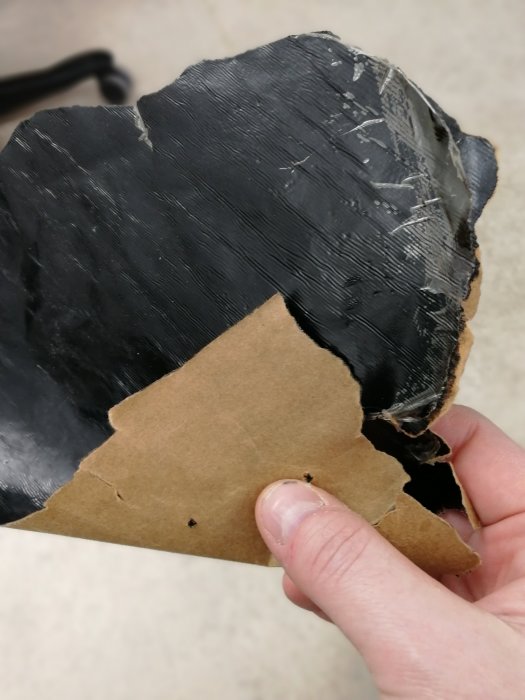
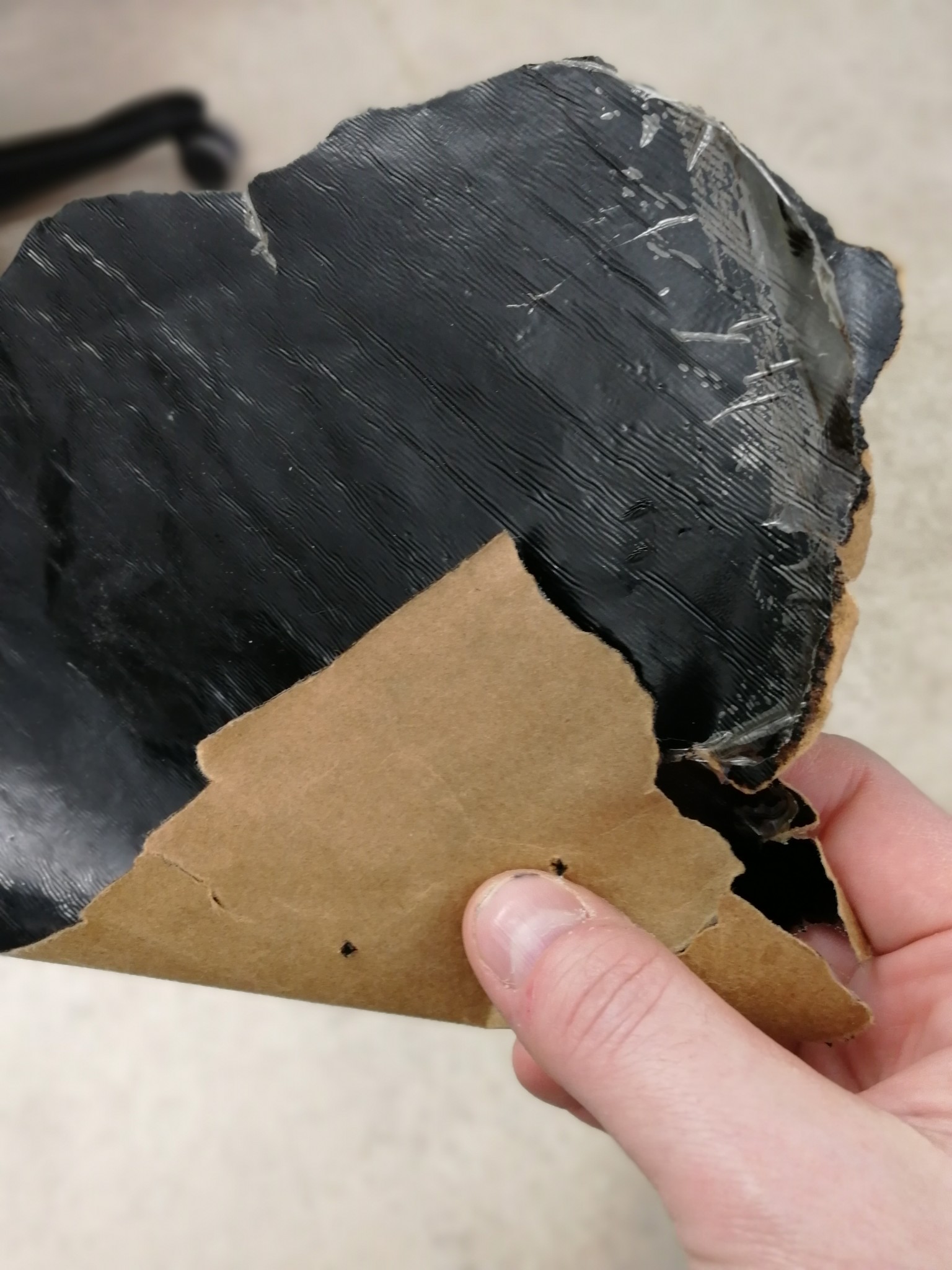
The moisture barrier that was in the wall must be replaced, everyone I've talked to and shown the old one doesn't know what it is. Some recommend real plastic, others a variable vapor barrier. And in the middle, I stand sleepless... The layer consists of a paper structure coated with something black and a thin plastic film. The black side was facing inward towards the room.
Anyone familiar with what I have based on the description and the picture? How vapor-tight can it be assumed to be?
I have never seen this material, but it seems to be some form of plastic-coated cardboard. Before plastic sheeting became common as a vapor barrier in the mid-70s, asphalt felt, type AC 350, was the most common. By today's standards, it was closest to a vapor retarder. Considering the material in your walls, it is advisable to replace the black plastic cardboard with plastic sheeting.
It probably doesn't matter if there are two bedrooms, no direct moisture load there.
There is quite a bit of moisture in the bedroom - sleeping (and awake) people emit a lot of moisture and you spend a long time in the bedroom (normally the whole night unless you're out painting the town).
Among 'ordinary' rooms, I also believe that bedrooms have significantly higher humidity levels than other rooms, perhaps even higher than bathrooms when looking at a 24-hour average. Houses from the early 70s have fared quite well, but when Svensk Byggnorm -75 was introduced with radically increased requirements for insulation and airtightness, problems began.
Vapor barriers were mainly introduced because mineral wool insulation loses its insulating ability with increased moisture presence. BABS 1960 is the first building code where the concept is found, as far as I know. Older types of insulation materials, solid wood, sawdust, or wood shavings, have significantly higher hygroscopic capacity, which makes the problem less pronounced. Bedrooms have higher moisture levels than most rooms. I agree with @Asgarvad that there is a conflict between traditional building methods and energy conservation.
As a friend said about his 60s house, "The walls are so thin that the dew point is outside the paneling, if I add insulation to the house the dew point moves into the wall, and I get problems."
Vapor barriers were primarily introduced because mineral wool insulation loses its insulating ability when moisture presence increases. BABS 1960 is the first building code where the concept is found according to what I know. Older types of insulating materials, solid wood, sawdust, or wood shavings, have significantly higher hygroscopic ability which makes the problem less pronounced. Bedrooms have higher moisture levels than most rooms. I agree with @Asgarvad that there is a conflict between traditional building methods and energy efficiency.
I studied at a technical high school in the construction program just when SBN-75 was released.
Oh, a lot of responses have come in here, thank you humbly!
It's nice that the majority agrees with what was actually put up on the walls, vapor barrier plastic. Trying to let go of this topic now and sleep peacefully at night
The idea to add extra insulation to the attic exists after the FTX is installed.
Click here to reply
Vi vill skicka notiser för ämnen du bevakar och händelser som berör dig.


Jonatan79 said:


