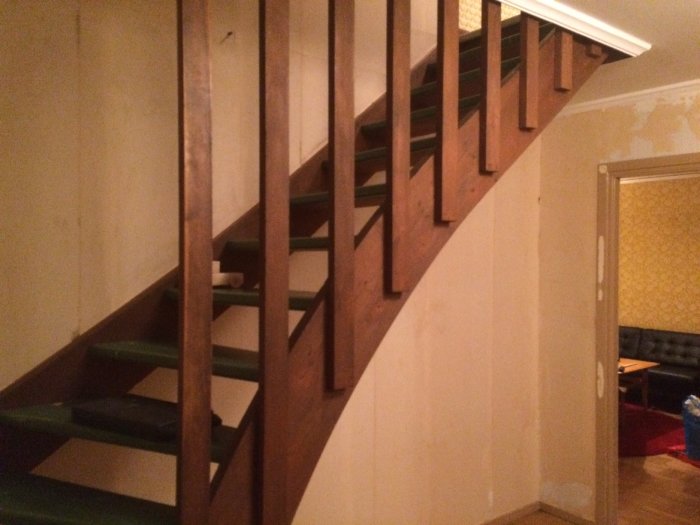
I'm in the process of renovating the staircase and would like to replace the balusters with something nicer, but I'm a bit nervous if the balusters might have a load-bearing function.
I've tried researching how it is, but all staircases are different. There is no thicker post going from floor to ceiling, just the spindles in the picture. I've also attached a picture of how they are mounted at the top.
You should have some kind of protection against falls, right?
So then it's just a matter of replacing the old "ugly" protection with the new "nice" one.
At the same time, you should check the distance between the steps.
They should be a maximum of 10 centimeters to provide fall protection for small children.
That looks more like 15 cm.
It's easiest to fix by attaching a strip, maybe 21x58 mm, on the underside of each step.
Since some people so confidently claim that the spindles cannot be load-bearing because they are too slender, it should be pointed out that they are primarily subjected to tensile stress and can thus bear a significant load despite being slender.
I did not mean (and did not write either) that they are load-bearing, I do not dare to have an opinion on that based on what I see in the pictures. What I meant is that one cannot draw any conclusions based solely on the dimensions of the slats because wood has an exceptional tensile strength in the fiber direction. If they are, for example, 16x45, one could theoretically hang 7 tons on a slat before it breaks.
It's not like the spindle is breaking, but if you try to hang 7 tons on it, it will split where it is nailed. You can see in the second picture that there is no sensible mounting, just a decorative top rail. Then it's a fact that this type of stairs is always bolted with heavy-duty bolts into the floor joist, not hung on spindles, especially since it's clear that it's an original staircase from the 70s.
Click here to reply
Vi vill skicka notiser för ämnen du bevakar och händelser som berör dig.