
5,549 views ·
11 replies
6k views
11 replies
Thoughts on load-bearing wall/beam.

Hello. I've read quite a bit here, but this is probably the first time I'm writing.
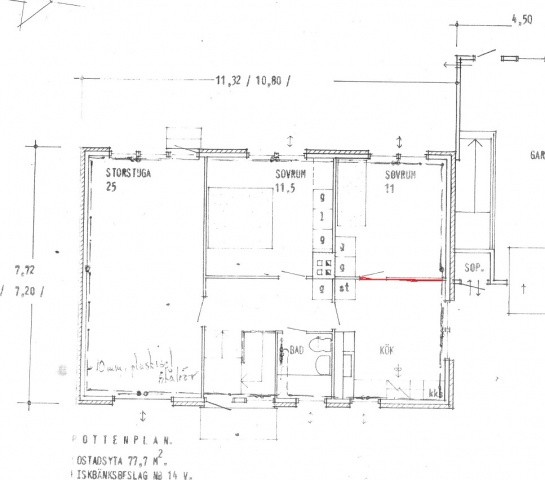
I am taking down almost an entire wall (red in the attached image) which my father-in-law and also a carpenter claim is load-bearing. I have already brought home a laminated veneer lumber (LVL) beam and posts, which I also got help with dimensioning, but that's not really what I'm wondering about.
As you can see on the house plan, the interior wall goes through the entire house but not through the so-called "great room". What surprises me is that when I picked up three supports today to temporarily brace the ceiling, I checked the floor structure in the attic (after reading here in another thread) and it is split in the middle right over the interior wall and joined together with nail plates (is that what it's called?). In other words, do I need three more supports on the other side? Do I need to support on both sides?
The strange thing(?) is that after another check in the attic, I saw that the floor structure is also split in the middle over the so-called great room and there is no load-bearing wall underneath. Is my load-bearing wall actually load-bearing?
But if it is, the follow-up question is, do I need supports on both sides when taking down the old wall and installing the LVL beam? It would certainly make things easier if it’s enough to have supports on just one side.
House plan. Red marks the part of the wall to be opened up and replaced with the LVL beam.
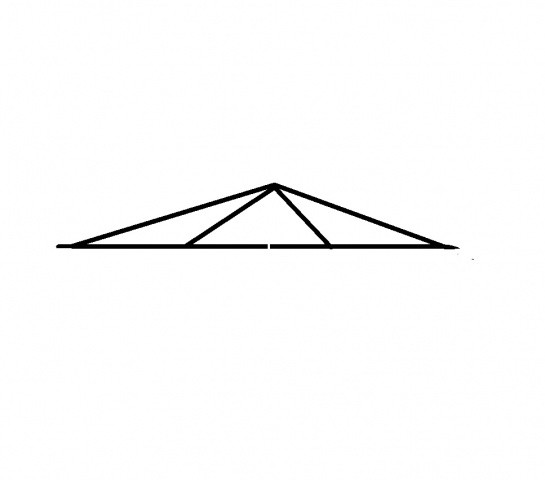
Paint drawing. This is how the floor structure is built and split in the middle where I have marked with a "white line".
Thanks in advance.
I am taking down almost an entire wall (red in the attached image) which my father-in-law and also a carpenter claim is load-bearing. I have already brought home a laminated veneer lumber (LVL) beam and posts, which I also got help with dimensioning, but that's not really what I'm wondering about.
As you can see on the house plan, the interior wall goes through the entire house but not through the so-called "great room". What surprises me is that when I picked up three supports today to temporarily brace the ceiling, I checked the floor structure in the attic (after reading here in another thread) and it is split in the middle right over the interior wall and joined together with nail plates (is that what it's called?). In other words, do I need three more supports on the other side? Do I need to support on both sides?
The strange thing(?) is that after another check in the attic, I saw that the floor structure is also split in the middle over the so-called great room and there is no load-bearing wall underneath. Is my load-bearing wall actually load-bearing?
But if it is, the follow-up question is, do I need supports on both sides when taking down the old wall and installing the LVL beam? It would certainly make things easier if it’s enough to have supports on just one side.
House plan. Red marks the part of the wall to be opened up and replaced with the LVL beam.
Paint drawing. This is how the floor structure is built and split in the middle where I have marked with a "white line".
Thanks in advance.
Member
· Västra Götalands Län
· 529 posts
Yes, of course, props on both sides! Place the prop on a sturdy plank on the floor, and in the prop's crowns, place a beam. It should form "like a wall" on both sides of where you are demolishing. About 80-100 cm from each side usually works well.
If the floor joists are joined in your living room, there should be something supporting this. Could you possibly have a beam in the ceiling that you don't see?
If the floor joists are joined in your living room, there should be something supporting this. Could you possibly have a beam in the ceiling that you don't see?
How many floor joists over 7 meters come unspliced??
How often is the splice exactly in the middle?
Not always, right!?
Those of you who say there must be support on both sides of the wall must then believe that you also need two load-bearing longitudinal walls?!
Do you understand what I mean?
TS: the picture of the roof truss probably has a gap to show where the splice is, but is actually held together with a nail plate connection?
I'm almost sure it’s enough to have support on one side, but close to the center if possible.
Sent from my Desire HD using Tapatalk
How often is the splice exactly in the middle?
Not always, right!?
Those of you who say there must be support on both sides of the wall must then believe that you also need two load-bearing longitudinal walls?!
Do you understand what I mean?
TS: the picture of the roof truss probably has a gap to show where the splice is, but is actually held together with a nail plate connection?
I'm almost sure it’s enough to have support on one side, but close to the center if possible.
Sent from my Desire HD using Tapatalk
Thank you for your response so far.
I have arranged three more jacks and will support on both sides. Being almost sure that it's enough to support on one side isn't enough, because with my usual luck, it probably wouldn't turn out well... Since you can support from a greater distance when supporting from two sides, the workspace isn't compromised either, just need to make sure the beam fits in between, or simply lay it on the floor inside the jacks before starting to support the ceiling.
But I still find it strange that the joists are divided over the great room without a lower load-bearing wall, and this is what makes one wonder if the interior wall running through the house in the middle is really that load-bearing... :S
I should also mention that the house plan isn't quite accurate anymore. The great room has been converted into two children's rooms, the wall between the two bedrooms in the plan is gone, and it now serves as the living room, and what I'm working on now is opening up the new living room to the kitchen. The basement rec room has been converted into a bedroom with a new wall against the stairs. So the house looks quite different inside compared to the plan, but the new layout feels really good. We have had the house for nine years now, so we've had plenty of time to think and feel before starting the renovations.
I have arranged three more jacks and will support on both sides. Being almost sure that it's enough to support on one side isn't enough, because with my usual luck, it probably wouldn't turn out well...
Since you can support from a greater distance when supporting from two sides, the workspace isn't compromised either, just need to make sure the beam fits in between, or simply lay it on the floor inside the jacks before starting to support the ceiling.But I still find it strange that the joists are divided over the great room without a lower load-bearing wall, and this is what makes one wonder if the interior wall running through the house in the middle is really that load-bearing... :S
I should also mention that the house plan isn't quite accurate anymore. The great room has been converted into two children's rooms, the wall between the two bedrooms in the plan is gone, and it now serves as the living room, and what I'm working on now is opening up the new living room to the kitchen. The basement rec room has been converted into a bedroom with a new wall against the stairs. So the house looks quite different inside compared to the plan, but the new layout feels really good. We have had the house for nine years now, so we've had plenty of time to think and feel before starting the renovations.
Last edited:
It may very well be that they are self-supporting. However, I don't have enough knowledge to determine this. Don't you have a truss manufacturer nearby that you can consult and maybe email the picture of the truss to get an expert opinion? It's quite similar to the truss here.
http://www.ragsag.se/Gismo/Bildarkiv/org/1289/takstolar 2011-02-15.pdf except for one diagonal brace.
It would certainly look much nicer if you could avoid a beam inside under the roof.
Another option to avoid the beam inside is to sneak it into the attic and place it on the upper side with hanger irons. Don’t you have an inspection hatch on the gable, or perhaps a slightly larger gable vent?
http://www.ragsag.se/Gismo/Bildarkiv/org/1289/takstolar 2011-02-15.pdf except for one diagonal brace.
It would certainly look much nicer if you could avoid a beam inside under the roof.
Another option to avoid the beam inside is to sneak it into the attic and place it on the upper side with hanger irons. Don’t you have an inspection hatch on the gable, or perhaps a slightly larger gable vent?
In your place, I would strongly consider placing the beam on the upper side if it doesn't encounter any problems. If it becomes difficult to get in there afterward, maybe it's possible to move the hatch upward or to the side. It shouldn't be too much work since the wall is probably of the simpler type up there.
Well, it would work but become a bit more inconvenient since there's grass there instead of the garage roof. The garage roof is quite handy for getting to the attic since the hatch becomes so small with my little roof slope, you really have to crawl through the low hole. I can't even imagine how it would be to get rid of wasps without the garage roof as well...
Click here to reply