
6,881 views ·
13 replies
7k views
13 replies
The carpenter has placed OSB down against concrete floor - risk of moisture problems?
Hello!
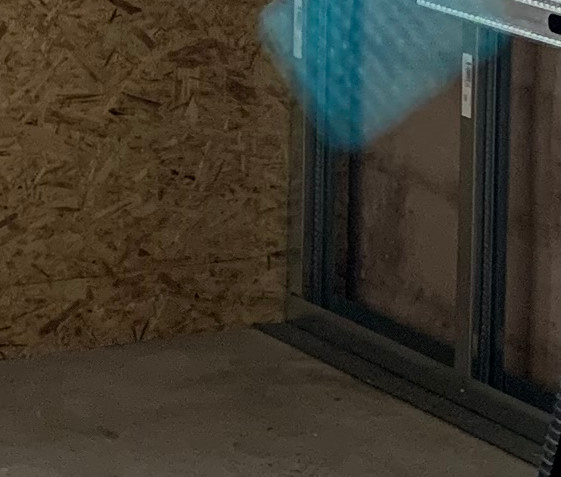
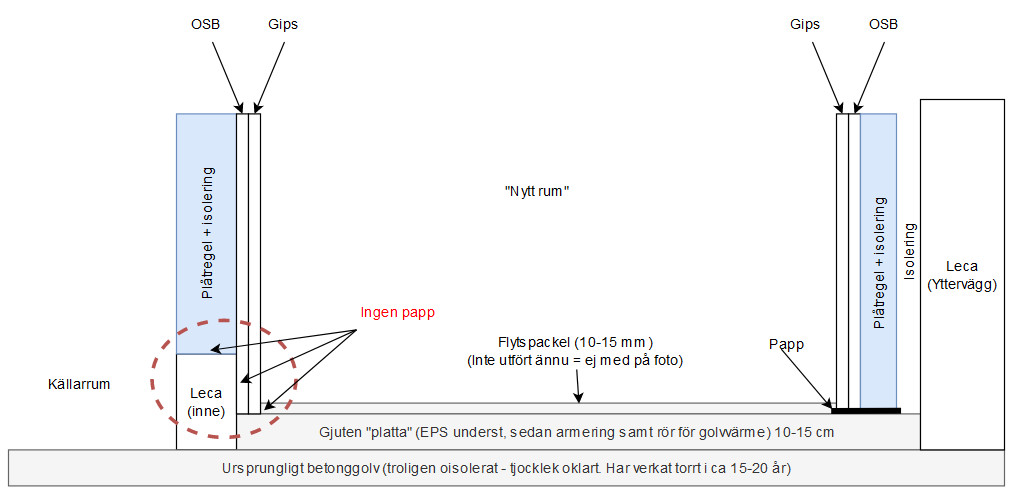
I have carpenters at home who are furnishing a room in the basement. I see under one of the four walls that there is no paper down against the underlying and newly cast concrete floor. Should one be worried about moisture problems here (that moisture is absorbed from the concrete and the underlying leca (see pictures)?
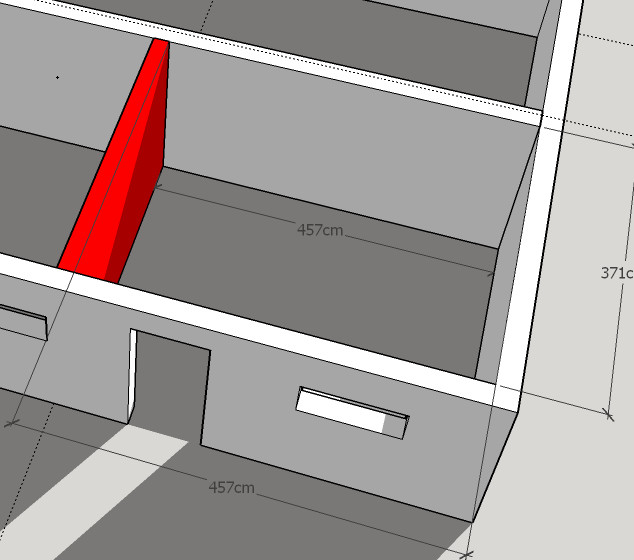
The red wall in the picture is the one without paper underneath. It is an "inner wall" that stands on a row of Leca blocks. The other walls have paper underneath.
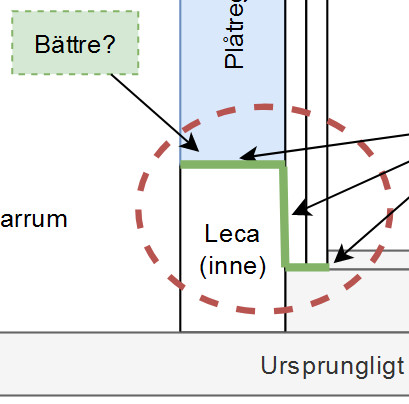
Should I ask the carpenters to redo under the "red wall" so that paper is laid there as well? (See image with green marking and text "Better?").
There also remains a layer of self-leveling compound (10-15 mm) to have an even floor. I assume they will cast directly against the walls (against the gypsum).
I have carpenters at home who are furnishing a room in the basement. I see under one of the four walls that there is no paper down against the underlying and newly cast concrete floor. Should one be worried about moisture problems here (that moisture is absorbed from the concrete and the underlying leca (see pictures)?
The red wall in the picture is the one without paper underneath. It is an "inner wall" that stands on a row of Leca blocks. The other walls have paper underneath.
Should I ask the carpenters to redo under the "red wall" so that paper is laid there as well? (See image with green marking and text "Better?").
There also remains a layer of self-leveling compound (10-15 mm) to have an even floor. I assume they will cast directly against the walls (against the gypsum).
S
SueCia
Electronics enthusiast
· Dalarna
· 5 582 posts
SueCia
Electronics enthusiast
- Dalarna
- 5,582 posts
H hemmafixaren98 said:Hi!
I have carpenters at home who are furnishing a room in the basement. I see under one of four walls that there is no paper down against the underlying and newly cast concrete floor. Should I be worried about moisture problems here (that moisture is being absorbed from the concrete and the underlying leca (see pictures)?
The red wall in the picture is the one missing paper underneath. It is an "internal wall" that stands on a row of Leca blocks. The other walls have paper underneath.
Should I ask the carpenters to redo under the "red wall" so that paper is also laid there? (See picture with green marking and text "Better?").
There is also a layer of self-leveling compound (10-15 mm) remaining to get an even floor. I assume they will pour directly against the walls (against the gypsum)
Yes, there is a risk, I mounted my OSB boards 0.5 cm above the concrete surface, and that solved the problem.
Thanks for the feedback. One could mill/saw off at the bottom edge - but it still rests against the Leca row at the back... (for me)S SueCia said:
I'm wondering if I should speak up now or not? It's annoying to "redo" the wall but easier now than later...
Last edited:
S
SueCia
Electronics enthusiast
· Dalarna
· 5 582 posts
SueCia
Electronics enthusiast
- Dalarna
- 5,582 posts
I'm no expert but based on my own experiences I would have spoken up.H hemmafixaren98 said:
However, I don't know how Leca works with moisture so someone else might answer better.
I would say high risk
We had some wood in the basement that was in contact with concrete without any sill paper in between. It has slowly but surely kind of rotted away from the bottom. But for us, it has been an extremely slow process that has taken decades.
It surely depends a lot on how well-drained the house is, what temperature you have indoors, and so on. I can't assess how risky it is, but it feels wrong in my gut to have wood in direct contact with concrete blocks/concrete.
It surely depends a lot on how well-drained the house is, what temperature you have indoors, and so on. I can't assess how risky it is, but it feels wrong in my gut to have wood in direct contact with concrete blocks/concrete.


The risk in an interior wall feels quite small, but on the other hand, it exists, and the effort right now to unscrew them, lay down sill paper, and screw them back is so minimal that there is no reason to ignore it.
Thanks for all the feedback - appreciated 
Called and talked to the carpenter about it. He insisted that it wasn't necessary since it is an interior wall...
(he said that, of course, you can unscrew it and redo it, but didn't think it was necessary)
Pulled out my old construction technique book from '89. It's not entirely clear regarding interior walls. Exterior walls are specifically mentioned (and especially wooden studs). Now it's about metal studs, but also OSB is organic...
Clearly, the best would be to have paper underneath, but the question is if I have the energy to insist. Feeling 50/50 right now.
Called and talked to the carpenter about it. He insisted that it wasn't necessary since it is an interior wall...
(he said that, of course, you can unscrew it and redo it, but didn't think it was necessary)
Pulled out my old construction technique book from '89. It's not entirely clear regarding interior walls. Exterior walls are specifically mentioned (and especially wooden studs). Now it's about metal studs, but also OSB is organic...
Clearly, the best would be to have paper underneath, but the question is if I have the energy to insist. Feeling 50/50 right now.


Things don't get damp just because they touch concrete.
There is cellular plastic underneath that will counteract moisture migration, and there is heat in the floor that will keep the floor warmer than the surroundings as long as the water circulates => no moisture wants in.
In my case, I have more cellular plastic underneath and a capillary-breaking layer and an age-resistant plastic under and on the sides of the concrete. In addition, I have year-round circulation in the underfloor heating. I consider my slab completely dry.
The slab in this case might not have equally good conditions, but I would still be a bit surprised if there were any problems.
There is cellular plastic underneath that will counteract moisture migration, and there is heat in the floor that will keep the floor warmer than the surroundings as long as the water circulates => no moisture wants in.
In my case, I have more cellular plastic underneath and a capillary-breaking layer and an age-resistant plastic under and on the sides of the concrete. In addition, I have year-round circulation in the underfloor heating. I consider my slab completely dry.
The slab in this case might not have equally good conditions, but I would still be a bit surprised if there were any problems.
Click here to reply