
78,554 views ·
78 replies
79k views
78 replies
Tear down load-bearing wall, install HEA Beam at 6 meters?

On further consideration, I believe that a sustainable cladding of an HEA beam requires a batten on the underside of the beam as well, which would mean an addition of 45+13 mm at the bottom. Another option you can start considering is reducing the span to about 5 meters. In that case, a 215x270 glulam beam could work.

Member
· Södermanlands län0
· 983 posts
You don't have to encase the steel beam in gypsum if you instead paint it with fire-retardant paint.

The starting point must be that it should be aesthetically pleasing and durable, capable of enduring the movements that occur. How beautiful is it to have a fireproof painted HEA beam in the kitchen ceiling? The construction that is meant to conceal the steel must also withstand the steel moving in a different manner.

Must steel beams always be fire-protected if they are not clad in gypsum?
And must they always be clad in gypsum otherwise?
But what do you do where the steel beam, for example, meets a wooden floor above? Must the steel beam be fire-protected on the top side before it is pressed up against the wooden floor? Sounds complicated.
What is said about oversized steel beams where wooden studs are pressed into the side of them without fire protection? The wooden studs should help carry some load, especially when the steel beam starts to lose its load-bearing capacity due to heat.
There are various ways to approach this, the question is what is allowed.
And must they always be clad in gypsum otherwise?
But what do you do where the steel beam, for example, meets a wooden floor above? Must the steel beam be fire-protected on the top side before it is pressed up against the wooden floor? Sounds complicated.
What is said about oversized steel beams where wooden studs are pressed into the side of them without fire protection? The wooden studs should help carry some load, especially when the steel beam starts to lose its load-bearing capacity due to heat.
There are various ways to approach this, the question is what is allowed.
Hey Martin!
The status is that I am waiting for the actual construction drawings to be able to make exact calculations, and then we'll see if it ends with HEA/HEB/IPE or glulam beams
I'll get back to you!
The status is that I am waiting for the actual construction drawings to be able to make exact calculations, and then we'll see if it ends with HEA/HEB/IPE or glulam beams
I'll get back to you!
Hello again!
It's time for a little update on the status!
Unfortunately, the municipality had no construction drawings, but they did have true scalable (scale 1:100) floor plans including a complete section.
Justusandersson above has taken a look at this and concludes the following options:
3.6-meter span:
115x225 mm glulam beam
3.8-meter span:
115x270 mm or 165x225 mm glulam beam
Both options are supported by 3 pillars of 115x115 mm glulam.
So depending a bit on where we place the middle pillar, we end up with either a 3.6-meter span or about 3.8 meters, and between these, there's a difference in the dimension of the roof beam.
We are going to build an approximately 1-meter high half-wall from the outer wall where we intend to place two base cabinets and a countertop on top, as we need more space in the kitchen. We therefore want to place the middle pillar right next to the half-wall, so the pillar won't get in the way since there's already going to be a wall there.
Would anyone else knowledgeable like to take a look at the dimensions above? It always feels good to get input from two different sources
I am attaching the following:
1. Floor plan + section in PDF (1:100)
2. Floor plan in image format to show pillar placement.
3. 3 images showing the idea with the half-wall.
Grateful as always for any help I can get.
It's time for a little update on the status!
Unfortunately, the municipality had no construction drawings, but they did have true scalable (scale 1:100) floor plans including a complete section.
Justusandersson above has taken a look at this and concludes the following options:
3.6-meter span:
115x225 mm glulam beam
3.8-meter span:
115x270 mm or 165x225 mm glulam beam
Both options are supported by 3 pillars of 115x115 mm glulam.
So depending a bit on where we place the middle pillar, we end up with either a 3.6-meter span or about 3.8 meters, and between these, there's a difference in the dimension of the roof beam.
We are going to build an approximately 1-meter high half-wall from the outer wall where we intend to place two base cabinets and a countertop on top, as we need more space in the kitchen. We therefore want to place the middle pillar right next to the half-wall, so the pillar won't get in the way since there's already going to be a wall there.
Would anyone else knowledgeable like to take a look at the dimensions above? It always feels good to get input from two different sources
I am attaching the following:
1. Floor plan + section in PDF (1:100)
2. Floor plan in image format to show pillar placement.
3. 3 images showing the idea with the half-wall.
Grateful as always for any help I can get.

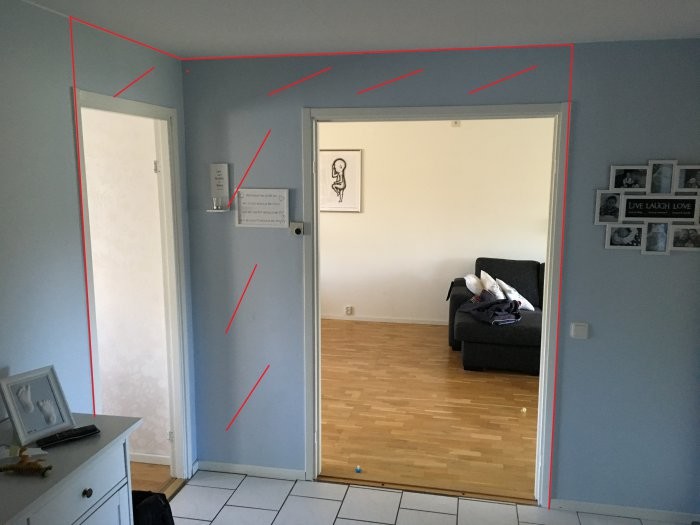

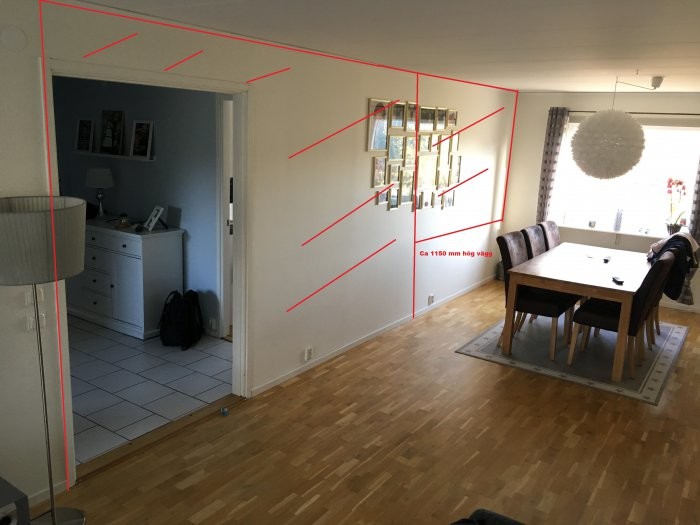
Yes, you can't span 6 meters. Especially not if it's supposed to be load-bearing. With 3.6 meters, there are no problems. Use a lower steel beam that is thicker. That way, you get more ceiling height. Then you can clad the underside with repair plasterboard that is only a few mm thick. On the sides, you can run down OSB and then regular plasterboard on top. Keep in mind that the thickness of the center pillar will also make a difference. So a steel pillar there will also look nicer.

Had the beam only spanned 3.8m and rested on two pillars, I would have thought it sounds weak. But since it continues for an additional 2.2m and gets a pillar in the middle that provides a helping moment, it sounds more reasonable. Note that I haven't calculated it, but it sounds OK.
Thank you for your answers!
As it stands now, I'm leaning towards a span of 3.8 meters (I will check this next week when I get the measurements for the kitchen base cabinets that will be placed in front of the dwarf wall).
Since the beam will meet an existing wall in the hallway that is only 115 mm deep, including drywall, the option with a glulam beam 115x270 mm feels like an entirely OK alternative. The beam won't protrude beyond the existing wall, and it will look uniform.
If I want the same width with a steel beam, the largest I can set is an IPE-180 beam, which is 91 mm wide and can thus be "hidden in the existing wall." When it extends beyond the existing wall, it will be 91+13+13 = 117 mm, including drywall cladding, so it's very close to the existing 115 mm. This beam is 180 mm high, which means, with a layer of drywall, the height becomes 193 mm, so I save 77 mm in height, which is not bad.
Can anyone give a rough estimate if an IPE-180 can handle this or if it might be too weak? I will, of course, double-check this with an engineer but just want a general idea if it's even plausible.
I am, of course, open to other solutions with different types of beams. It seems like both HEA and HEB would be significantly lower, but I would then have to live with projections on either side of the existing wall in the hallway, which might not be noticeable once it's in place. What do you think?
Thanks in advance!
As it stands now, I'm leaning towards a span of 3.8 meters (I will check this next week when I get the measurements for the kitchen base cabinets that will be placed in front of the dwarf wall).
Since the beam will meet an existing wall in the hallway that is only 115 mm deep, including drywall, the option with a glulam beam 115x270 mm feels like an entirely OK alternative. The beam won't protrude beyond the existing wall, and it will look uniform.
If I want the same width with a steel beam, the largest I can set is an IPE-180 beam, which is 91 mm wide and can thus be "hidden in the existing wall." When it extends beyond the existing wall, it will be 91+13+13 = 117 mm, including drywall cladding, so it's very close to the existing 115 mm. This beam is 180 mm high, which means, with a layer of drywall, the height becomes 193 mm, so I save 77 mm in height, which is not bad.
Can anyone give a rough estimate if an IPE-180 can handle this or if it might be too weak? I will, of course, double-check this with an engineer but just want a general idea if it's even plausible.
I am, of course, open to other solutions with different types of beams. It seems like both HEA and HEB would be significantly lower, but I would then have to live with projections on either side of the existing wall in the hallway, which might not be noticeable once it's in place. What do you think?
Thanks in advance!
Hello
I'm jumping in here with a question, planning to change the garage roof from flat to trusses.
On one side where the trusses will be placed, I have a garage door opening of 4.8m (6m total width), where I've been advised to either install a glulam beam 630mm (I don't know the thickness) or an HEA260 beam. But how do I attach the trusses to the beam and other "carpentry"?
Best regards, Peter
I'm jumping in here with a question, planning to change the garage roof from flat to trusses.
On one side where the trusses will be placed, I have a garage door opening of 4.8m (6m total width), where I've been advised to either install a glulam beam 630mm (I don't know the thickness) or an HEA260 beam. But how do I attach the trusses to the beam and other "carpentry"?
Best regards, Peter
To attach wooden rafters to a steel beam, angle brackets and holes in the beam are required. Glulam often becomes considerably simpler. Glulam 90x630 and HEA 260 are quite similar.