
78,585 views ·
78 replies
79k views
78 replies
Tear down load-bearing wall, install HEA Beam at 6 meters?
Hello!
My name is Andreas and I live in a 1.5-story house outside Gothenburg.
I want to create an open floor plan on the ground floor between the living room and the kitchen.
I had a carpenter visit who told me that the wall is load-bearing and that a beam needs to be installed. I could either go with a glulam beam that would protrude about 300 mm from the ceiling or a HEA steel beam that would protrude 200 mm from the ceiling, though the HEA would be significantly more expensive than the glulam. Since my ceiling height is 2400 mm, I feel it's worth paying extra to save 100 mm in height, so I've decided to proceed with the HEA solution.
The carpenter has suggested a HEA 200, which would need to be about 6 meters long. Is there anyone here in the forum with experience with these who can take a quick look at the attached drawing to see if it seems correct? I definitely don't want to compromise the load-bearing capability of the house. However, I would prefer to avoid adding extra pillars, so the 6-meter opening is important.
I've been given a price for the removal of the existing wall, installation of the beam, and minor fixes like drywall, thresholds, etc., totaling about 50,000-60,000 SEK including all materials and after the rot deduction. Painting and electrician costs will need to be handled externally. Does this seem like a reasonable amount?
I'm a complete beginner at this, so I would appreciate some help.
Best regards,
/Andreas
My name is Andreas and I live in a 1.5-story house outside Gothenburg.
I want to create an open floor plan on the ground floor between the living room and the kitchen.
I had a carpenter visit who told me that the wall is load-bearing and that a beam needs to be installed. I could either go with a glulam beam that would protrude about 300 mm from the ceiling or a HEA steel beam that would protrude 200 mm from the ceiling, though the HEA would be significantly more expensive than the glulam. Since my ceiling height is 2400 mm, I feel it's worth paying extra to save 100 mm in height, so I've decided to proceed with the HEA solution.
The carpenter has suggested a HEA 200, which would need to be about 6 meters long. Is there anyone here in the forum with experience with these who can take a quick look at the attached drawing to see if it seems correct? I definitely don't want to compromise the load-bearing capability of the house. However, I would prefer to avoid adding extra pillars, so the 6-meter opening is important.
I've been given a price for the removal of the existing wall, installation of the beam, and minor fixes like drywall, thresholds, etc., totaling about 50,000-60,000 SEK including all materials and after the rot deduction. Painting and electrician costs will need to be handled externally. Does this seem like a reasonable amount?
I'm a complete beginner at this, so I would appreciate some help.
Best regards,
/Andreas
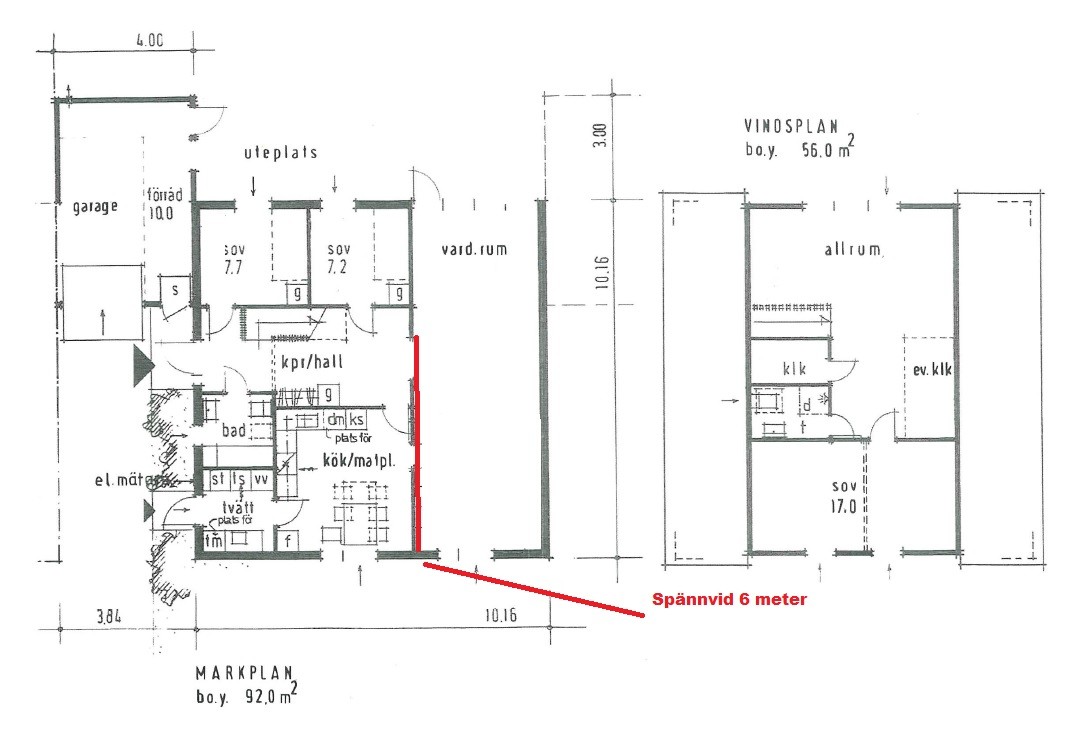

You are at least in the right ballpark. More cannot be said without more information, especially a sectional drawing. If the height difference between glulam and steel is not greater than 10 cm, I would probably choose glulam. (There is no glulam in standard size that is 30 cm, but 27 or 31.5, however) The visual difference is negligible. A glulam beam, on the other hand, is much more attractive. It is enough to paint it. A steel beam must be built in with gypsum and studs and is generally a bit troublesome when it has to meet wood.
The fact that there is only a 100mm difference between the two options raises some questions. The steel beam is much stronger and stiffer than the glulam beam. Is the glulam beam too weak or is the steel beam way too strong? As justus writes, it's hard to say anything without additional information. Don't forget that you need to make a building notification, and a calculation of the beam may be required, which I had to do.

The price doesn't have to be strange if it's for a complete assembly (excluding the items you mentioned). The material isn't particularly expensive but it does take some hours to tear down, adjust, and fit a beam. The major cost is in the hours.
But Bossespecial has a point; the two options raise questions as they are not equivalent in terms of capacity. Did they crunch some numbers?
As previously mentioned, a sectional drawing is missing, but it's likely that the wall is load-bearing for both the floor structure and the roof trusses. If the beam is meant to be a load-bearing beam under the floor structure, and the term "builds down 300" means it's a beam of about 300, then it sounds quite flimsy and I doubt you can rely on it over 6m. A HEA200 sounds more reasonable but I'm not sure. You should definitely let a structural engineer perform a load calculation and give you the correct dimensioning value before you proceed with the demolition.
But Bossespecial has a point; the two options raise questions as they are not equivalent in terms of capacity. Did they crunch some numbers?
As previously mentioned, a sectional drawing is missing, but it's likely that the wall is load-bearing for both the floor structure and the roof trusses. If the beam is meant to be a load-bearing beam under the floor structure, and the term "builds down 300" means it's a beam of about 300, then it sounds quite flimsy and I doubt you can rely on it over 6m. A HEA200 sounds more reasonable but I'm not sure. You should definitely let a structural engineer perform a load calculation and give you the correct dimensioning value before you proceed with the demolition.
The difference between wood and steel is partly the weight and that wood bears weight directly while steel flexes down even from its own weight. Have someone (steel supplier) calculate this for free, check with Bröderna Edstrand AB. The solution for steel is to "camber" by bending the beam a few mm before installation (heating the beam with a welding torch in some places), when the beam is loaded with the roof, they will flex down to a straight profile.
It is also possible to completely or partially recess the beam into the ceiling.
Thank you so much for all the answers, truly a great help.
We only have 2370 mm in ceiling height and I am 2 meters tall, which means we almost have to exclude a glulam beam since it adds 320 mm in height, leaving only 50 mm left, which means I would have to "duck" every time I pass the beam.
From what I can see, an HEA200 builds 190 mm in height. Can it then be clad with only about 10 mm of plaster, or how does the carpenter determine that the steel beam only extends 200 mm from the ceiling in total?
As mentioned, the quote states that an HEA200 at 6 meters has the same load capacity as a glulam beam with a height of 31.5 cm (the width is not specified, but maybe that doesn't matter?). This doesn't feel particularly reassuring when you say that this is not at all accurate.
When I talked about possibly consulting a structural engineer during the carpenter's site visit before the quote, the carpenter mentioned that he had good experience in this area and that he uses a sizing program to determine beam dimensions.
How do you think I should proceed? Trust the carpenter and go ahead with an HEA200, or take a step back, get my own structural engineer, and then contact the carpenter again?
I'll see if I can get hold of some section drawings this week.
Again, thank you so much!
We only have 2370 mm in ceiling height and I am 2 meters tall, which means we almost have to exclude a glulam beam since it adds 320 mm in height, leaving only 50 mm left, which means I would have to "duck" every time I pass the beam.
From what I can see, an HEA200 builds 190 mm in height. Can it then be clad with only about 10 mm of plaster, or how does the carpenter determine that the steel beam only extends 200 mm from the ceiling in total?
As mentioned, the quote states that an HEA200 at 6 meters has the same load capacity as a glulam beam with a height of 31.5 cm (the width is not specified, but maybe that doesn't matter?). This doesn't feel particularly reassuring when you say that this is not at all accurate.
When I talked about possibly consulting a structural engineer during the carpenter's site visit before the quote, the carpenter mentioned that he had good experience in this area and that he uses a sizing program to determine beam dimensions.
How do you think I should proceed? Trust the carpenter and go ahead with an HEA200, or take a step back, get my own structural engineer, and then contact the carpenter again?
I'll see if I can get hold of some section drawings this week.
Again, thank you so much!
Glued laminated timber is available in widths from 42 to 215 mm. A 315 mm high glulam beam can therefore withstand a bending moment of between approximately 14 and 75 kNm, which is a considerable variation. There's a lot to be said about carpenters and calculation programs, but I think we'll save that until you've produced a section.
I would probably not believe that they have taken into account the deflection in their calculation program, with a 6m span there can likely be a bit of a trampoline feeling on the upper floor. If you are going to use the steel beam, you should encase it with at least 13mm gypsum board for fire safety, I recall that there is usually an R15 requirement in small houses?
Well... I don't think it feels like a trampoline.
We have a 5 m HEA180, where the floor structure has been "inserted" into the beam so that the beam is completely embedded in the floor structure.
There are actually 2 HEA180s, because there's a staircase where the beam would have gone, so we have a beam on each side of the staircase.
But for such a construction, you should consult a structural engineer. It's not just the beam that needs consideration but also the support points, as there's a very high point load where the beam rests. Sometimes the foundation also needs to be reinforced underneath.
We have a 5 m HEA180, where the floor structure has been "inserted" into the beam so that the beam is completely embedded in the floor structure.
There are actually 2 HEA180s, because there's a staircase where the beam would have gone, so we have a beam on each side of the staircase.
But for such a construction, you should consult a structural engineer. It's not just the beam that needs consideration but also the support points, as there's a very high point load where the beam rests. Sometimes the foundation also needs to be reinforced underneath.

Hi Andreas, welcome to the Bugga Hus forum!
I have roughly the same solution, with a beam over 5 meters of the open area between the dining area and the "living room."
But creating this when the house is being built is of course much easier.
My HEA 200 mm beam is 5400 m long, and it cost 5000 SEK including delivery in 2010.
(In addition, there was 5454 SEK for the crane truck for lifting the trusses and beam)
But my beam is built into the joist system, meaning five trusses are cut and rest with the underframes on the beam. (The joist system is 290 mm high).
In principle, you should be able to cut the joist's studs and set the beam hidden in the joist system, but unfortunately, that's probably too much work.
Regarding the requirement for a 6 m opening: You will likely have to install posts to place the beam on to support the forces, and these posts must also be properly placed and anchored.
By the way, how are you handling the beam during the remodel inside the house?
It will weigh 250 kg.
PS
Oh, this almost became a copy of Hempularen's comment
I have roughly the same solution, with a beam over 5 meters of the open area between the dining area and the "living room."
But creating this when the house is being built is of course much easier.
My HEA 200 mm beam is 5400 m long, and it cost 5000 SEK including delivery in 2010.
(In addition, there was 5454 SEK for the crane truck for lifting the trusses and beam)
But my beam is built into the joist system, meaning five trusses are cut and rest with the underframes on the beam. (The joist system is 290 mm high).
In principle, you should be able to cut the joist's studs and set the beam hidden in the joist system, but unfortunately, that's probably too much work.
Regarding the requirement for a 6 m opening: You will likely have to install posts to place the beam on to support the forces, and these posts must also be properly placed and anchored.
By the way, how are you handling the beam during the remodel inside the house?
It will weigh 250 kg.
PS
Oh, this almost became a copy of Hempularen's comment
Last edited:
Hello again everyone, and once again, a big thank you!
I have found some original drawings and a section; however, the section was not completely complete, but I hope it provides enough information, see attached.
I have also had a phone call with the intended carpenter to get more information. The carpenter has sought help from the blacksmith who will manufacture the steel beam and has concluded that they will use the following:
1 IPE 200 beam, approximately 6 meters long
2 VKR columns with base plate 80*80*5
He justifies the IPE 200 beam with the fact that the existing wall is only 115 mm deep, so with this beam, we can build the columns into the existing walls without the columns protruding (as it would do on an HEA 200, for example).
As mentioned, we want to avoid adding more columns, and according to the carpenter, the above construction should be fine without any issues, i.e., there is no need to add more columns; the 6-meter opening is OK!
The pressure from the columns down to the foundation has not been mentioned by the carpenter, the house has a "slab-on-grade" solution, should this also be looked into more closely?
Regarding HOW assembly, transport, etc., will be done, I do not plan to get involved; the idea is to hire the carpenter on a turnkey contract, so all material and assembly are his responsibility. The reason I'm writing here is just to double-check that the calculations are correct, as I said, I don't want to jeopardize the structural integrity of the house; if there is the slightest uncertainty, I'd rather keep the wall
Once again, I am very grateful for all the help I can get here.
I have found some original drawings and a section; however, the section was not completely complete, but I hope it provides enough information, see attached.
I have also had a phone call with the intended carpenter to get more information. The carpenter has sought help from the blacksmith who will manufacture the steel beam and has concluded that they will use the following:
1 IPE 200 beam, approximately 6 meters long
2 VKR columns with base plate 80*80*5
He justifies the IPE 200 beam with the fact that the existing wall is only 115 mm deep, so with this beam, we can build the columns into the existing walls without the columns protruding (as it would do on an HEA 200, for example).
As mentioned, we want to avoid adding more columns, and according to the carpenter, the above construction should be fine without any issues, i.e., there is no need to add more columns; the 6-meter opening is OK!
The pressure from the columns down to the foundation has not been mentioned by the carpenter, the house has a "slab-on-grade" solution, should this also be looked into more closely?
Regarding HOW assembly, transport, etc., will be done, I do not plan to get involved; the idea is to hire the carpenter on a turnkey contract, so all material and assembly are his responsibility. The reason I'm writing here is just to double-check that the calculations are correct, as I said, I don't want to jeopardize the structural integrity of the house; if there is the slightest uncertainty, I'd rather keep the wall
Once again, I am very grateful for all the help I can get here.
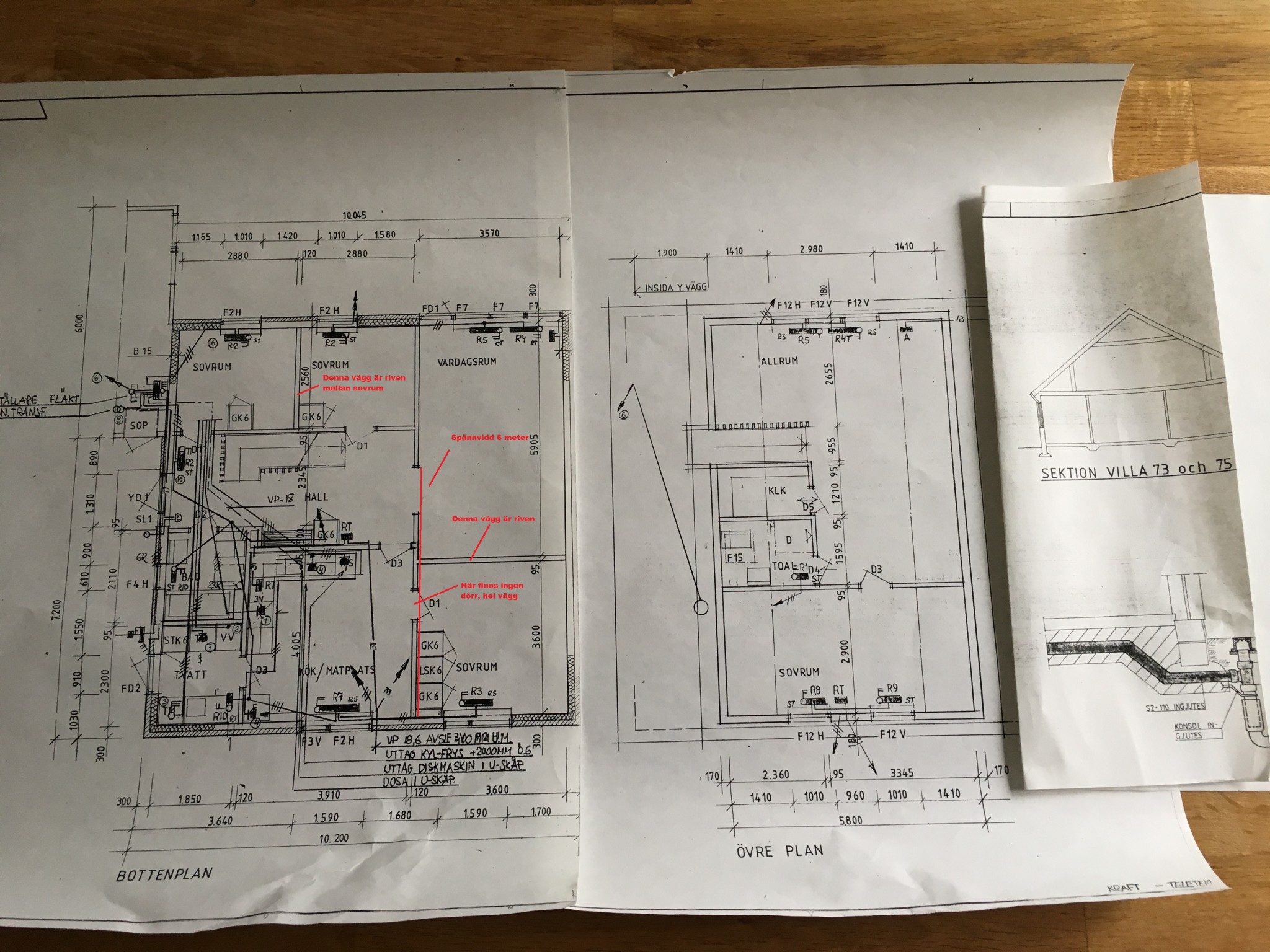
I believe that the carpenter and others have calculated based on tensile strength and not on deflection as bossespecial previously guessed. When I check quickly, I think you need to go up to IPE 270 for it to be OK. A glued laminated timber beam of 215x315 can handle it too.
Hello again!
Just thought I'd update with the status, as it might happen that someone in the future is working on a similar project, and it could be good to follow up on what happens.
After excellent help from Justusandersson and some of my own research, we have concluded that there are 3 different options to choose from:
1. IPE 270 (150*285 mm including 15 mm gypsum cladding)
2. Glulam beam (215*315 mm)
3. HEA 220 (235*225 mm including 15 mm gypsum cladding)
The IPE beam is immediately ruled out because there is only a 30 mm height difference between it and the glulam beam, so now it's between the glulam beam and the HEA 220 beam.
How would you all reason here? Is it worth saving 90 mm in height and going with a steel beam, or is the glulam beam so much better and nicer that it outweighs the other? As mentioned, we have a ceiling height of 2370 mm, and I am 2000 mm, so I'm a bit unsure here
To be more precise, I have requested the actual construction drawings of the house from the municipality, and I'll get back to you once I have those to see how it ends.
Thanks for all the help!
Just thought I'd update with the status, as it might happen that someone in the future is working on a similar project, and it could be good to follow up on what happens.
After excellent help from Justusandersson and some of my own research, we have concluded that there are 3 different options to choose from:
1. IPE 270 (150*285 mm including 15 mm gypsum cladding)
2. Glulam beam (215*315 mm)
3. HEA 220 (235*225 mm including 15 mm gypsum cladding)
The IPE beam is immediately ruled out because there is only a 30 mm height difference between it and the glulam beam, so now it's between the glulam beam and the HEA 220 beam.
How would you all reason here? Is it worth saving 90 mm in height and going with a steel beam, or is the glulam beam so much better and nicer that it outweighs the other? As mentioned, we have a ceiling height of 2370 mm, and I am 2000 mm, so I'm a bit unsure here
To be more precise, I have requested the actual construction drawings of the house from the municipality, and I'll get back to you once I have those to see how it ends.
Thanks for all the help!


Skogsägare
· Stockholm och Smålands inland
· 23 851 posts
If both HEA and glulam require a solution that is slightly wider than the existing walls, I would choose HEA for the ceiling height's sake if you are that tall.