
Have started planning to furnish our upstairs and have the idea to remove some rafters to get better ceiling height.
My question is whether it is possible to remove rafters according to the sketch?
Then it would be interesting if anyone has a rough idea of what a dormer like this might cost to have done.
My question is whether it is possible to remove rafters according to the sketch?
Then it would be interesting if anyone has a rough idea of what a dormer like this might cost to have done.
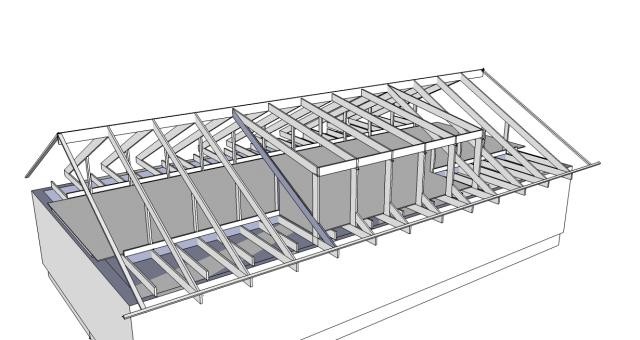

It is certainly possible to alternate the trusses with the help of a beam. The problem is how you are going to transfer the forces that arise to the foundation in a proper way. Contact a structural engineer and consult on how you should do it properly.
What I know is that the house is prepared for an upper floor and the space inside the support legs is already covered with 22mm floor particle boards. I hope this indicates that the ground floor/foundation (slab on ground) should withstand the forces you mention. I made a calculation on the beams with moelvens pgm and I should manage with 45*225 and received a downward force of 0.6kN. My biggest question is whether it is possible to alternate so many rafters. Perhaps a laminated timber beam along the ridge will be needed.
Of course, a constructor will have to calculate this finally, but it is interesting to see if it is at all feasible for a not too high cost in relation to what we gain. Otherwise, it will have to be interior decoration without raising the roof height. Possibly some smaller dormers. Another consideration that has come up is how it works with roof tiles on this low roof pitch? Is it possible? Will likely need a proper roof underneath, plank + felt. As the roof stands today, there are roof tiles and boards.
Of course, a constructor will have to calculate this finally, but it is interesting to see if it is at all feasible for a not too high cost in relation to what we gain. Otherwise, it will have to be interior decoration without raising the roof height. Possibly some smaller dormers. Another consideration that has come up is how it works with roof tiles on this low roof pitch? Is it possible? Will likely need a proper roof underneath, plank + felt. As the roof stands today, there are roof tiles and boards.
I'm working on a similar project where I'm going to remove 2 roof trusses, thus 3.6 m.
In your case, it looks like you need to remove 4 roof trusses, totaling 6 m, right?
I will be placing a glulam beam at the bottom which the new roof trusses will rest on. The loads from these are then transferred down to the foundation through a column at each end.
However, it's not only the side where you want to raise that is affected, but surely also the other side. My engineer has instructed me that I need to install kertobalkar on the opposite side.
In your case, it looks like you need to remove 4 roof trusses, totaling 6 m, right?
I will be placing a glulam beam at the bottom which the new roof trusses will rest on. The loads from these are then transferred down to the foundation through a column at each end.
However, it's not only the side where you want to raise that is affected, but surely also the other side. My engineer has instructed me that I need to install kertobalkar on the opposite side.

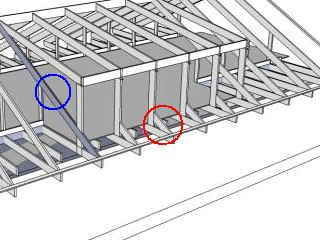
If you reinforce the trusses around the dormer, the blue marked one, to almost 3 times the strength (e.g. three trusses next to each other (=worse insulation)), you can then place a strong glued laminated timber in the ridge and no longer need to take large forces between the upper and lower frames.
But check with a structural engineer, I might be completely off base as well.
I might be making it more complicated than it is ... :blushing:
But check with a structural engineer, I might be completely off base as well.
I might be making it more complicated than it is ... :blushing:
The problem, if you intend to transfer the forces to the foundation using pillars instead of letting the truss handle it—which, as already pointed out, probably can't do without reinforcement—is that the foundation must withstand the point load caused by the pillar, otherwise it risks cracking there.
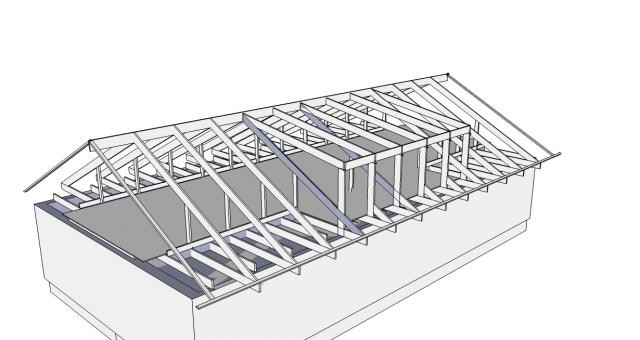
It is probably a better solution to keep a truss in the middle. The force from the bypassing is then distributed to more trusses if you do it that way, and then maybe the remaining trusses can handle the load without reinforcement, but I'm not entirely sure about that. However, you shouldn't need to reinforce them as much later on in your first example, at least.
Click here to reply