Yes, I have read everything. And a controlled collapse IS one of the solutions. I've also seen everything from the comedic side, as long as no one is in the storage if it collapses.
My father-in-law has worked hard to build it while I was doing other things, and my wife wants the storage. I said I'm not positive about this if I don't know how it's supposed to be built, so it's both a shame and a lesson.
If nothing else is done, then yes, I will load test after new snow by hanging on the ceiling. But reinforcing with pillars is probably better so my wife can be happy:|.
But do as I wrote in #2. Reinforce the weak/notched parts with metal/iron on the underside. It will be stronger than before the notching. Easiest with long nail plates. Done in 15 minutes.
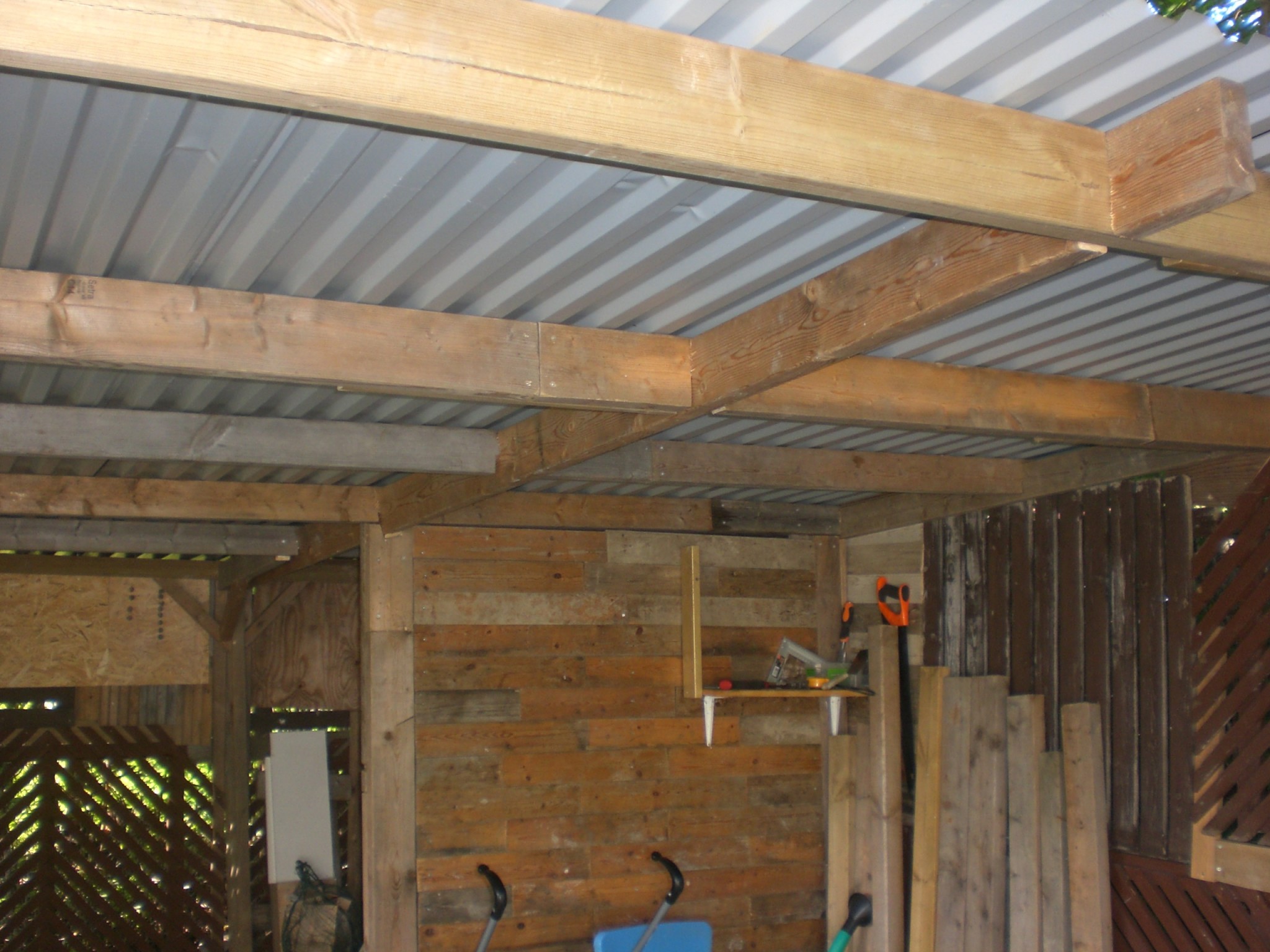
Ok thank you for being persistent, I initially thought it wouldn't be so strong, but the steel is stronger, just need to have sufficiently long ones with many screws. However, some notches are upwards, some are downwards.
One beam is also spliced with a 22mm plank, I'll check again if a total solution can work. There are several errors, but if it can hold for a few years then :|.
I like your engineering approach at the beginning of the thread! I would think it is difficult to salvage this in a neat way. Also, socially complicated to fix without it seeming like you think your father-in-law has no clue
I don't know how it looks apart from your sketches, but I assume the foundation, etc., is also a bit questionable. So doing something that loads the walls more, I wonder if it's advisable...
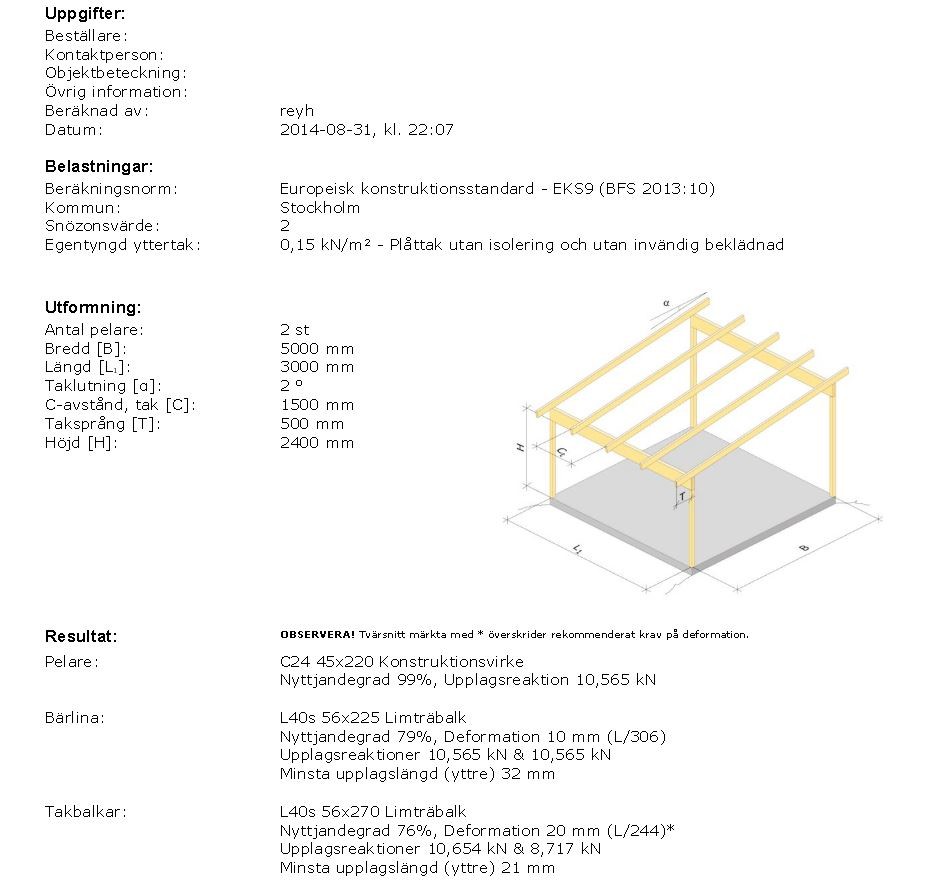
What happens if in the middle you insert maybe 2 standing 45x195s or a laminated beam 56x220 or similar (you can calculate this on byggbeskrivningar.se, I think), and at the ends, you drill down pillars using something like an auger and place posts, then you have a construction that should hold at least in the middle. If the span becomes too large for the long beam (about 5m, I assume, since you mentioned 3m and it is 15m2 in total), you can also drill down a pillar with a post in the middle.
Then you can also say that you just continued their idea with a supporting beam there. All this you should manage in a weekend.
Alternatively, you remove the roof, insert something like a standing 45x170 or 195 instead of the existing ones (if the walls seem okay).
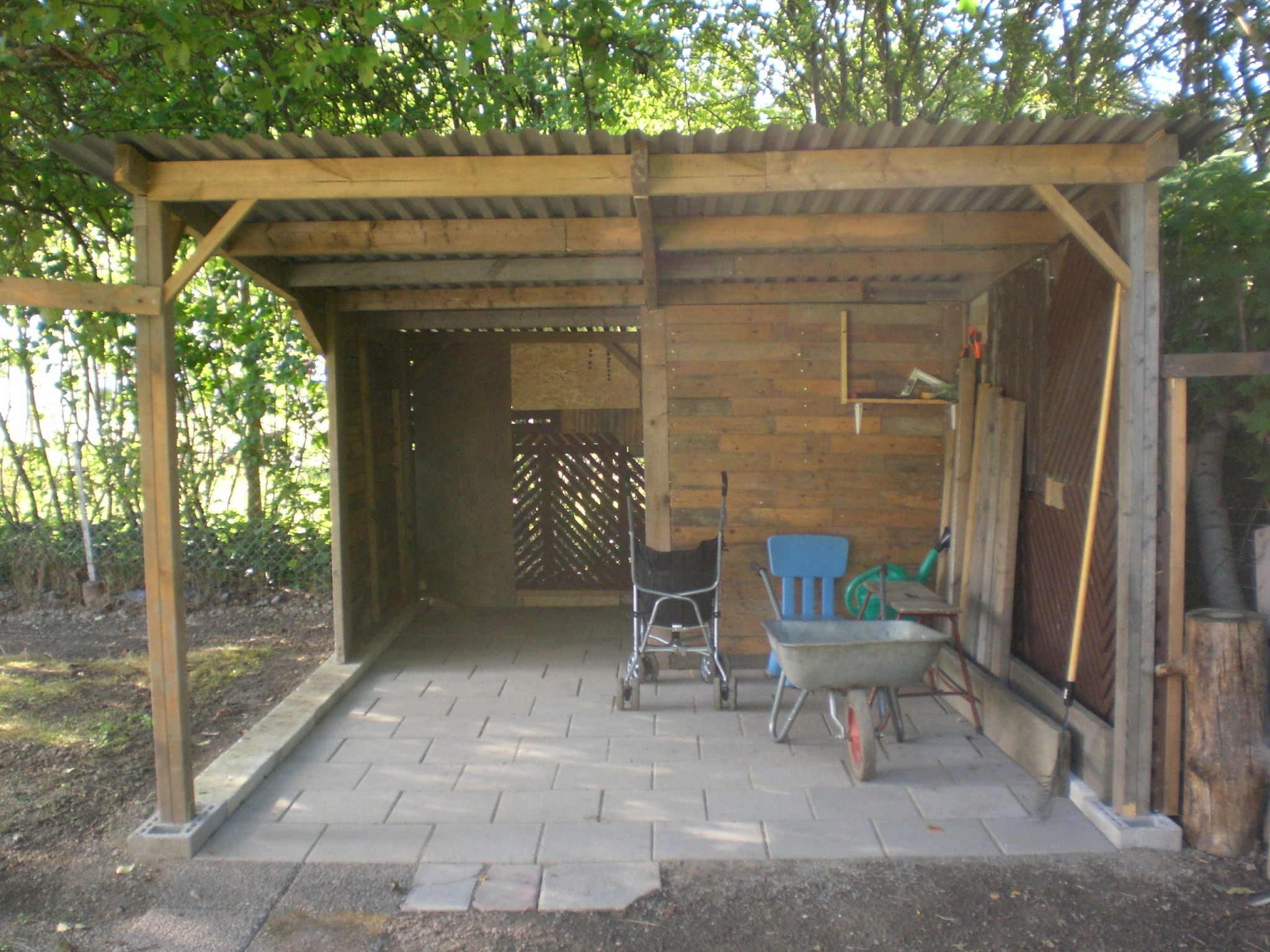
It is built from scrap material, which is partially okay. +tiles+ sheet metal roof+screws = 4000:-
This is how it looks anyway. One end of the center-long-rule has ground support, but not on the front side. Reinforcing with iron under the beams doesn't work without partially tearing down first. Glulam beam requires ground support.
Yes, it's very much a social problem, for example, enclosing and putting up warning signs. Of course, the in-laws can't read Swedish, I can say it reads "WELCOME".
This was ONE project among several. It has also involved repainting the doors/windows, including locks and fittings, so you can see around the windows that they have been painted.
The in-laws are going back to China in October, so...
The only thing I can think of is pillars under the beams (perhaps also under the side beams). I've mentioned this to my wife, the ball is in her court.
[image]
[image]
This is how it looks anyway. One end of the middle-long-rule has ground support, but not on the front side.
Reinforcing with iron under the joists doesn't work without partially tearing down first.
Glued laminated beams require ground support.
PERFORATED STRIP 25X2.0 or similar at the bottom of the two outermost joists seems to work without doing anything but it's still like putting lipstick on a pig. It's still a pig. Possibly it delays the disaster that will occur with one night's snowfall if you're unlucky. Given the construction, it seems quite predictable how the roof will collapse though.
Yep, 4 of them + acquaintances. Your suggestion to let it collapse is better than doing nothing, for safety. The worst is a building that just stands and stands, but could collapse at any moment. One extra vibration and you'll probably be stone-dead under 1 ton of metal roofing. And I'm not sure it will collapse this winter as it's on the edge with a normal winter, and foliage catches a large part of the snow. The 50mm-rule is the most sawn-off, the others are up to 60mm.
myrstack said:
HOLE STRAP 25X2.0 or similar on the underside of the two outermost beams seems to work without doing anything but it's just like putting lipstick on a pig. It's still a pig. Possibly it delays the disaster that occurs with one night's snowfall if you're unlucky. Given the construction, it seems quite predictable how the roof will collapse though
A hole strap is not easily used on the outermost beam; the hole direction is upwards.
Barnrikehuset said:
...
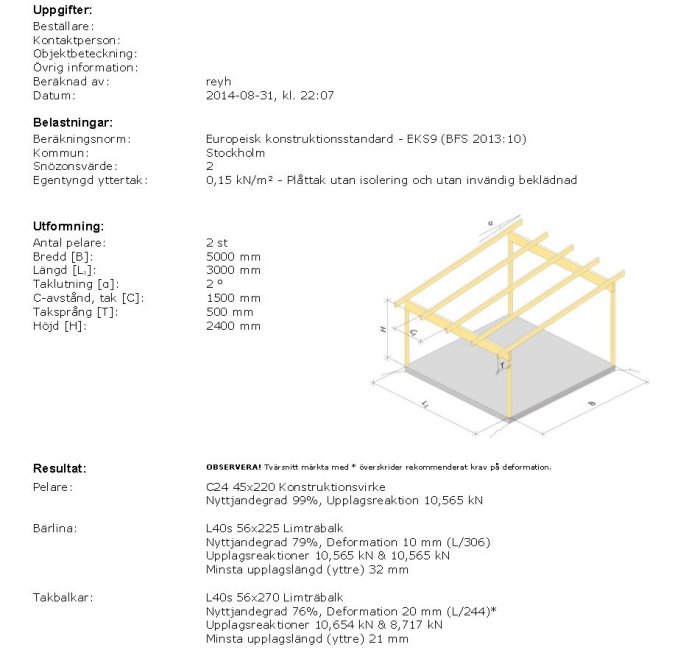
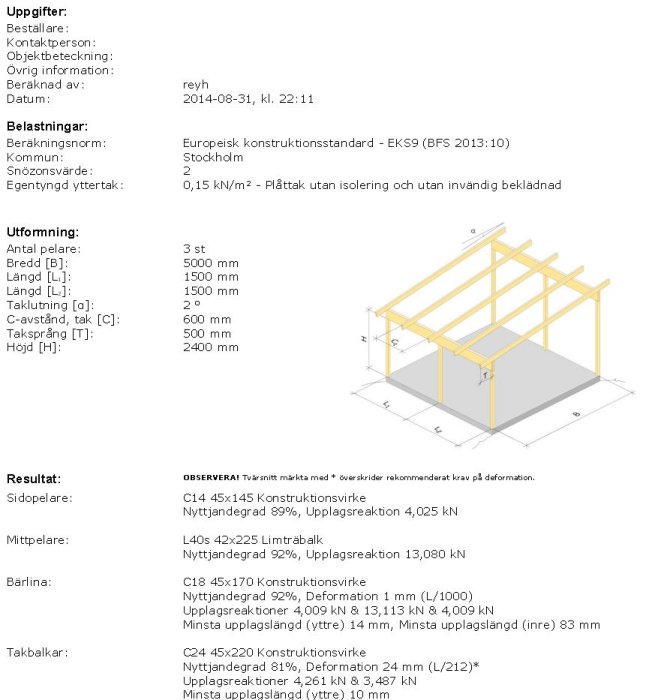
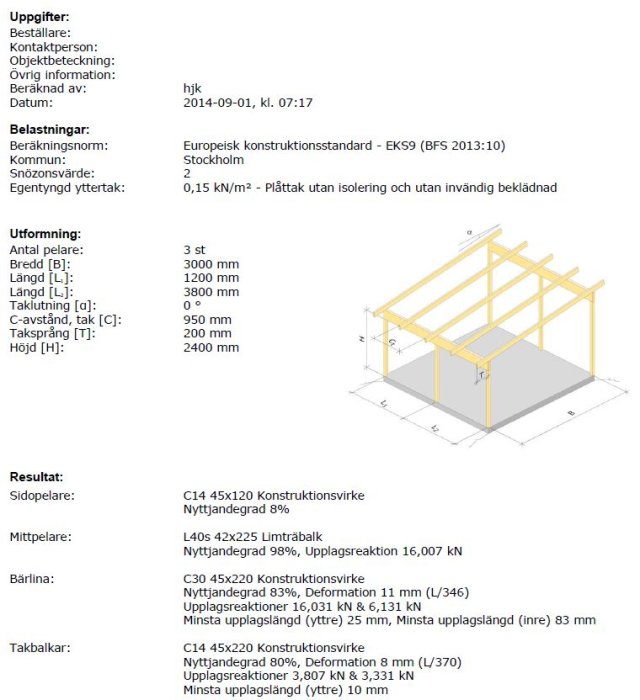
Your example is 5000mm and cc=600 which with 220 beams gives 10 N/mm2. My roof is 3000mm and cc=950mm which would have been 170 beams. Now, if I have say 55 beams, it's 95 N/mm2.
If it had been the original 55mm beams, it would have been alarmingly unstable. Now that they're cut out to 120 beams, my wife thinks it feels much more stable, (though it doesn't hold better ).
It seems they have chosen to place the notches on the right side at each point. So it's not as bad as it might seem.
If it collapses, it's the foremost beam that gives way first. As long as it holds, the roof won't cave in.
An alternative to reinforcement is to cut off the protrusions on the front and screw on a whole beam along the entire front edge of the existing one.
But the shed is about 5m deep? and I can't really see but does it have pillars in all four corners and two more about 2/3 in? There should also be a problem with the load-bearing beam across the roof joists, if theI've set the roof pitch to 0° so don't think about it sloping the wrong way.
Yes, it's probably due to what I call length being width in your calculation.
Now I understand your calculation.
With cc 60, 5m 220 rule, it results in an overload of 10N/mm^2 with standard quality. Therefore, another quality C24 on 220 rule is chosen.
In your second example with cc 95, 3m 220 rule quality C14, the load is 6N/mm^2.
CC 60 would be preferred, and then 170 rules would be sufficient for 6.2N/mm^2.
And yes, the side posts are not centered, but about 1/3. The beams are also spliced and notched, but not in the middle between the posts.
Click here to reply
Vi vill skicka notiser för ämnen du bevakar och händelser som berör dig.