It is probably difficult to quantify in numbers how the strength changes. However, I think we can agree that 2-3 screws are not sufficient. When there is a load on the roof, the upper legs want to spread apart, and the lower leg holds the construction together. A good alternative to nails/press plates is to nail (and possibly glue) plywood pieces in place. These pieces are made larger than the corresponding nail plate and therefore distribute the forces over a larger area.
If you have a load-bearing ridge, as long as it's secured properly there, it doesn't need to be secured at the bottom, well, of course, it should be secured But what you've drawn is not a truss as it has a beam supporting the ridge.
The construction depends on many factors, so is this an actual case or just a question? If the truss in the picture has a span of 1 meter, it should probably be fine, but if it has a span of 10 meters, that's a different matter.
Please elaborate on the question to make it clearer.
If you have a load-bearing ridge, as long as it is secured properly there, it doesn't need to be secured at the bottom—well, of course, it should be secured But what you've drawn is not a truss as it has a ridge that supports the top.
The construction depends on many things, so is this an actual case or just a question? If the truss in the picture has a span of 1 meter, it might work quite well, but if it has a span of 10 meters, it's another question.
Please elaborate on the question to make it clearer.
The question is generally about screws vs. nail plates, but I understand that it's not possible to give an exact answer since conditions can vary greatly (wood quality, angle, how close to the edge you screw, screw quality, material and size, etc. etc.).
I just thought of it when I saw a structure built with the construction on the right side in the picture in the first post, i.e., the upper arms were screwed into the lower arms with wood screws. The usual method is to use nail plates, which look more robust, but I got a bit curious if the wood screws might hold just as well, it's just that you don't see them from the outside in the same way as a nail plate.
I might have used the word "truss" a bit carelessly, but I don't know what else you'd call the structure that's in the picture?
The question is really about screws vs. nail plates in general, but I understand that it's impossible to give an exact answer since the conditions can vary a lot (the quality of the wood, angle, how close to the edge the screw is, the screw's quality, material, and size, etc. etc.).
I just thought about it when I saw a construction that had the structure on the right in the image in the first post, i.e., the upper arms were screwed into the lower arms with wood screws. Usually, nail plates are used, which look sturdier, but I became a bit curious if wood screws might hold just as well, it's just that you don't see them from the outside in the same way as a nail plate.
Maybe I used the word "truss" a bit carelessly, but I don't know what else to call the structure in the picture?
Generally, and basically every day of the week, nail plates are not just preferable but a requirement.
Do you mean spikplåt (factory mounted) or skarvbleck (attached on-site with nails or screws)? The former is significantly stronger. Construction screws might be sufficient, but generally, they're likely weaker, especially since they only work in certain directions. The skarvbleck need to be attached considering the forces present. A typical hanbjälke is primarily subjected to tensile forces, which means the plates should be positioned along the length of the beam. In the current example with the nockbalk, the roof beams should be anchored against uplift forces, which are potentially the most dangerous.

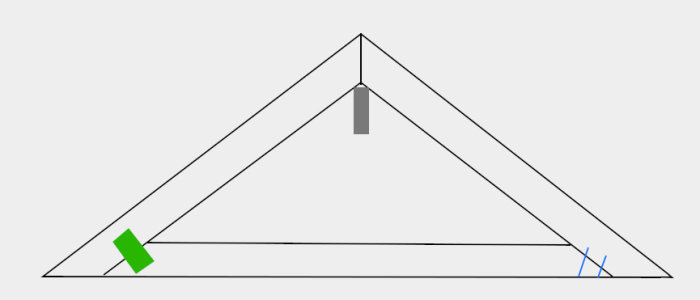

 But what you've drawn is not a truss as it has a beam supporting the ridge.
Workingclasshero said:
If you have a load-bearing ridge, as long as it is secured properly there, it doesn't need to be secured at the bottom—well, of course, it should be secured