On one wall, I have two 220x45 studs standing and attached to the wall, with the wide side against the wall.
I want to build a dip stand that can be folded or easily removed.
My current idea is to simply drill two parallel holes in the studs, into which I'll insert two 50 cm dowels (35 or 45 mm). The dowels could easily be removed if I want to save space.
The question is whether dowels, and the simple 45 mm deep attachment/hole in the studs, can hold my 95kg. I imagine that my grip and thereby the center of gravity on the dowel will be about 50 cm from the attachment in the studs.
Should I rather use a steel pipe?
Should the attachment in the studs be reinforced with some kind of bracket?
Attaching the dowel to just 45 mm of wood feels weak. Is it possible to saw a smaller piece of the beam that you screw on as a second layer outside the long 220x45 beam? It could be 220x220x45 but can also be as small as 110x110x45. You would then get a hole that is 90 mm deep and the moment on the dowel you are going to insert is radically reduced (to half, actually). I don't think a plate of 45 mm at the dowel's attachment point will hinder your exercises.
Attaching the dowel to just 45 mm wood feels weak. Is it possible to saw a smaller piece of the beam that you screw on as a second layer outside the long 220x45 beam? It could be 220x220x45, but can also be as small as 110x110x45. This way you get a 90 mm deep hole, and the moment on the pin you are going to push in is radically reduced (actually to half). I don't think a 45 mm plate at the attachment point of the pin will hinder your exercises.
If you weigh 95 kg and hang statically 50 cm out on the dowels, the maximum bending moment on a dowel is about 950 x 500 / 2 = 238000 Nmm. The bending resistance for a circular cross-section is pi x d^3 / 16. With a diameter of 35 mm, the bending resistance is 8418 mm^3. The ratio between these quantities gives a maximum normal stress of 28 MPa. With a diameter of 45 mm, the stress decreases to 13 MPa.
I'm not very familiar with the strength values for wood, but after a bit of googling, I'd say that with 45 mm it would hold with spruce or pine of good quality; if you want 35 mm, you might need to choose, for example, oak.
I agree with previous posts that 45 mm insertion into the beam is weak, especially if you don't achieve a tight fit in the hole. I disagree that the moment is nearly halved; it decreases by the equivalent reduction in the lever arm (by a factor of 45/50).
I haven't accounted for any additional load due to dynamics since dips are static; otherwise, it's cheating
If you weigh 95 kg and hang statically 50 cm out on the dowels, the largest bending moment in a dowel is approximately 950 x 500 / 2 = 238000 Nmm. The bending resistance for a circular cross-section is pi x d^3 / 16. With a diameter of 35 mm, the bending resistance is 8418 mm^3. The ratio between these quantities gives the largest normal stress 28 MPa. With a diameter of 45 MPa, the stress decreases to 13 MPa.
I'm not very familiar with the strength values for wood, but I googled a bit and would say that with 45 mm it holds with spruce or pine of good quality. If you want 35 mm, you may need to choose, for example, oak.
I agree with earlier posts that 45 mm insertion in the joist is weak, especially if you don't get a tight fit in the hole. I don't agree that the moment is nearly halved; it decreases corresponding to the reduction of the lever arm (by a factor of 45/50).
I haven't considered any load increase due to dynamics since dips are static, otherwise, that's cheating
Thanks a lot, love the calculations. Really fun to learn a bit.
It feels like the right thing is to double the thickness of the mount and aim for an oak dowel ... or maybe a steel pipe?
Test, but for the feeling of security, I would have probably chosen the larger dimension for the dowel and made the mounting as recommended above.
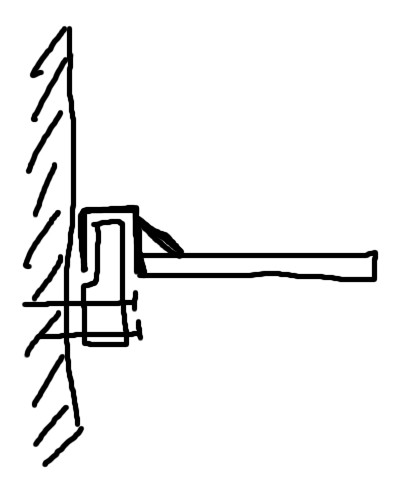
Otherwise, if you can weld a little, you could have something that hooks into a beam with notched grooves. Fantastic sketch in paint attached!
Then you can just lift out the pins. You would ideally want as little play as possible in the construction, so presumably the "stick pin in hole" model is best.
Try it, but for the feeling of security, I would have taken the larger dimension on the dowel as well as made the attachment as recommended above.
Otherwise, if you can weld a little, you could have something you hook onto a beam that has notched grooves. Fantastic sketch in paint attached!
Then you can just lift out the pins. You want as little play as possible in the construction, so probably the "stick pin in hole" model is best.
[image]
I would have loved to be able to weld Then I would have tried your suggestion!! Thanks!
Click here to reply
Vi vill skicka notiser för ämnen du bevakar och händelser som berör dig.


Bernieberg said:
If you weigh 95 kg and hang statically 50 cm out on the dowels, the largest bending moment in a dowel is approximately 950 x 500 / 2 = 238000 Nmm. The bending resistance for a circular cross-section is pi x d^3 / 16. With a diameter of 35 mm, the bending resistance is 8418 mm^3. The ratio between these quantities gives the largest normal stress 28 MPa. With a diameter of 45 MPa, the stress decreases to 13 MPa.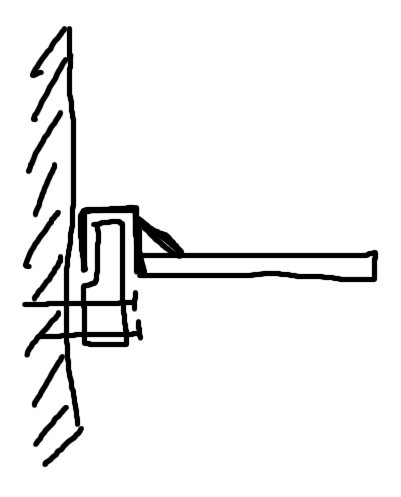
tensiden said:
Try it, but for the feeling of security, I would have taken the larger dimension on the dowel as well as made the attachment as recommended above.