
5,363 views ·
24 replies
5k views
24 replies
Step on electric underfloor heating help!
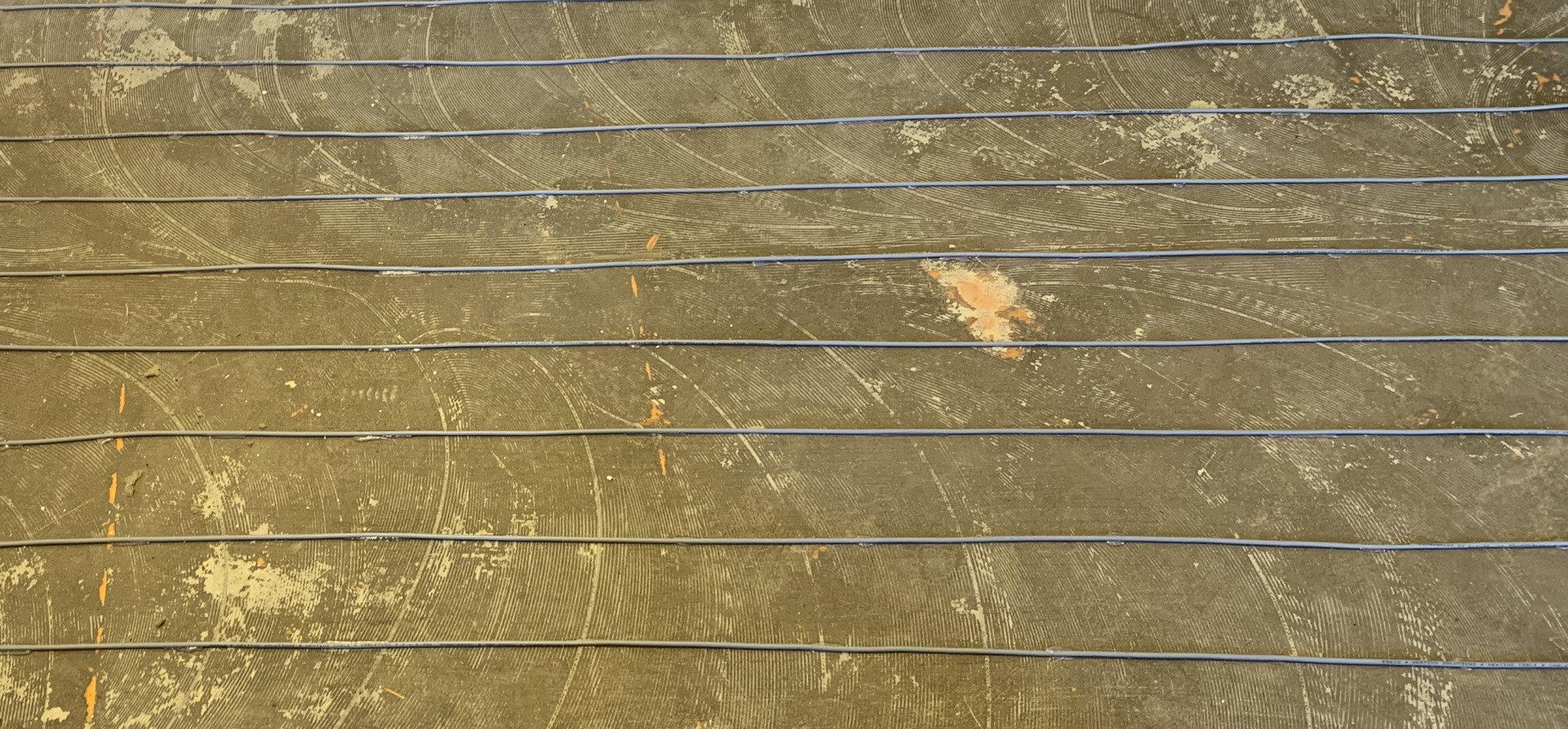


We met. 55 Ohm. Just as it says in the manual.

Have probably laid out 300+ of these loops I would guess, none have broken yet from being stepped on which happens sometimes at the end of the installation, also has remained intact every time after the screed workers have trampled around.
That is, as mentioned, the cable's resistance. It is unlikely to be damaged by stepping on it. What could hypothetically happen is that the insulation on the cable gets damaged. Such a fault cannot be detected with a regular multimeter (which I assume you/your partner used to measure 55 ohms).A Amaryllis92 said:
In different contexts where there is insulation damage, it is common for the conductors not to be completely together. There is no metal-to-metal contact. Perhaps a crack in the insulation.
If you then measure between the conductors in the cable and the protective earth (the 3rd conductor in the cable) with a regular multimeter, it will show an open circuit, which is what you want to see. There is no galvanic contact between the wires, but they may be only a tenth of a millimeter apart. The multimeter puts out a voltage of perhaps 5V when measuring resistance (ohms).
But in reality, there will be 230V on the conductor that is a tenth of a millimeter from the ground. Then the current will jump over, creating a spark/arc. It is often said that electricity can jump 1mm per 1000V (applies in a vacuum).
Therefore, an insulation tester is used for this type of inspection. This instrument performs the same measurement as the multimeter but uses a test voltage of approx. 500V (selectable between 250 - 1000V). With the high test voltage, the current can find its way through cracks and other insulation faults. If 1000V cannot penetrate the insulation, then 230V won't succeed either. It should perhaps be added that despite the high test voltage, the instrument is safe, it cannot output any meaningful current.
Click here to reply