
2,096 views ·
9 replies
2k views
9 replies
Steel beam in old log house - Deflection and sizing.
Hello,
I have a significant concern that keeps me awake at night and I would like to hear your thoughts on it.
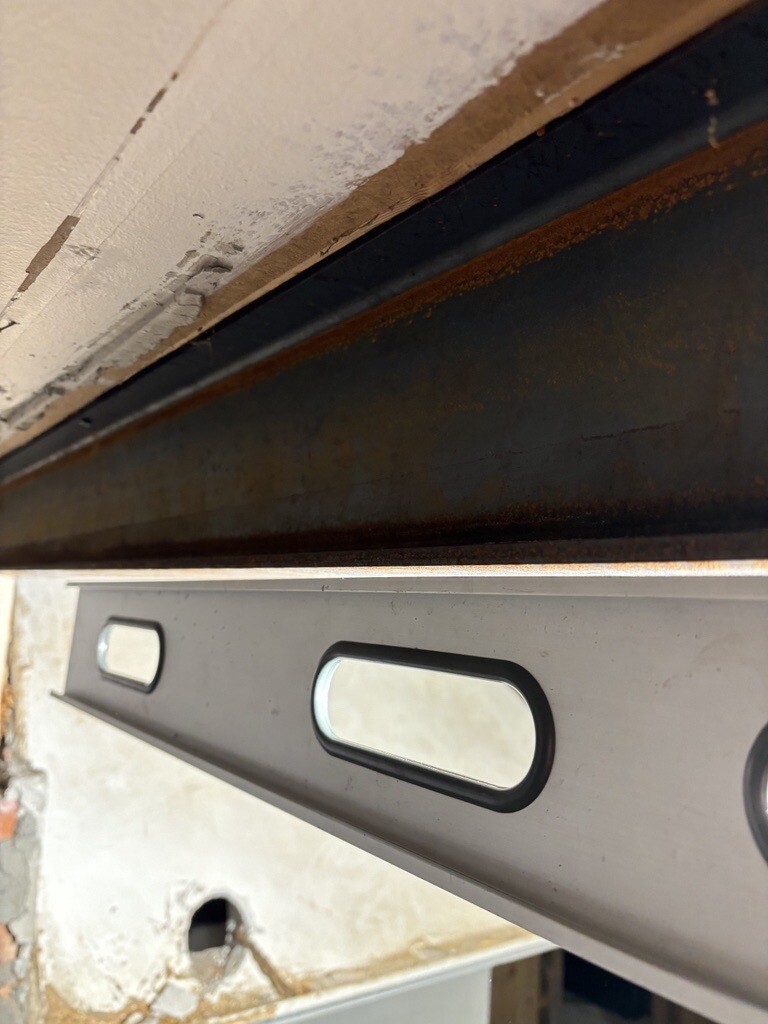
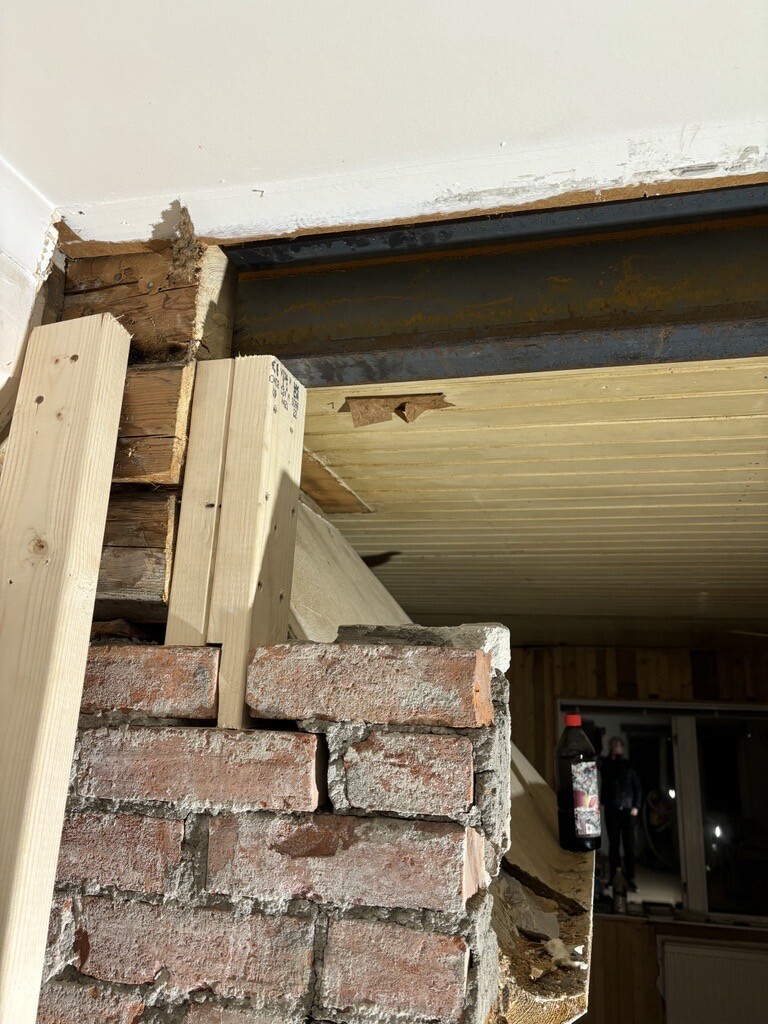
I've had help from craftsmen who took down a load-bearing log wall in our "archipelago house." Instead of the log wall, the craftsmen have now installed a steel beam of type IPE140. The span is 3830mm. See pictures of the beam and its support below.
When I came out to the house after the work was done, I immediately noticed that the beam was not completely straight. I used a long level and indeed saw a few millimeters of gap (about 5mm) at each end of the 180cm long level.
According to the craftsmen, the bending may have come from the beam being pressed up with great force. But it should be noted that we plan to renovate the bathrooms on one half of the floor above and install tiles on the floor, waterborne underfloor heating, new furnishings, and possibly a bathtub. So, it is important that the floor is rigid.
After consulting both craftsmen and suppliers, I have received several opinions suggesting that the beam felt unnecessarily thin and questioned why a heavier beam was not chosen. I also heard that Length/360 or Length/300 are limit values used to calculate the boundary for acceptable bending. Which is roughly where we stand today, without the house being filled with furniture, a new bathroom, people, etc.
For those of you with experience in these types of interventions, how would you have done it? Isn't it strange that the craftsmen didn't choose a stronger beam with the same height? If I understand correctly, an HEB140 is almost three times as strong and an HEM120 (140 high) almost four times as strong as the IPE currently chosen (Bending resistance = 77.3 vs. 216 vs. 288)?
Grateful for both help and supportive cheers!
I have a significant concern that keeps me awake at night and I would like to hear your thoughts on it.
I've had help from craftsmen who took down a load-bearing log wall in our "archipelago house." Instead of the log wall, the craftsmen have now installed a steel beam of type IPE140. The span is 3830mm. See pictures of the beam and its support below.
When I came out to the house after the work was done, I immediately noticed that the beam was not completely straight. I used a long level and indeed saw a few millimeters of gap (about 5mm) at each end of the 180cm long level.
According to the craftsmen, the bending may have come from the beam being pressed up with great force. But it should be noted that we plan to renovate the bathrooms on one half of the floor above and install tiles on the floor, waterborne underfloor heating, new furnishings, and possibly a bathtub. So, it is important that the floor is rigid.
After consulting both craftsmen and suppliers, I have received several opinions suggesting that the beam felt unnecessarily thin and questioned why a heavier beam was not chosen. I also heard that Length/360 or Length/300 are limit values used to calculate the boundary for acceptable bending. Which is roughly where we stand today, without the house being filled with furniture, a new bathroom, people, etc.
For those of you with experience in these types of interventions, how would you have done it? Isn't it strange that the craftsmen didn't choose a stronger beam with the same height? If I understand correctly, an HEB140 is almost three times as strong and an HEM120 (140 high) almost four times as strong as the IPE currently chosen (Bending resistance = 77.3 vs. 216 vs. 288)?
Grateful for both help and supportive cheers!
Last edited by a moderator:

Have no opinion on the beam's sizing, but the setup over your brick wall doesn't look suitable to me. The two studs might have enough surface area, even though I think they are borderline, but having them distribute the force downward on essentially the end of a brick doesn't feel optimal. Perhaps they are not finished there, and now it's too late to leave the bottom log intact for a few more decimeters.

For a beam to bear load, deformation is needed. The deformation comes partly from its own weight, which is permanent, and from the load of people, which is variable. It's possible to calculate the deformation for each respective load, and for the deformation of the permanent load, wedges can be used so that the upper floor remains horizontal. But the beam will bend.
Thank you for all the engagement and good opinions. It seems that most of you mainly have comments on the steel beam's placement. I have seen this as a minor issue since the brick is part of the chimney that goes all the way down to the basement and because the joist on the other side is so well anchored to the outer wall. But of course, I will make sure this is improved.
Is there anyone here on the forum who has suggestions on how this can be improved, so that we can feel really secure? Contacts or sources on where one can get answers on how it should be done would also be appreciated!
/Marcus
Is there anyone here on the forum who has suggestions on how this can be improved, so that we can feel really secure? Contacts or sources on where one can get answers on how it should be done would also be appreciated!
/Marcus

Thank you hemlagad! Do you have any thoughts or tips on how it should be done? Any input for upcoming discussions on how this should be fixed would be golden.H heimlaga said:
The best option is to build a new log wall, but it may be possible to install a glulam beam recessed into the outer wall and supported by a post standing freely beside the wall. In that case, the outer wall must be reinforced with followers, meaning 6x6 or 5x5 inch battens standing one on the inside and one on the outside, held together with heavy bolts that go straight through and run in elongated holes in the followers so the logs can settle without catching.
Click here to reply
Similar threads
-
Looking for advice on framing up an old sloping roof, timber house
Building Materials and Construction Technology -
Replacement of sill logs on an old timber house before new exterior paneling
Building Materials and Construction Technology -
Windbreak in uninsulated old log house?
Building Materials and Construction Technology