
Hello, I have an old house where we will be renovating the upper floor. The room in question is 6×4 meters and the beams run in the long direction. There are 4 beams, 2 of which are on the edges, so there is a long distance between the beams. Problem number 2 is that the ceiling in the room below is raised between the beams, so height is lost there. My idea is to tear out the old floor, try to level the beams, and then lay a subfloor of tongue and groove planks 42×120 to distribute the pressure as best as possible, what do you think about this?
//Thord
//Thord
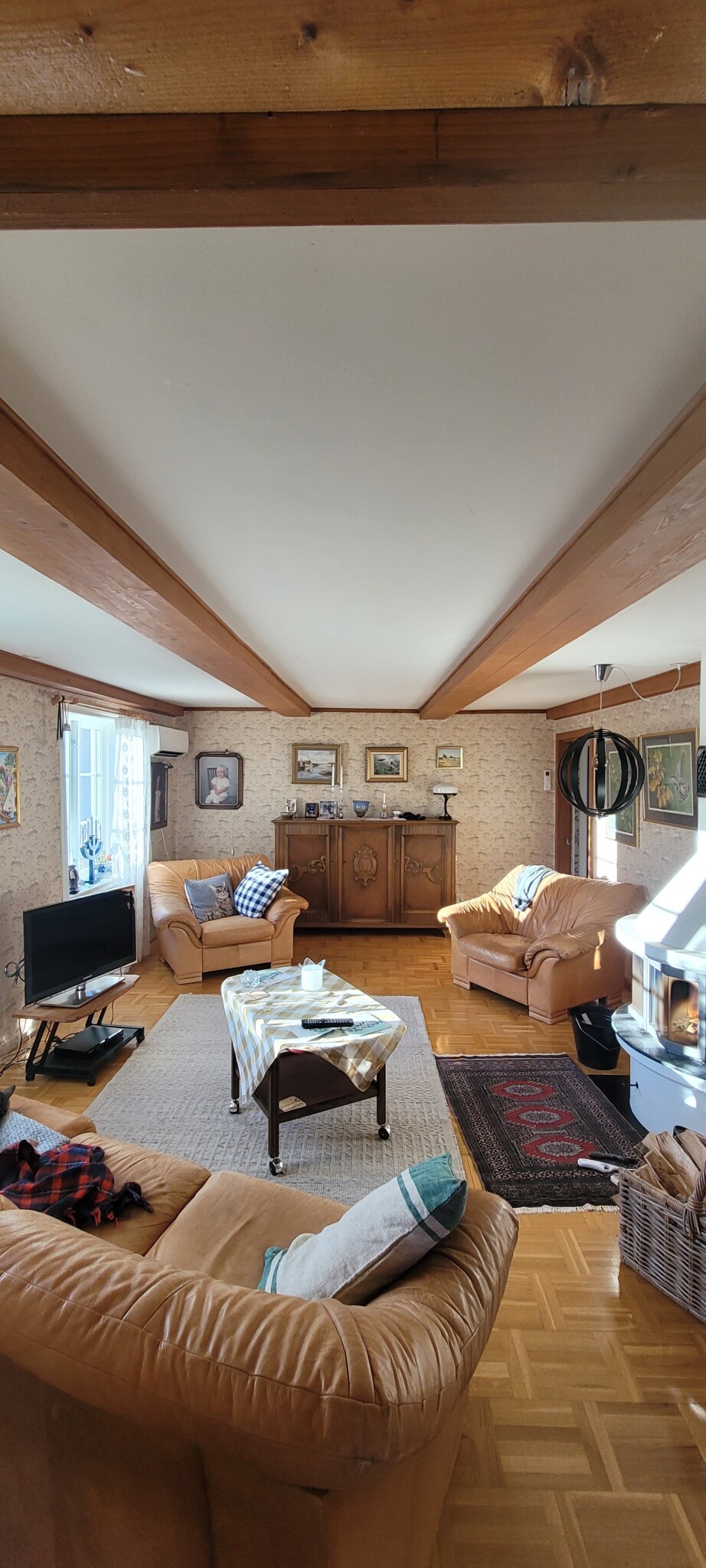
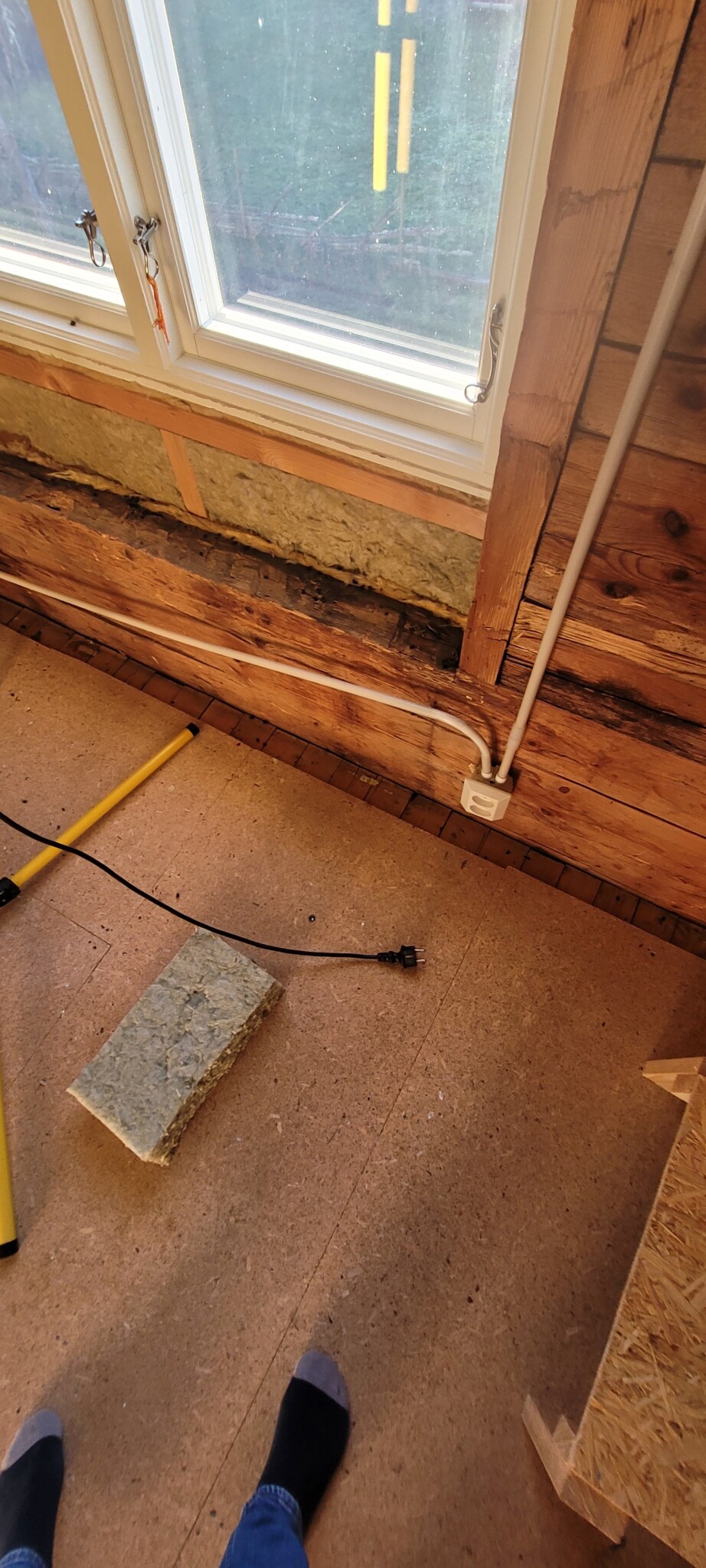
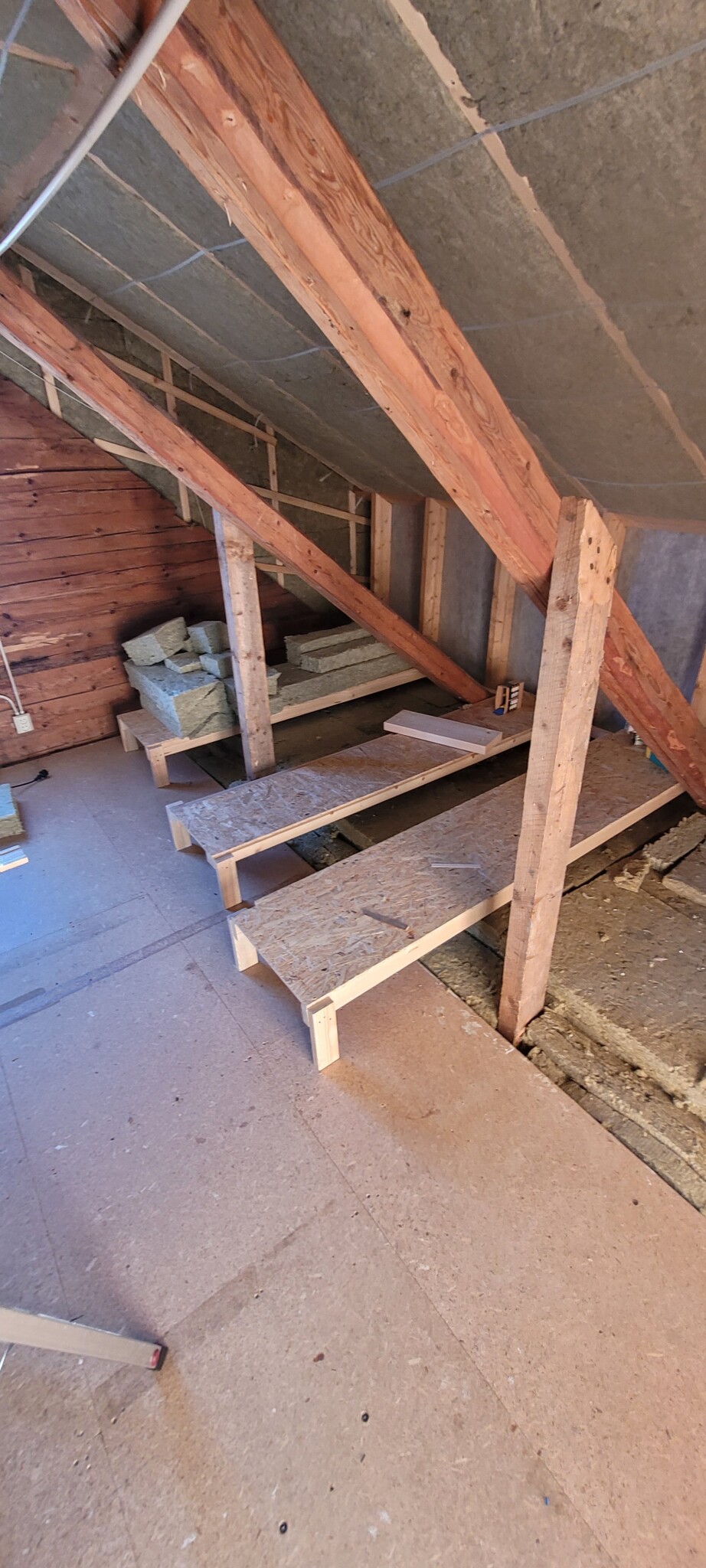

What is the problem you want to solve? I don't quite understand how it is structured. The floor beams we see in the ceiling of the lower floor run lengthwise in the house, right? In the picture at the gable on the upper floor, you can see a wooden floor under the chipboard, which is also lengthwise. It feels like something is missing in your description.


My problem is that the existing floor is too bouncy, I need to make it more stable without tearing up the ceiling on the lower floor. Therefore, my idea was to remove the old chipboard floor panels and the old wooden floor that seems to be under the panels, and lay a solid plank subfloor.A Avemo said:What is the problem you want to solve? I can't quite figure out how it is constructed. The floor joists we see in the ceiling of the lower floor run lengthwise in the house, don't they? In the picture at the gable on the upper floor, you can see a wooden floor under the chipboards that is also lengthwise. It feels like something is missing in your description.
Cross-brace the joists from above, screw/glue chipboard to the top side; if the distances between the existing floor joists are greater than 55 cm, add more floor joists. If the existing joists are weak or just slightly too spaced out, you can try screwing a board to the side of the joists.T Thord58 said:My issue is that the existing floor is too bouncy; I need to make it more stable without tearing up the ceiling on the floor below. Therefore, my idea was to remove the old chipboard flooring as well as the old wooden floor that seems to be underneath the boards and lay down a thick tongue-and-groove plank subfloor.
In what way is it bouncy? If it's the joists that are flexing, laying a heavier floor won't make a difference. In that case, the floor joists need to be reinforced. But you'll see that once you've torn up the floor.T Thord58 said:My problem is that the existing floor is too bouncy, I need to make it more stable without tearing up the ceiling on the floor below. Therefore, my thought was to remove the old chipboard floorboards and the old wooden flooring that seems to be under the boards, and lay a tongue-and-groove heavy plank subfloor.
Edit
It's most likely no joists but the floor probably just rests on the purlins of the roof truss.
Last edited:
I don't think that's the right solution. It looks like a space that was never intended to be furnished. It can be reinforced. But it's likely the joists rather than the floorboards that are flexing.T Thord58 said:My problem is that the existing floor is too bouncy, I need to make it more stable without tearing up the ceiling below. Therefore, my thought was to remove the old chipboard floor as well as the old wooden floor that seems to be under the boards, and lay down a sturdy tongue-and-groove plank subfloor.
Yes, that's true, but my idea was that with heavier tongue and groove planks, the pressure would be distributed over a larger area, which would make it more stable. But from a construction standpoint, I would add more beams and reinforce it that way, but I'm trying to find another solution.A Avemo said:
Then it would be easier to glue a layer of subfloor panels on top of the existing ones.T Thord58 said:
There might be several solutions. But I think you have to consider that it is the joists that need reinforcing, not the surface.T Thord58 said:

Just speculating a little:
Probably, the house wasn't designed for the attic to be living space.
The rafters look to be 5x5"? That is, not particularly thick. They are probably intended for a light roof - straw or shingles.
The beams are likely in the same dimension, 5x5" or maybe 5x6", with a span of 4 m. It might very well be that there are no corresponding beams between the trusses, but it's around 120 cm on center or so. There would be some flex in the floor, but nothing that should be a problem in terms of load-bearing capability.
The room is very long for an old (?) house, which indicates that partition walls have been removed. In our old house with a similar structure, i.e., 5x6" beams with varying 100 - 140 cm on center and a span of 5.5 m, there are 6x6-8" beams running lengthwise with the house between cross walls with a distance of 3 - 3.6 m. The trusses' beams are screwed together with these beams with large hand-forged wagon bolts. I think that if it was similar in the thread starter's house, that reinforcement disappeared when they probably removed a partition wall to make the room on the ground floor larger. That is, a room 4x6 m instead of 2 rooms approximately 4x3 m.
As others have written, the beams must be reinforced, which is most easily done with taller studs nailed to the sides of the existing ones. However, this means the floor will come up a bit higher, which might not work practically up there?
Probably, the house wasn't designed for the attic to be living space.
The rafters look to be 5x5"? That is, not particularly thick. They are probably intended for a light roof - straw or shingles.
The beams are likely in the same dimension, 5x5" or maybe 5x6", with a span of 4 m. It might very well be that there are no corresponding beams between the trusses, but it's around 120 cm on center or so. There would be some flex in the floor, but nothing that should be a problem in terms of load-bearing capability.
The room is very long for an old (?) house, which indicates that partition walls have been removed. In our old house with a similar structure, i.e., 5x6" beams with varying 100 - 140 cm on center and a span of 5.5 m, there are 6x6-8" beams running lengthwise with the house between cross walls with a distance of 3 - 3.6 m. The trusses' beams are screwed together with these beams with large hand-forged wagon bolts. I think that if it was similar in the thread starter's house, that reinforcement disappeared when they probably removed a partition wall to make the room on the ground floor larger. That is, a room 4x6 m instead of 2 rooms approximately 4x3 m.
As others have written, the beams must be reinforced, which is most easily done with taller studs nailed to the sides of the existing ones. However, this means the floor will come up a bit higher, which might not work practically up there?
Click here to reply