guessing that your 95x95 posts handle between 1.5 to 2 tons each at 3m length, and many posts seem to be shorter = can handle more load. Is it really the posts that are bending? Feels more like you have too weak beams or too long span on the beams. And if so, braces won't help much.
Probably the dimensioning of the beams is the issue. Often you don't need to calculate too accurately on the posts if you adjust the number of posts according to the span the beams can handle. Beams often become the weak point (if you use common dimensions of construction timber )
= Unusual to have bending due to too weak posts, more common due to undersized beams.
I don't have a sagging floor. But I can make the entire deck sway by pulling on the posts (the new ones already feel more stable) or rocking while standing on the deck.
Don't have a sagging floor. But I can make the whole deck sway by pulling on the posts (the new ones actually feel more stable already) or by rocking while standing on the deck.
But isn't that simply because you don't have any bracing or X-bracing between the tall posts?
I don't have a sagging floor. But I can make the whole deck sway by pulling the posts (the new ones actually feel more stable already) or rocking standing on the deck.
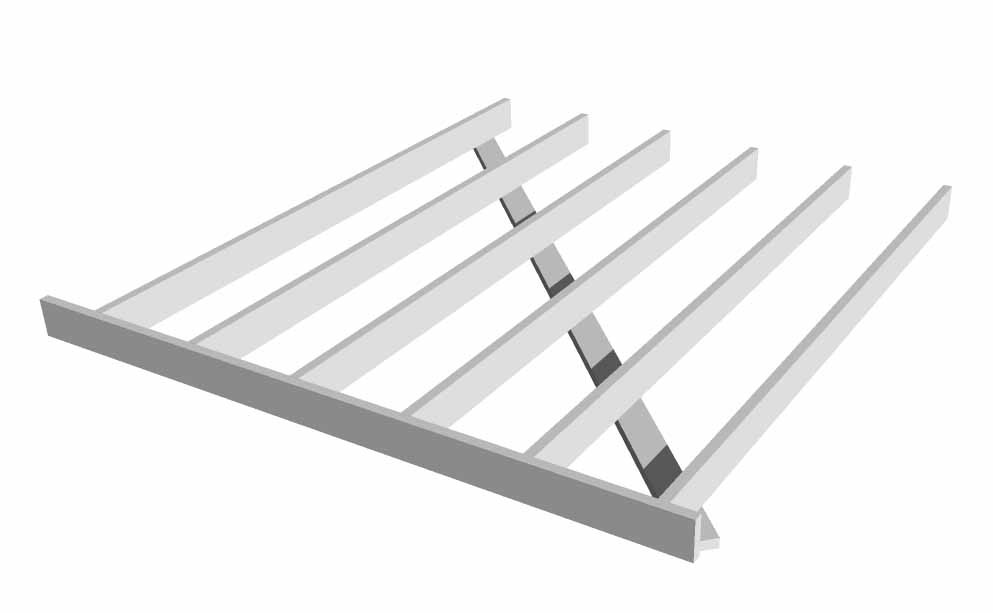
Does it sway sideways? Then it might help to screw in diagonal braces under the floor to lock the construction.
Depending on how your deck is built, you may encounter three different types of stability issues. 1) Post constructions without diagonals and boards are not stable, particularly against lateral movements. Diagonals in the plane of the deck solve this problem. 2) Deflection problems, i.e., the deck moves too much vertically when you walk on it. This is due to the beams having too weak dimensions relative to the span. The easiest solution is to reduce the span. It can also be because the decking is too weak relative to the c/c distance. A 28 mm decking with c/c 600 mm is sufficient. 3) Buckling tendencies in the longest posts, which can give a somewhat swaying feeling. This can be addressed with braces or something similar at half the height of the posts.
It doesn't really matter much where you attach them. It is usually easiest to attach them to the underside of the beams. From the facade to the outer edge at about a 45-degree angle. With your large deck, you will need several in a zig-zag pattern.
1) Post constructions without diagonals and boards are not stable, especially against sideways movements. Diagonals in the deck's plane solve this problem. 3) Bending tendencies in the longest posts, which can give a slightly swaying feeling. This is remedied with noggings or similar halfway up the post height.
1: are diagonals and boards like strävor but short at the top of the post?
2: no sagging floors. We have 28mm flooring on 195x45 beams.
3: unfortunately, I don't understand how the noggings should be screwed.
Now I have replaced all the posts and the outer support beam/rule.
Posts, from 2 joined together (possibly glued) 45x95 to 95x95 posts.
Outer support beam 45x195 with joints outside the plinths and lazily screwed together at the back with a board.
New beams with all joints on post and plinth. Screwed with 4 pcs 6.0x80 on the posts and 4 pcs 6.0x100 on each beam.
As well as beam shoes screwed with 16 anchor screws per shoe/rule.
It already feels significantly less wobbly, actually.
Remaining tasks, diagonal braces from post to outer support beam/rule.
A row of posts in the middle of the deck to increase load-bearing capacity.
Straps (boards) in a zig-zag pattern under the deck and beams.
Click here to reply
Vi vill skicka notiser för ämnen du bevakar och händelser som berör dig.


 )
)