
14,281 views ·
69 replies
14k views
69 replies
Spruce or pine?

From Svenskt Träskydd
20-year rot protection guarantee against decay!
Quality-certified NTR wood is unbeatable when it comes to protection against decay – consumers have a 20-year rot protection guarantee.How the guarantee works
The rot protection guarantee is valid for 20 years from the time you purchase the wood, and if misfortune strikes and you still suffer from rot damage, you can receive replacement wood up to a value of 100,000 SEK. For example, a deck should function as a deck for at least two decades. The guarantee covers wood protection classes NTR A and NTR AB and applies to consumers. The wood must have a physical NTR marking, but even if it has fallen off, the guarantee still applies. When you purchase the wood, the seller should inform you to save all purchase documents.I agree with that, but it's fences that you buy "ready-made" like at Jula, so maybe they have lower quality.A AndersS said:And the neighbor's and ours from the early '90s have nothing rotten, standing slats, and painted on all sides.
I've replaced the material in the docks when the surface starts to wear out after about 20 years, there is nothing rotten and it gets reused as ground material for wood stacking outside.
I apologize, but that fence with pressure-treated wood built in 2016 hardly rots, this sounds very strange.
I think it's according to the link.A AndersS said:From Svenskt Träskydd
20-Year Rot Protection Guarantee Against Rot!
Quality-certified NTR wood is hard to beat when it comes to protection against rot – consumers have a rot protection guarantee of 20 years.
How the Guarantee Works
The rot protection guarantee is valid for 20 years from the time you purchase the timber, and if you're unlucky enough to suffer from rot damage, you can receive replacement timber worth up to 100,000 kronor. A deck, for example, should function as a deck for at least two decades. The guarantee covers the wood protection classes NTR A and NTR AB and is valid for consumers. The timber should have a physical NTR marking, but even if it has fallen off, the guarantee still applies. When you buy the timber, the seller should inform you to save all purchase documents.
https://www.hornbach.se/p/staket-jabo-114-original-80x205cm-impregnerat/6640521/
It's not only bad but ugly too
 .
.
Well, this isn't something I've made up myself, but something that is generally described. If one is to point to an authoritative source, it would be the industry itself:O said:
https://traskydd.com/bestandigt-tra/rotskyddsgaranti/monterings-och-anvandarinstruktioner/

https://www.svenskttra.se/trafakta/allmant-om-tra/traskydd/

I myself have thought that it simply is because the impregnation has limited penetration into the wood and therefore mainly resides in the outer layer. But when I read more closely on the Swedish Wood Protection Association, they talk about it being due to heartwood being exposed, which doesn't quite add up for me. So I'll leave it unsaid why one should avoid machining.

Diversearbetare
· Göteborg
· 11 473 posts
It is only a general increased risk in question. Not a definitive fact. Naturally, the wood becomes more susceptible to impact if water and moisture cannot run off or evaporate. It's just a matter of thinking a bit before constructing something in wood for outdoor use. Water runs downwards. 🤓
The impregnation penetrates less effectively into heartwood, so when processing the wood, it can reduce resistance to rot. One way to counteract this is to let the wood dry, build a gate, and then paint it with an appropriate paint. The suggestion with linseed oil paint allows the wood to have a layer of linseed oil inside, which, apart from the impregnation's ability to prevent rot, also stops some water from penetrating. Then two layers of paint are applied, which not only add more linseed oil to the wood but also create a fairly tight film that provides even more protection against water. However, it does not create a completely tight film, so if water gets in, it can escape again.
During the annual cleaning of the gate, you can dampen a cloth with linseed oil and wipe over the gate, which extends the time before repainting and also "seals" any damage in the paint. Alternatively, you can repaint before it starts looking too bad.
The painting naturally also works on plain white timber, but if there are construction mistakes, it provides slightly less protection against rot. The major advantage of white timber is that it is more pleasant to work with and usually comes relatively dry.
During the annual cleaning of the gate, you can dampen a cloth with linseed oil and wipe over the gate, which extends the time before repainting and also "seals" any damage in the paint. Alternatively, you can repaint before it starts looking too bad.
The painting naturally also works on plain white timber, but if there are construction mistakes, it provides slightly less protection against rot. The major advantage of white timber is that it is more pleasant to work with and usually comes relatively dry.
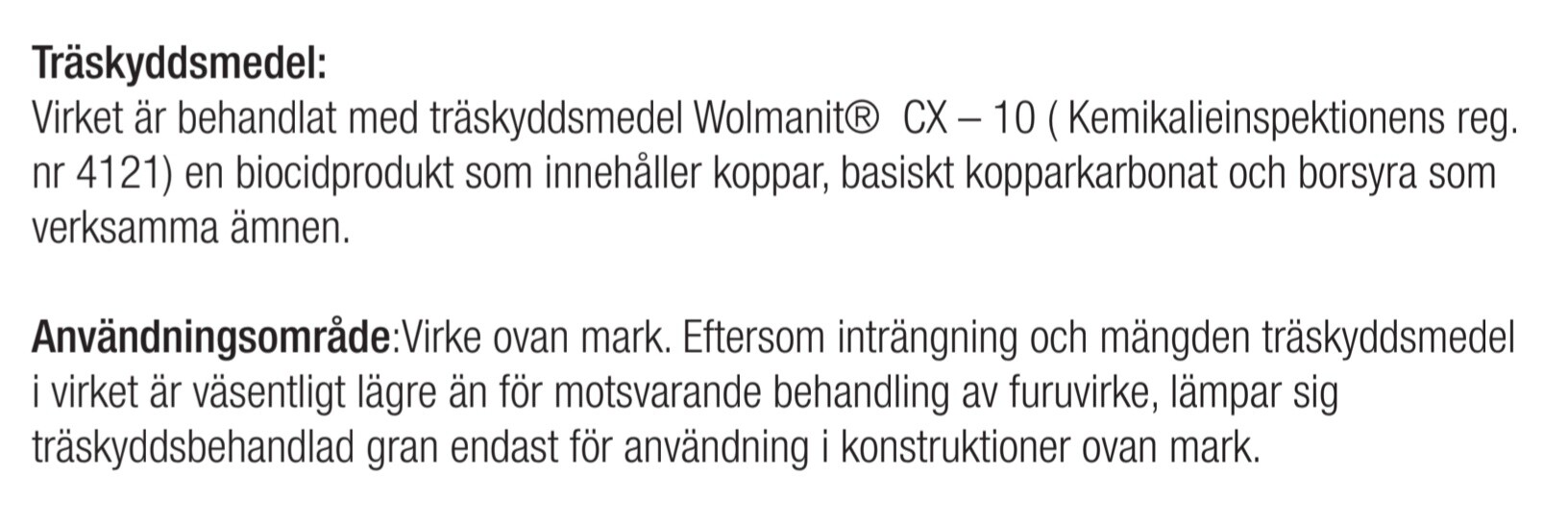
There are probably different classes not only of impregnation agents but also of impregnation depth. The surface might get a bit more impregnation, but normally pine should be impregnated all the way to the core (which can be tricky to assess on freshly split wood, but impregnation plants can use a chemical color indicator for heartwood when doing quality control, and sulfide can be used to show where copper impregnation has reached). On spruce wood, which is not impregnated as often (there are two special classes for spruce), it only penetrates a little bit, and there are probably some qualities of pine that are not fully impregnated (class B, while A and AB should be fully impregnated).C cpalm said:The problem is that impregnation agents have changed over time. Impregnated wood in the 1800s = tarred wood. But that's not really comparable.
Another problem with pre-impregnated wood in this context is that most of the impregnation is lost when you split the wood. So it's not very suitable for carpentry like gates, unless it's a very simple gate. Then you also can't compare decking with upright constructions. Completely different conditions.
Click here to reply