
13,644 views ·
69 replies
14k views
69 replies
Spruce or pine?
A bit tricky with pressure-treated wood if you want to paint the gate white. You then have to wait a year or two for the impregnation to "dry" a bit before you can paint (at least that's what the experts say)...O said:
If it is going to be outside, it will be exposed to weather and moisture from all sides, which is a tough environment. In that case, I would always choose pressure-treated wood for the best durability. Preferably as knot-free as possible.
"kärnfuru" is available in different qualities but it's hard to find really good ones. If you choose treated wood, it doesn't matter. In fact, it's even an advantage to avoid heartwood since the impregnation has a harder time penetrating it. "kärnfuru" simply has lower resistance and a higher price and is harder to find.


Good things come to those who wait... Joking aside, if it has to be painted this year, treated wood isn't so ideal, but if you value the extra durability, perhaps you can wait a year or two before painting.E Ehrlemark said:

Diversearbetare
· Göteborg
· 11 227 posts
No problems with painting pressure-treated NTR-AB/B if you sand and degrease the surface with naphtha and then prime with a metal primer, like Caparol's Uniprimer. No base oils or the like. However, you need to let the moisture evaporate properly. Preferably over a winter outdoors before you build it.E Ehrlemark said:
Not quite.E Ehrlemark said:
The important thing is that the wood has dried before you paint. Pressure treatment means the wood becomes thoroughly wet. So, it takes a while before it has dried sufficiently. The moisture content should be below 16% when you paint. Just measure if you want to be sure.
Often, decking wood has dried sufficiently already at the lumberyard.
I built using spruce studs, trying to find as knot-free and densely grown as possible. I made quite an advanced gate in my opinion, everything is half-lapped and glued, no screws except for the fittings. I believe and hope it will last a long time, potential rot damage can be repaired in the future. If I were to build another gate, I would probably choose pine from someone who can saw and plane the right dimensions directly. But it was nice that the cost was low for the wood since there were mistakes sometimes, it was easy just to redo that part.
I also cast the gate posts myself.
I also cast the gate posts myself.
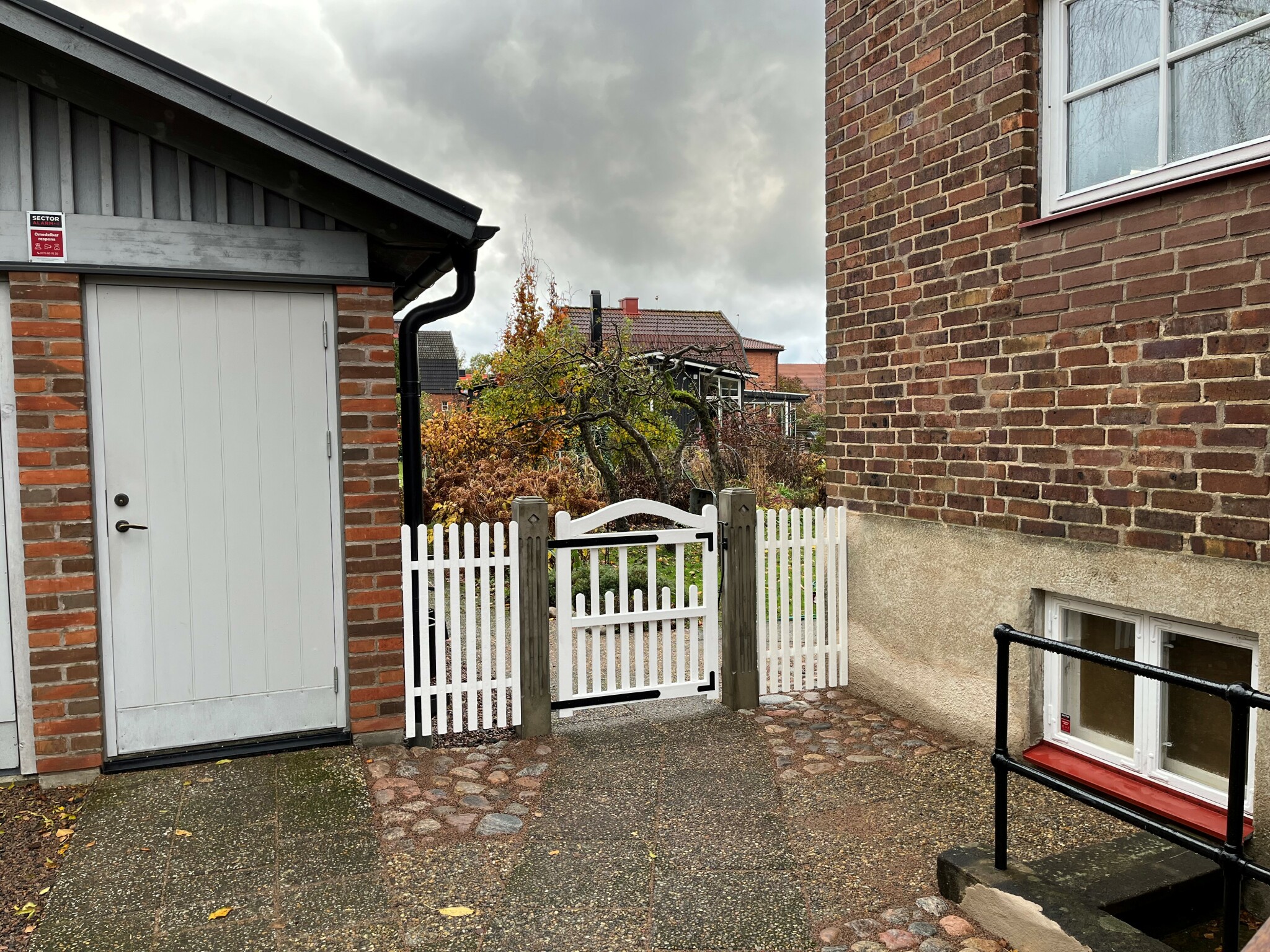
Planed or unplaned depends entirely on the type of gate you plan to build. If you have a simple fence made of standing unplaned boards and you just want an opening, you'll likely make it the same way. On the other hand, if you want a slightly fancier gate, planed wood fits much better. Spruce is available in many dimensions, but only the thicker ones are planed on all sides. Pine is always planed but is generally available in very few dimensions. Pressure-treated wood is available but is not very good for painting.
Planing can easily be done yourself, so you (usually) save money by buying unplaned wood. When there's not more timber than for a gate, hand planing works excellently.
Moreover, if you're planning to cut down the dimensions, you'll have to plane afterward if it needs to be planed.
Moreover, if you're planning to cut down the dimensions, you'll have to plane afterward if it needs to be planed.
Have painted pressure-treated wood with linseed oil paint directly after construction with good results. However, it's worth pointing out that for building a foundation, one should ensure the wood is dry.
Many parameters here. What will you paint with? Linoljefärg or plastic paint? Linolja must/should be planed. Plastic paint is directly unsuitable when you are going to paint on all sides because it traps all moisture and the wood cannot breathe. So either linolja or another diffusion-open paint.
If you consider a scale of resistance to water/rot where 1 is worst and 10 is best, spruce is about 1. Pine is about 4 and oak 5 if it's of about the same quality. In other words, pine is much better than spruce, especially a rich heart pine.
I would definitely advise against using treated timber if you're going to paint it; I've learned this the hard way, painting fences white, and foolishly I've done it several times because many have said, "there is no problem with the new treated planks." I have also measured the moisture content but it didn't help, the paint peels off.
Linolja on treated wood I haven't tried, but in theory, it should work better.
If you consider a scale of resistance to water/rot where 1 is worst and 10 is best, spruce is about 1. Pine is about 4 and oak 5 if it's of about the same quality. In other words, pine is much better than spruce, especially a rich heart pine.
I would definitely advise against using treated timber if you're going to paint it; I've learned this the hard way, painting fences white, and foolishly I've done it several times because many have said, "there is no problem with the new treated planks." I have also measured the moisture content but it didn't help, the paint peels off.
Linolja on treated wood I haven't tried, but in theory, it should work better.
I have lots of unplaned pine at home, must be uniqueA AG A said:Planed or unplaned depends entirely on the type of gate you plan to build. If you have a simple fence made of standing unplaned boards, and you just want an opening in it, you'll likely make it the same way.
On the other hand, if you want a slightly fancier gate, planed wood is much more suitable.
Spruce comes in many dimensions, but only the thicker pieces are planed on all sides. Pine is always planed but is usually available in very few dimensions. Pressure-treated wood is available but is not very good for painting.
 and yes, I bought them.
But painting pressure-treated wood is hopeless! It doesn't matter if you wait several years before painting. Rough-cut wood outdoors, planed indoors.If it is going to be outside, it will be exposed to weather and moisture from all sides; it is a tough environment. In that case, I would choose pressure-treated wood every time for the best durability. Preferably as knot-free as possible.
"kärnfuru" is available in different qualities, but it's hard to find really good quality. If you choose pressure-treated wood, it doesn't matter. In fact, it's an advantage to avoid heartwood since the impregnation has a harder time penetrating it. "kärnfuru" simply has less resistance, a higher price, and is harder to find.
That's not something I've noticed.Christer G.V. said:
If there's no difference if you wait several years, then there's no point in waiting at all. Additionally, the surface becomes sun-bleached gray and contaminated, which is not good if you're going to paint.
If you use dry wood to build with and paint immediately, it works whether it is impregnated or not.
You'll have the least work and problems if you don't paint at all. Pressure-treated wood holds just fine without painting.
The difference between spruce and pine is mostly the number of knots in the core. Pine is pine wood and essentially has the same properties as spruce but with fewer "pearl knots" (small knots between the branches' core)E Ehrlemark said:1. Planed because most gates seem to be built with that wood
2. Spruce just because, among other things, Svenskt Trä recommends it in their construction descriptions...
3. The gate will be outside and painted white...
P.S. But now I'm leaning towards choosing heart pine instead, seems to be available at "regular" lumberyards as decking timber