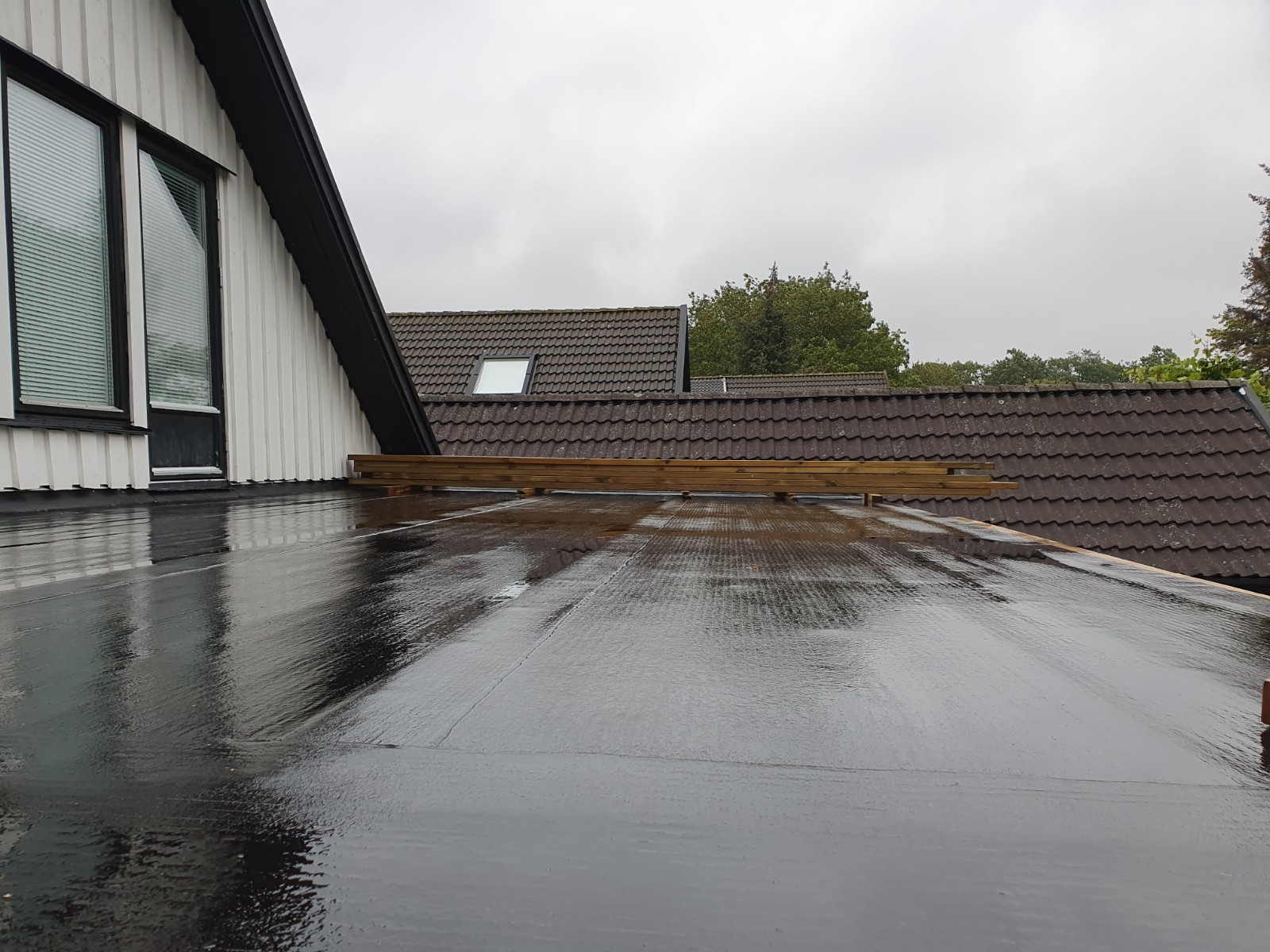
I will be placing decking on a low slope that was installed 5 years ago and consists of a Derbigum mat.
A flat roof covered with black Derbigum matting, wooden beams placed on top, adjacent to a house with large windows and neighboring tiled roofs.
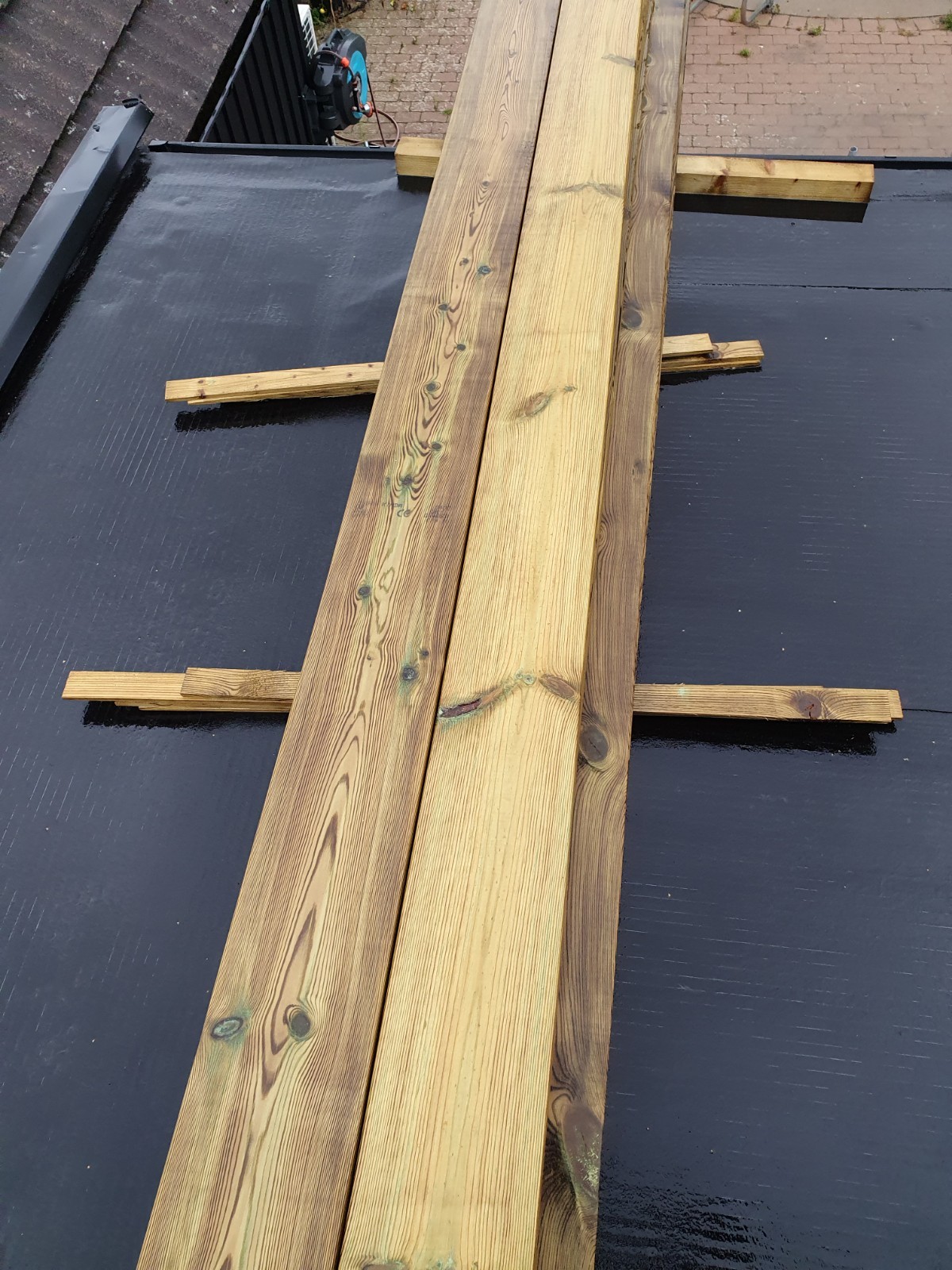
I have purchased 8 pieces of 45x170 boards that will be ripped lengthwise to compensate somewhat for the roof slope. The height will be 45mm against the house and 125mm at the outer edge.
Wooden planks laid on a low slope Derbigum roof for decking project. Planks are on spacers to adjust slope. Discussion on optimal side facing up.
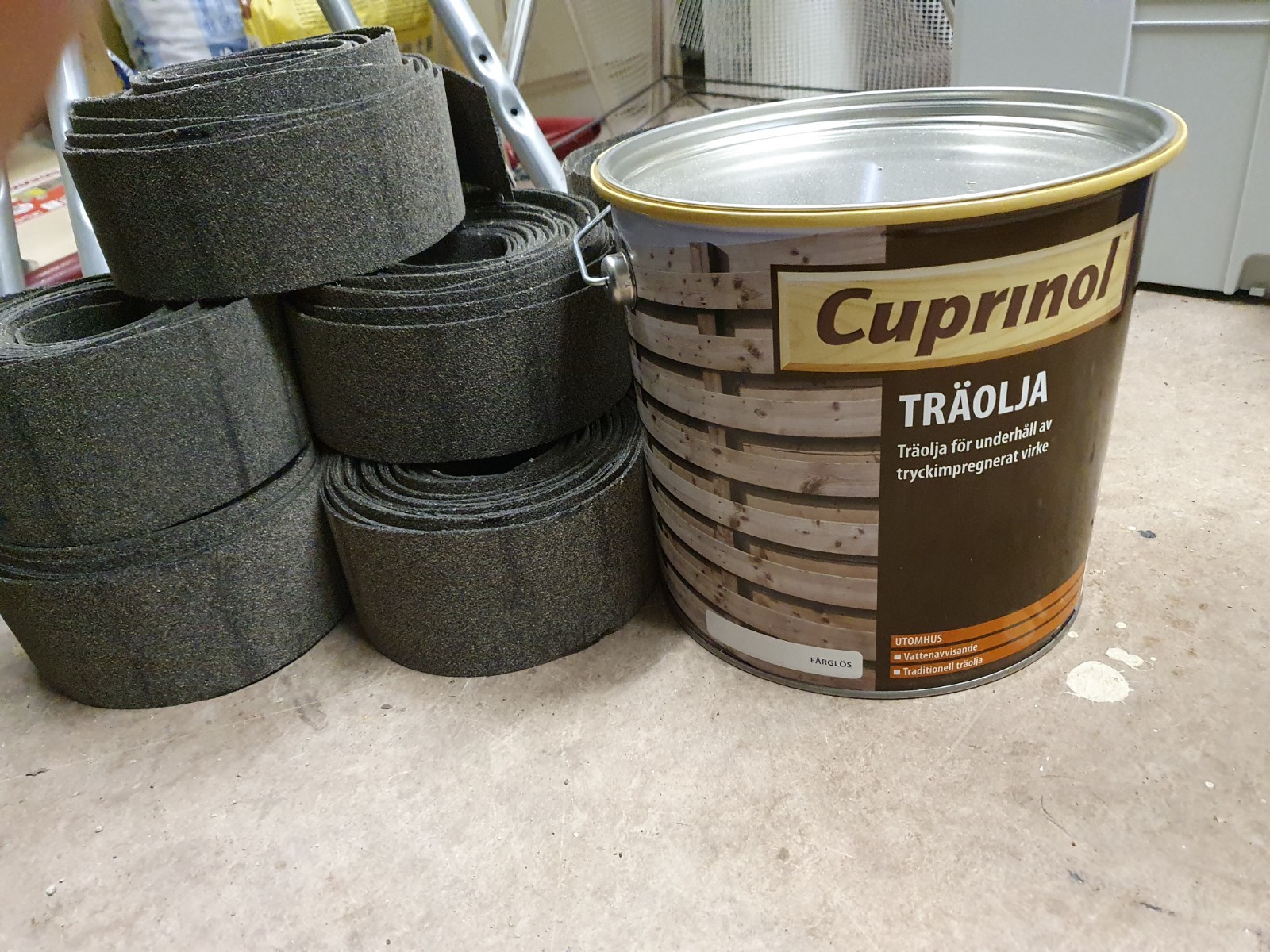
Now the big question is which side should be facing upwards? The joists will rest on shim pads (min 5mm) + pieces of (4mm) Derbigum against the roof (cc 60). I plan to treat the cut surface with Cuprinol and have prepared strips of roofing felt to lie between the joist and the decking.
A stack of roofing felt rolls is next to a can of Cuprinol wood oil, intended for outdoor maintenance of pressure impregnated wood.
It feels best to place the cut surface downwards to have the perfectly straight side of the joist facing up towards the decking. But according to Swedish wood instructions, the cut surface should be faced upwards:

Good to know about impregnated wood - processing

To achieve maximum durability of the wood, one should avoid processing and ripping. Otherwise, there is a risk of exposing the heartwood in pine which, despite some natural resistance to wood-destroying organisms, does not have the same protection as the impregnated sapwood in pine.

For constructions in ground or water, one should always place unprocessed surfaces downwards and processed upwards. The unprocessed end grain has the best protection.

Where cutting and some processing are unavoidable, these surfaces should be treated with a wood preservative, credential class 3, intended for surface treatment.
What do you think? Will there be any danger in having the cut surface downwards if it is elevated and treated with oil?
 
I don't think it has any major significance in your case. A impregneringen is meant to protect against ground and soil contact, and in that case, the cut surface is probably somewhat less impregnated, but that's not relevant here. I can imagine that it's easier to make a neat laying with the cut surface facing downwards.
 
Click here to reply
Vi vill skicka notiser för ämnen du bevakar och händelser som berör dig.