I'm thinking of adding some insulation (perhaps 50-70 mm Isolina or iCell) and double drywall between the ceiling joists between the ground floor and the upper floor, partly to retain warmth a bit more on the ground floor, and partly to dampen sound transmission between the floors. I'd like to discuss this a bit!
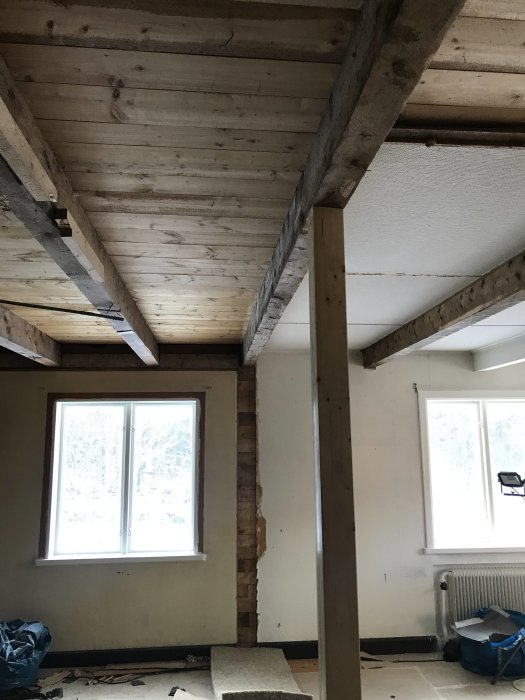
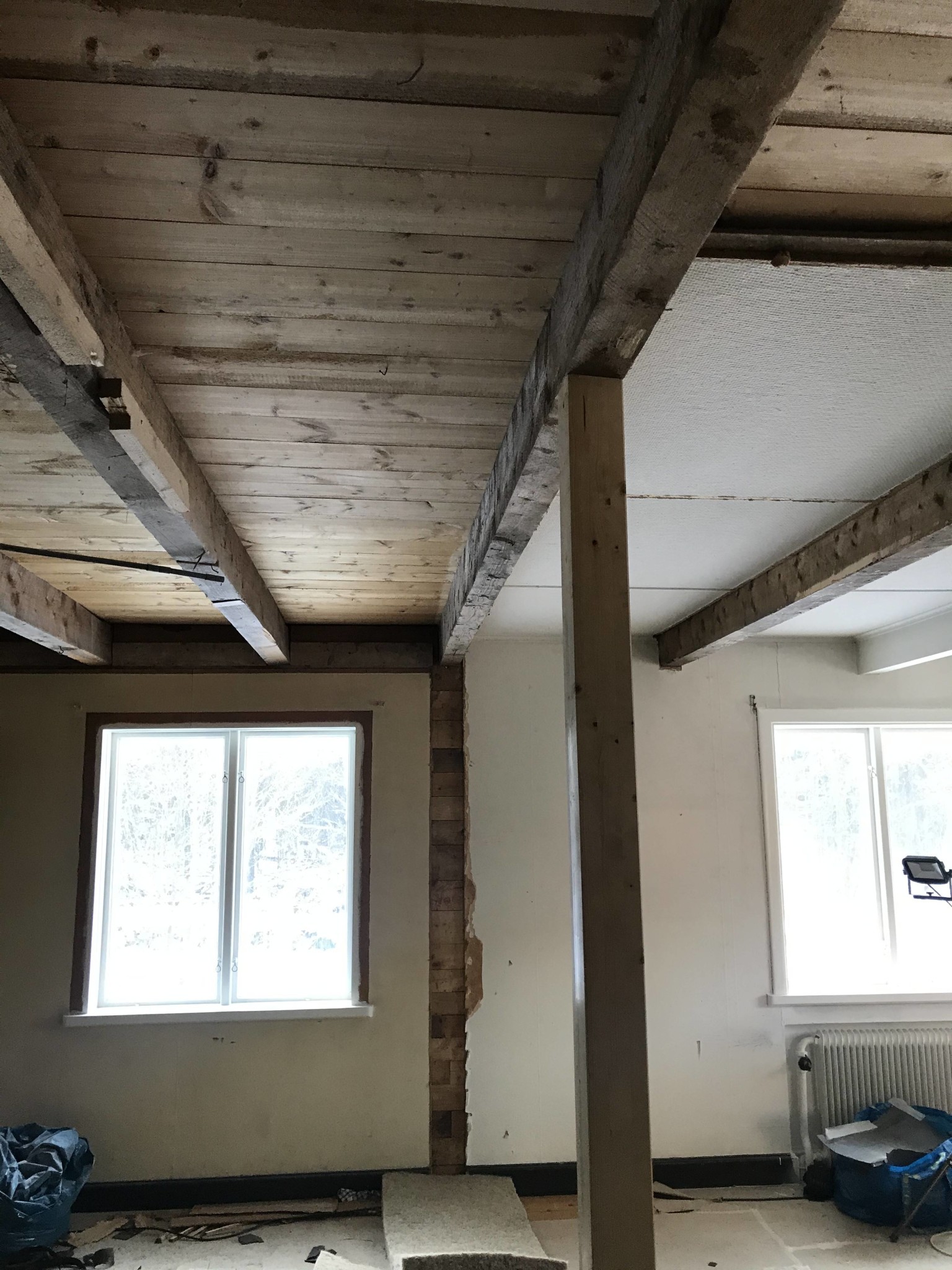
The house is from around 1945, with an outer brick and then a wood construction inside. It's two stories, partly unfinished (cold) but mostly finished upstairs (we plan to finish it all in four/five years). The joists are 200 high and 100 wide. The planks you see on top of the ceiling joists are also the floor of the upper floor, so there's really nothing there today. Sound-wise, it's like being in the same room... As you can see in the picture, there used to be a ceiling in parts of the house (e.g., the kitchen, on the left), which ran under the joists, while in other places (e.g., the living room, on the right), the joists were visible, then with a layer of "Treetex" on sparse panels between the joists and nailed hardboard on the joists. The plan is also to replace the "Treetex" with insulation and double drywall here.
What is a good approach? I found this description from GDS (http://tipsattgora.eu/gds_sv_131150-haev_loftet_17_web.pdf) Is it useful? And what's the difference if I want to do it with wooden frames instead of metal frames? Higher sound transmission? And is there anything else to consider?
As usual, there's probably background info I've missed to provide and a lot of other conditions I take for granted but that might be necessary to give answers and tips... so feel free to ask .
What are good approaches? I found this description from GDS ([link]) Is it worth anything? And what is the difference if I want to do it with wooden studs instead of metal studs? Higher sound transmission? And is there anything else to consider?
In terms of soundproofing, it’s not very good. However, if you want a visible framework or higher ceiling height, it's an option.
A better alternative is to insert new wooden beams between the existing ones and then in smaller dimensions, maybe 42x180, so that they have no contact with the overfloor or the other beams. You should also lower the beams a bit so that the plasterboard doesn't contact the old framework. Then apply 2-3 layers of plasterboard. Fully insulate with rock wool.
Soundproofing-wise, it's not so good. However, if you want a visible joist or higher ceiling height, it's an alternative.
A better option is to install new timber beams between the existing ones, in smaller dimensions, perhaps 42x180 so that they have no contact with the upper floor or the other beams. You need to lower the beams somewhat so that the plasterboard doesn't contact the old joists. Then plaster 2-3 layers. Fully insulate with rock wool.
Thank you for the response, FG! Interesting. These beams you place in between, what are they attached to? The span is almost five meters in each room. Would they need to be anchored in the walls in that case? It would involve both interior and exterior walls. And wouldn't the sound transmit that way then? I'm thinking it would be a significantly larger intervention than planned ... Hmmm ... And would a beam of 45x95 be sufficient if you want just under half of the original beam visible?
Wow, the issue of sound transmission is a science in itself, I've checked various sources and depending on your requirements, it might just take a screw that puts materials in contact with each other and you're "done for." Luckily, I don't have such strict demands, mainly a wish that clearly spoken words at least transition into muffled murmurs ... I'm thinking about spacing between materials, with acoustic sealant, perhaps something dampening between the wood parts (sill insulation or fiber cloth), but then screws and other things always come into play that transfer anyway ...
Thanks for the reply, FG! Interesting. These beams you put in between, what are they attached to? The span is almost five meters in each room. Do you need to attach them to the walls in that case? Both interior and exterior walls. And doesn't the sound travel that way then? I think it would be a much bigger intervention than planned... Hmmm... And would a "beam" of 45x95 be enough if you want just under half of the original beam visible?
Oh dear, this sound transmission thing is a science in itself, I've checked various sources and depending on your requirements, it can be enough with a screw that puts materials in contact with each other and it's "done". Luckily, I don't have those requirements, mostly a daily wish that clear speech at least might turn into muted mumbling... I'm thinking precisely of the distance between materials, with acoustic sealant, maybe something damping between the wooden parts (sill insulation or fiber cloth), but then there's always screws and other things in the picture that still transfer...
I should add that I'm clearly not thinking a stud (which it becomes) of 45x95 with a five-meter span can carry two layers of gypsum. That's why it would be interesting to discuss how a "hanging" solution can be made, which allows the beams not to be built in. I have, for example, seen solutions somewhere where you gradually add a beam/supporting stud, but then the suspension is attached to something as well... so... And many of these solutions also seem to be based on being able to build it from the start, meaning it can't be done in a renovation of a 1940s house... yeah, there’s a lot that becomes more difficult precisely because it needs to be done in relation to an old solution, which itself isn't made with gaps between materials and seals that should prevent sound transmission...
FG's proposal is not a bad solution and would provide good sound insulation. To achieve this, an air spring is needed, which you get with a dropped ceiling that is decoupled from the joists.
A standard variant is to attach the dropped ceiling to an acoustic profile, possibly the site you linked should work in such a way. I know that Gyproc's acoustic profile AP25 works well. 2 layers of gypsum and at least 70 mm mineral wool are not bad in the dropped ceiling. If you add floor gypsum or have another heavy overlay floor, the sound insulation increases.
The principle is that more mass = better sound insulation, with two heavy surface layers and an air spring with absorbers in between, you automatically get good sound insulation. Long screws or improper installation “short-circuits” the construction.

 .
.
FG said:
Soundproofing-wise, it's not so good. However, if you want a visible joist or higher ceiling height, it's an alternative.