
3,367 views ·
21 replies
3k views
21 replies
Soundproof and reinforce partition walls
The idea is not for it to be completely soundproof, but from the beginning, I wanted to get a more solid and sturdy wall as the walls currently sway when you press on them, which is not surprising considering the cross braces are missing and there is only one layer of gypsum on each side. Soundproofing is secondary in this case.L Liljeros said:For all solutions more extensive than simple gypsum and a bit of insulation like 45-70mm, the door will directly become the limiting factor.
However, if you want the wall itself to be a bit more solid, an extra layer of gypsum is a good option. If you want to easily screw up a lot of things, it helps to have OSB, but it has worse sound performance than gypsum. Any construction more extensive than 2 sheet layers per side, some insulation, and a 70mm stud in a typical house is not particularly meaningful since the sound will still take other paths.
OSB will definitely be needed so that we can mount shelves and similar in the future, as it is intended to become an office or children's room.
Just throw in some insulation and close the wall again; do all the studs really need to be replaced? If there's just a single one that's warped, make a couple of cuts in it and screw it together with a new straight 45x70.Scj said:The idea is not for it to be completely soundproof, but from the start, I wanted to put up a more solid and sturdy wall because the walls currently flex just by pressing on them, which isn't surprising given the lack of cross bracing and the fact that there's only one layer of gypsum on each side. So soundproofing is secondary in this case.
Osb will definitely be needed so that we can mount shelves and similar things in the future as it's intended to become an office or children's room.
I don't think you need to tear down the whole wall.
No, there are 2 that are bent, the rest look fine. You mean I should make cuts into the stud to then "force" it straight? Is that really possible? Quite substantially bent...L Liljeros said:
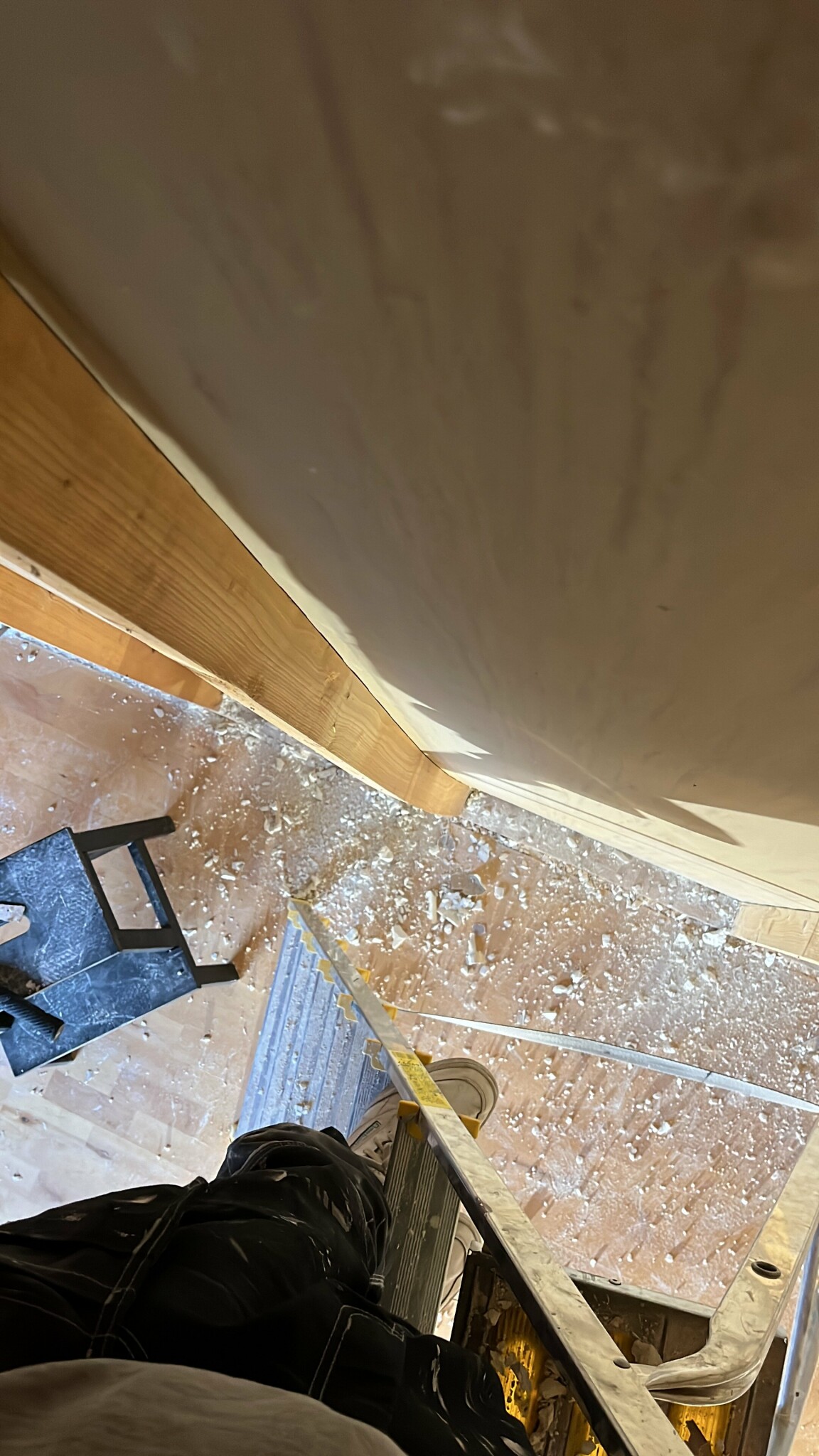
No, you probably have to make quite a few cuts, about 90% of the depth of the stud. Then a new stud next to it and force it straight. That way you don't have to tear down so much, guessing there's a lot of electricity in the wall that needs to be rerouted then...?
no electrical wiring runs between or against these studs 👍🏼L Liljeros said:
Why not securely attach proper posts next to the existing ones?
And then add noggins between them.
Completely replace the two crooked posts with new ones according to the chosen dimension above. Nothing to complicate.
And then add noggins between them.
Completely replace the two crooked posts with new ones according to the chosen dimension above. Nothing to complicate.
45x70 should still be considered standard today, right? Why would you need to reinforce the entire wall?H Hybro said:
If you replace the crooked posts, you end up having to paint the other side of the wall as well, which might not be necessary, hence aligning the existing ones and screwing new studs to them.
What purpose are the noggings supposed to serve? It's hardly something you normally install in a wall when you're putting up OSB; it would take really heavy shelves for that need to arise.
Click here to reply