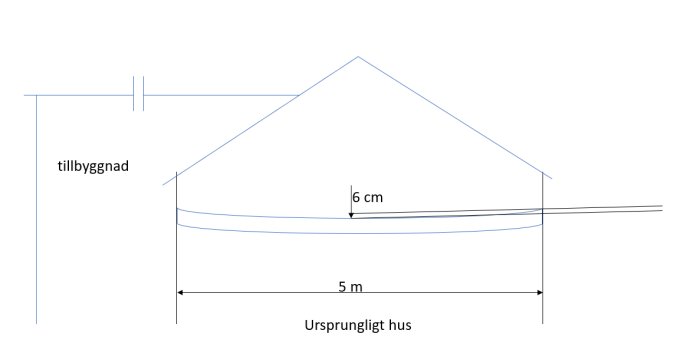
In our single-story house, the beams in the attic have sagged up to 6 cm. The house was built in the early 1930s, and that part of the house is very small. A larger extension perpendicular to the existing house was made in the mid-1970s.
The room with the sagging ceiling is 5 m wide and 4 m in the other direction. When the previous owner extended the house, I believe they went into the attic and removed the props for the rafters and covered the entire ceiling with paneling. They probably removed the props for the rafters to make it easier to move around in the attic. Everything else they did to the house was very amateurish and suggests a lack of knowledge, so I'm not surprised if that's the case. I heard a comment when we bought the house that can be interpreted as the previous owner noticing that the outer roof was sinking, which is why there are now simple props between the floor and the roof ridge. It's visible on the outer roof that it dips towards the middle of the house, but it's been like that for 45 years.
We bought from an estate and I'm aware that we have to take it as it is. That's the background. The sketch shows how it sags.
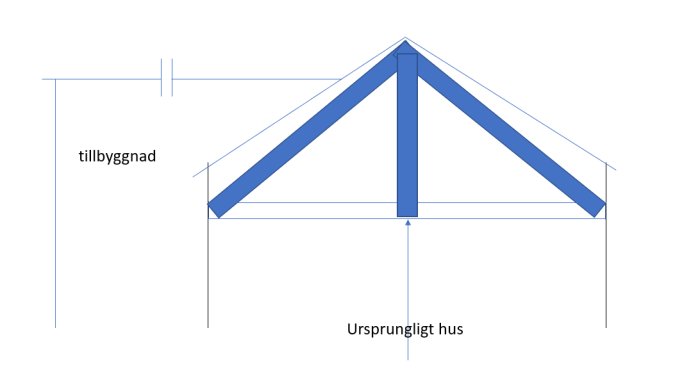
My plan for action is to go to the middle beam, lift it up, and then fix it with an extra rafter as shown in the sketch. From that rafter, I also plan to support the outer roof. The forces will land at each end of the floor beam and result in tensile forces along its length.
I have not yet opened the attic floor and measured the dimensions of the floor beam.
My idea is to straighten and reinforce so it lasts "forever," and I plan to do what's necessary but no more. Grateful for feedback on this solution.
I believe the main reason is the span being too long in relation to the beam dimensions. It requires rather sturdy beams to handle 5 meters. If it's been humid as well, it may have contributed to a permanent deformation. I think your solution is unnecessarily complicated and believe there are simpler options. Either reinforce each beam or add a beam in the ridge direction above or below the joists. It all depends on the floor beams' dimensions (I'm guessing 3x7 inches) and how you use the space in the attic. Removing support legs mostly affects the rafters' main posts.
How is it on the ground floor? The most common otherwise is that flimsy trusses are built on supporting interior walls that may be gone? Your idea about reinforcement doesn’t make things worse, but if the truss is flimsy, it doesn’t contribute much other than its own bearing capacity. It's still the same weight it carries, and the post is pushing downwards as well. If it's the weight of the floor that is greater, the post will instead pull the roof downwards and load the ends incorrectly if it's also flimsy there.
I believe the main reason is too long a span relative to the beam dimension. It requires fairly strong beams to handle 5 meters. If it has also been humid, that may have contributed to a permanent deformation. I think your solution is unnecessarily complicated and believe there are simpler alternatives. Either a reinforcement of each beam or a beam in the direction of the ridge above or below the floor structure. Everything depends on the floor beams' dimensions (I'm guessing 3x7 inches) and how you use the space in the attic. Removed support legs mostly affect the top chords of the trusses.
Thank you for the response, I would then open the floor in the attic, and at the same time as I jack up each beam, also screw-glue a new beam, probably 2"x7", to each existing beam. It's likely 3"x7" as you mentioned. It will be the same solution you suggested for the extended part of the floor where it was bouncing and was unstable due to long spans with too flimsy beams.
I then have a following question, the floor in the attic is 1"x4" tongue and groove and is more or less loosely attached with some nails here and there. To increase stability, would it be better to screw-glue 22 mm chipboard flooring instead? Does it work just as well as floorboards in an attic that is dry but unheated?
How is it on the ground floor? The most common otherwise is that weak trusses are built on load-bearing interior walls that may be gone? Your idea about reinforcement doesn't make the situation worse, but if the truss is weak, it doesn't contribute much more than the truss's own load-bearing. It's still the same weight it carries, and the post also presses downward. If the weight of the floor between stories is larger, the post will instead pull the roof downward and stress the ends incorrectly if it's also weak there.
Thanks for the response. The ground walls are the exterior walls, and there hasn't been any interior wall in the room in question. However, in the other half of the old building structure, there's an interior wall that makes a difference. The exterior walls in the old building structure have solid dimensions on the studs and are clad with 1" tongue-and-groove timber on both sides, with boards on the inside and panel outside.
When I measure the ceiling using a laser, the height around the perimeter is more or less the same, and the height curve is fairly consistent as I move towards the center of the room. This suggests that I will be able to raise about a 6 cm sag when I reinforce the joists.
The next step is to lower for a new ceiling, and when I screw 2"x2" into each joist and then attach 1"x4" battens to these, I gain additional strength and stability for the joists.
Now something has happened because I have received help. The construction is made of 2”x8” untreated wood with center-to-center spacing between 75 and 80 cm. The entire span is 5 meters. With the help of the posts here about my idea not being so smart, I have reconsidered.
We have opened the floor in two lengths diagonally across the joists on each side of the chimney wall and emptied the sawdust. The distances between what we have opened and the outer walls are fairly evenly distributed. We now plan to insert noggins between each joist after we have jacked up the ceiling from the living floor, and then we’ll place double 2”x9” beams 4 meters in length on top of the noggins between the outer wall joist and the joist that is supported on the chimney wall (it also lies directly above an interior wall). We will connect each twin joist using long rafter hangers down into the existing ceiling joists.
The attic floor/living floor ceiling will not be able to sag again. We will need to deal with the inconvenience of stepping over the standing 2”x9” twin joists on that half of the attic, but it is a storage attic, and I think the inconvenience is a small price to pay to fix the problem.
Of course, it would have been better to open the entire attic floor and insert more joists, but at some point, it’s good enough. If they were able to live with a sagging ceiling for 90 years, then I can live with visible joists on the attic floor for 10-20-30 years.
With this solution, I also get a stable solution that I can use to support the rafters in the roof, which I mentioned in the first post.
I have taken your comments into account and am grateful for feedback on the solution I have described above.
Now it is done as I described above and it turned out very well. We pumped up the beams as much as I think was possible without risking damage in other areas, which means that now it only hangs down ~ 2-3 cm instead of the previous 6 cm. It's probably the straightest ceiling in this house
Thanks for the great suggestions
Click here to reply
Vi vill skicka notiser för ämnen du bevakar och händelser som berör dig.