
4,744 views ·
6 replies
5k views
6 replies
Sizing studs for preparing the upper floor
Hello
First thread here, hope to get some help in this excellent forum.
I have a query regarding the dimensioning of studs in outer walls in connection with additional insulation we are planning for our house. We have a little idea of adding a floor maybe in 5-10 years, and I thought it might be possible to partially prepare for this now when we are adding insulation to the facade this summer.
So I thought I’d test my reasoning here to see if I’m on the right track or not, I will take this to a structural engineer for final calculations but would like to test the theory first. Here are the conditions and my planned approach:
The house, as mentioned, is from 1946 and resembles a "small home" style even though it is not located in such an area. The basement has masonry walls and one residential floor with wooden outer walls. The outer walls are about 12 cm thick, so my guess is that it is a plank wall frame with 2-inch planks (I will open it up and check as soon as the drainage work around the house is completed). The span is approximately 6.7m.
We will remove the existing wooden facade and install insulation in two layers (and then new cladding). First vertical studs and then horizontal. My idea was to dimension the vertical studs to support an upper floor sometime in the future.
I have two main questions that I can't quite grasp, but I'd welcome other opinions as well.
This became a long post but I hope someone has the patience to read all of it and give some input.
Regards,
Ulf
First thread here, hope to get some help in this excellent forum.
I have a query regarding the dimensioning of studs in outer walls in connection with additional insulation we are planning for our house. We have a little idea of adding a floor maybe in 5-10 years, and I thought it might be possible to partially prepare for this now when we are adding insulation to the facade this summer.
So I thought I’d test my reasoning here to see if I’m on the right track or not, I will take this to a structural engineer for final calculations but would like to test the theory first. Here are the conditions and my planned approach:
The house, as mentioned, is from 1946 and resembles a "small home" style even though it is not located in such an area. The basement has masonry walls and one residential floor with wooden outer walls. The outer walls are about 12 cm thick, so my guess is that it is a plank wall frame with 2-inch planks (I will open it up and check as soon as the drainage work around the house is completed). The span is approximately 6.7m.
We will remove the existing wooden facade and install insulation in two layers (and then new cladding). First vertical studs and then horizontal. My idea was to dimension the vertical studs to support an upper floor sometime in the future.
I have two main questions that I can't quite grasp, but I'd welcome other opinions as well.
- Firstly, what dimension would be required to support an upper floor? My thought was to use 45x95 timber. According to the table on Träguiden (https://www.traguiden.se/konstruktion/konstruktiv-utformning/stomme/vaggar/vaggreglar/), 45x95 (C14, cc 600, snow zone 2) can handle a span of 6 meters. If I move up to C24 and cc 450mm, it seems like I should be able to reach a span of 6.7m without doing the calculations?
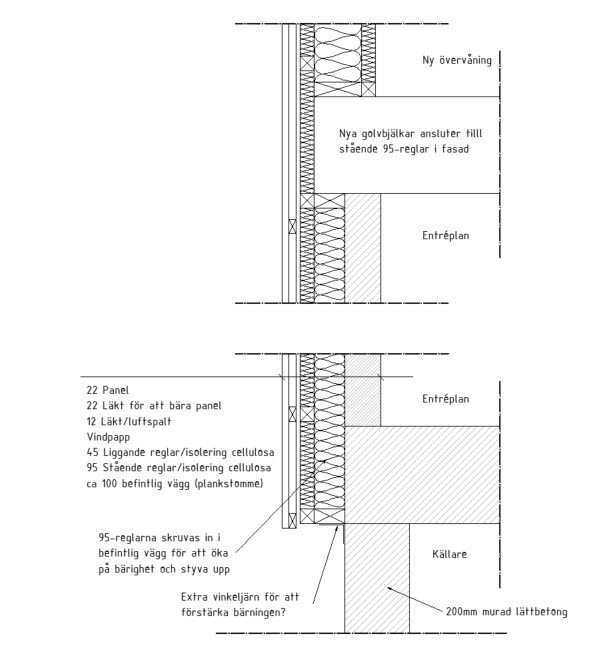
- The second question is that the vertical studs will not stand on the basement walls, so the force from the vertical studs will need to be "transferred" into the existing wall. Is it sufficient/does it work to just screw the studs securely into the existing wall, and can the plank wall handle the loads that way? To further improve the situation, I could also place an angle iron under each vertical stud that is secured into the foundation wall?
This became a long post but I hope someone has the patience to read all of it and give some input.
Regards,
Ulf

Most indications suggest that the plank walls will be able to handle the additional loads when you build an extension. It is more important to check that the basement walls under the main road can also do so.
Okay. Thanks for the reply. However, it seems there are no load-bearing walls inside the house; the load is supported from outer wall to outer wall. At least that's how I interpret it since the walls in the basement are not located under the walls on the entrance floor.
I find it difficult to comment on that without a sectional drawing.
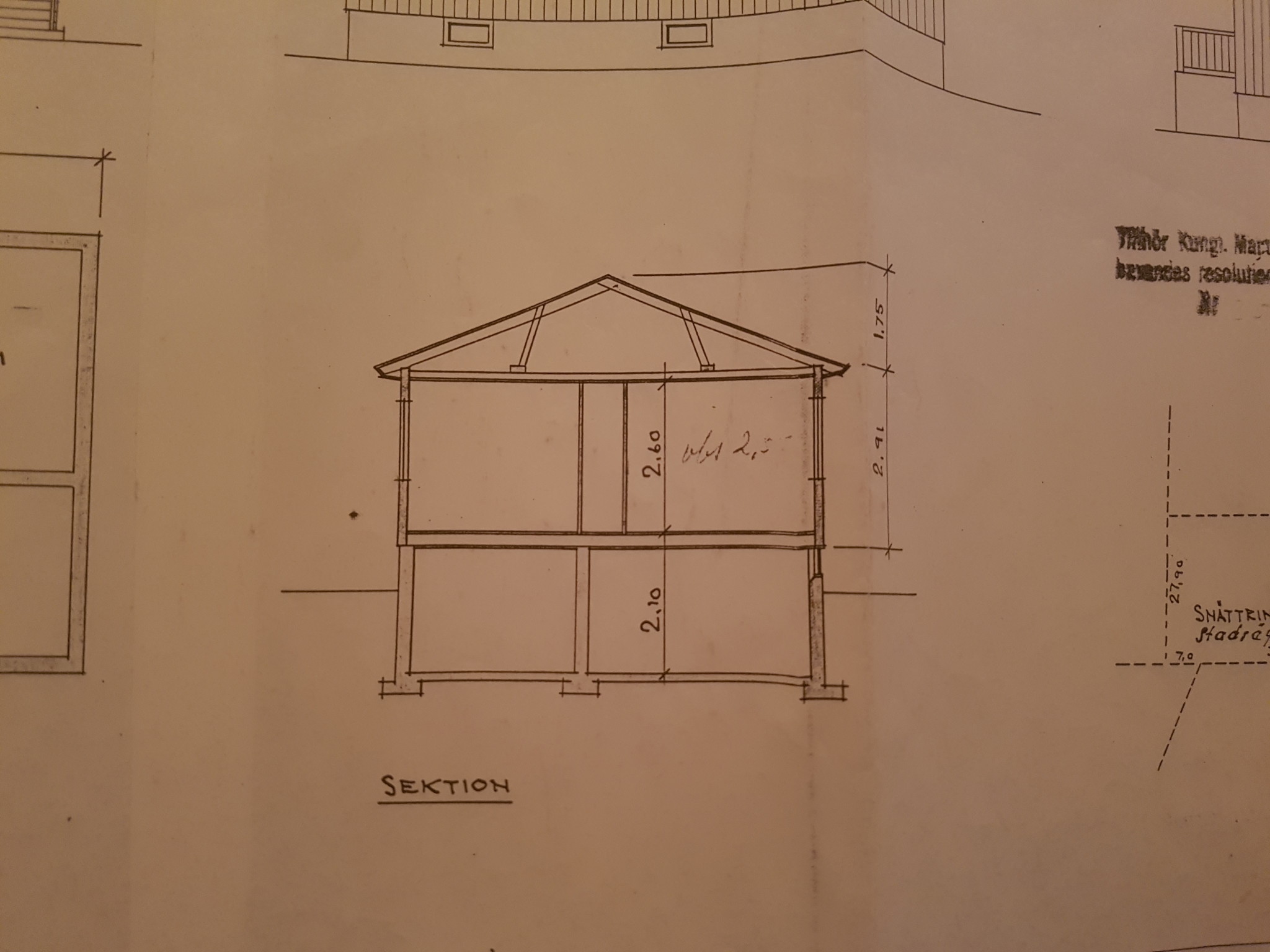
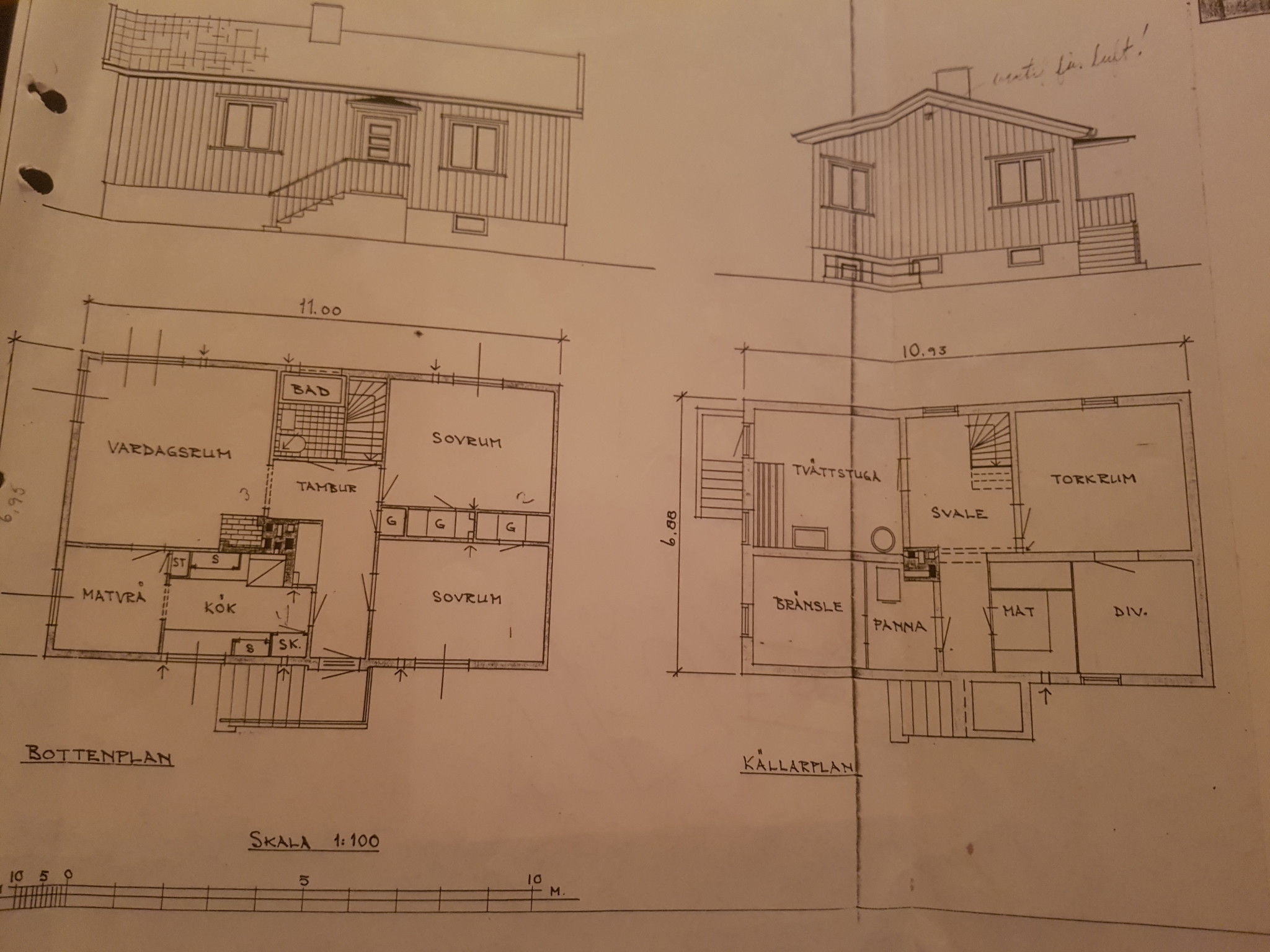
Maybe the ground floor is made of concrete? The roof trusses are certainly not self-supporting. The load-bearing walls handle some of the roof loads. There are some technical challenges in adding a floor that require you to have access to building engineering knowledge. But it's not impossible.
The basement's slab is concrete (presumably unreinforced), the slab between the basement and the entry floor is a wooden joist structure, not concrete. I work in construction but mostly in project management, so my construction books have been collecting dust for quite a few years. My idea is to replace the rafters with new beams that can bear from outer wall to outer wall when the time comes for the upper floor; perhaps additional reinforcement is needed in some places but I think one should be able to utilize the studs in the additional insulation in some way. My idea of the cuts is roughly as in the attached image.
Click here to reply