
4,728 views ·
20 replies
5k views
20 replies
Sizing of Floor Structure - Glulam vs Steel Beam with Dovetail Sheet
A floor structure measuring 8.2mx9.3m is very large and requires its dimensions. I believe more in a collaboration between metal decking and steel than metal decking and wood. The designer should also be able to calculate this if so. Depending on how much load the walls can handle, there are either hollow-core slabs or prestressed slabs. In the slab structures, one could also cast in sparks to save weight. Where will the drainage stack go down?
The drain pipe goes through the house at the top of the T, straight down through the old chimney (utilizes the cavity).B bossespecial said:A floor slab of 8.2mx9.3m is very large and requires its dimensions. I believe more in collaboration between metal sheets and steel than metal sheets and wood. This should also be something the engineer can calculate if so. Depending on how much load the walls can handle, there are hollow core slabs or pre-stressed slabs. In the slabs, it would also be possible to cast in toe kick floors to save weight. Where will the drain pipe go down?
I have considered both HDF and cast-in slabs, slack or pre-stressed, but the total weights of these become larger regardless. Additionally, it seems tricky to find a carpenter who works with small homes but can handle such slabs, HDF / filigree suppliers who want to work on these small jobs, lead times around 8 months, etc., so I've decided to abandon this.
Regarding the house's bearing capacity, the frame is a mix of concrete block and brick. I have found it a bit difficult to find a structural engineer who works with small stone houses and is interested in making assumptions about the bearing capacity for such an old house.
If my research is correct, the closest assumption is to use BABS 1946 table page 22 regarding concrete block,
BABS 1946 - Boverket
www.boverket.se › contentassets › babs-1946
And there somewhere, I would like to have an engineer with me before making more assumptions or further amateur research.
On the upper floor, it seems to be a so-called nopsamur of brick (thickness about 40-43 cm excluding plaster).
On the ground floor, which is partially underground, there are two different systems, see attached plan with comments. Part of the wall is made with concrete block that is about 22-25 cm with 3 air channels for the thickness, and brick wall with a similar nopsa system as on the upper floor. Additionally, there are several load-bearing walls on the ground floor in brick.
The foundation seems completely stable, and according to SGU, the house stands directly on bedrock with a little topsoil. Cracks and subsidence are absent.
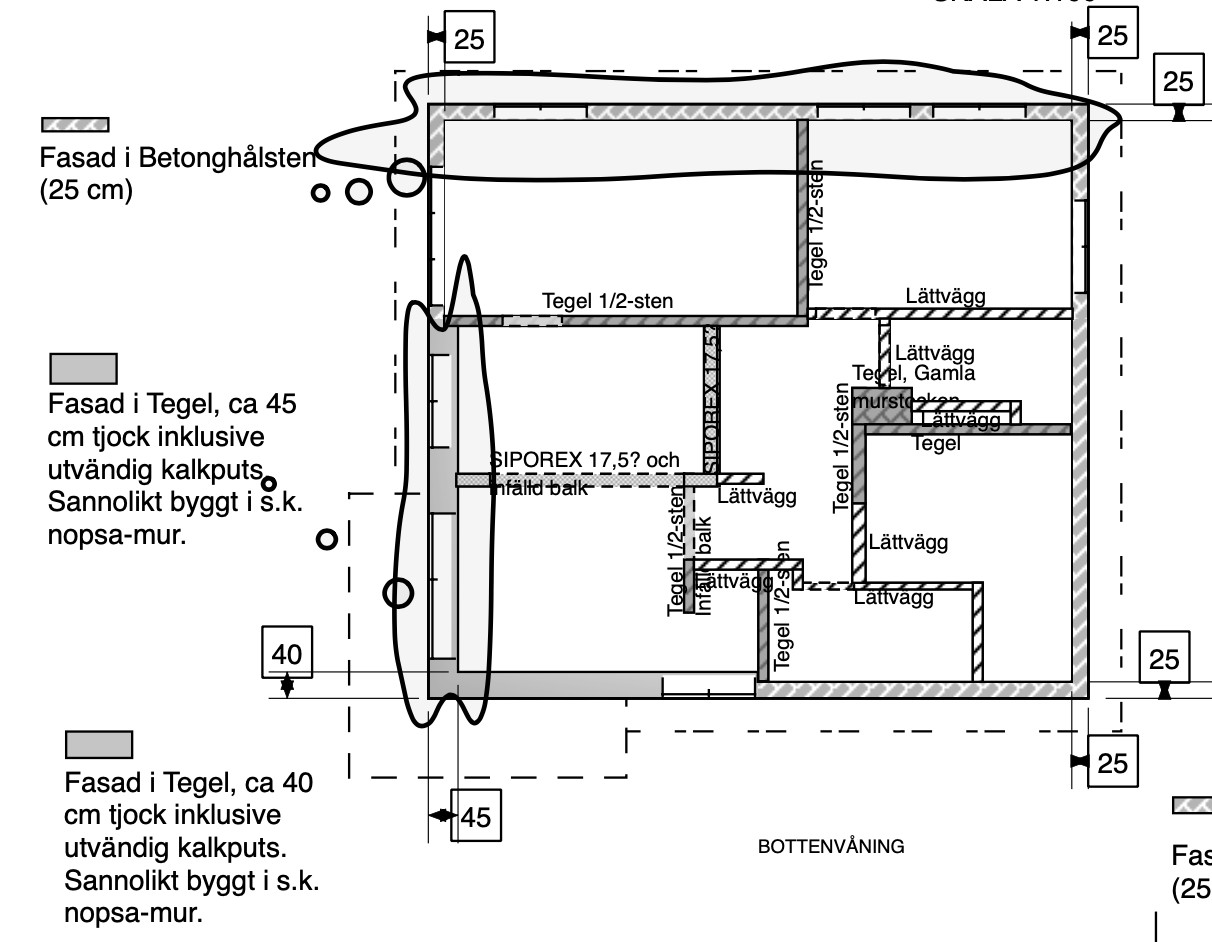
What was the previous attic floor resting on, by the way?
It rested over the span of 8.2 and was placed on top of the brick wall. It doesn't seem to have been designed at all for load but was intended as a completely unused cold attic. But for various reasons, it needs to be removed, and the idea now is to cast a concrete beam 200x200 around the entire facade to serve as support for a new floor (reinforcement above the beams over windows, etc.).B bossespecial said:
Was it the same roof pitch and raised wall in the original design as well? Were there trusses spanning 8m?
Click here to reply