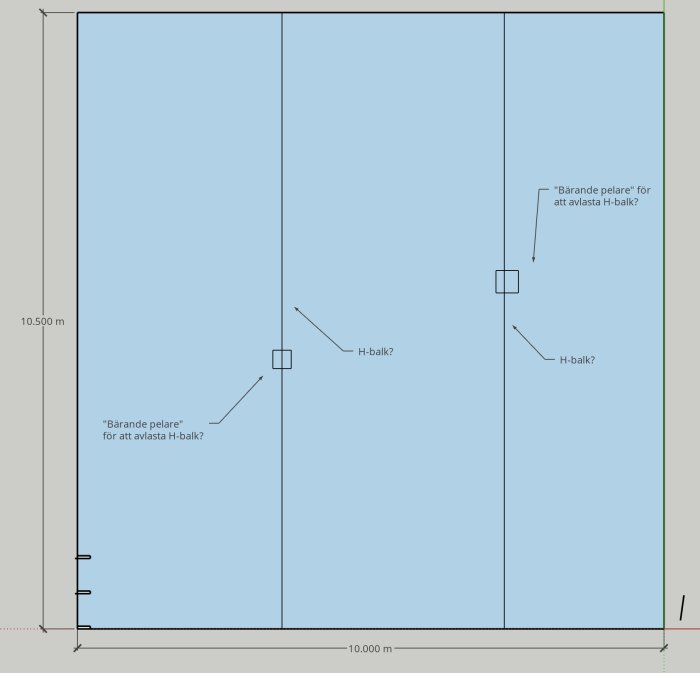
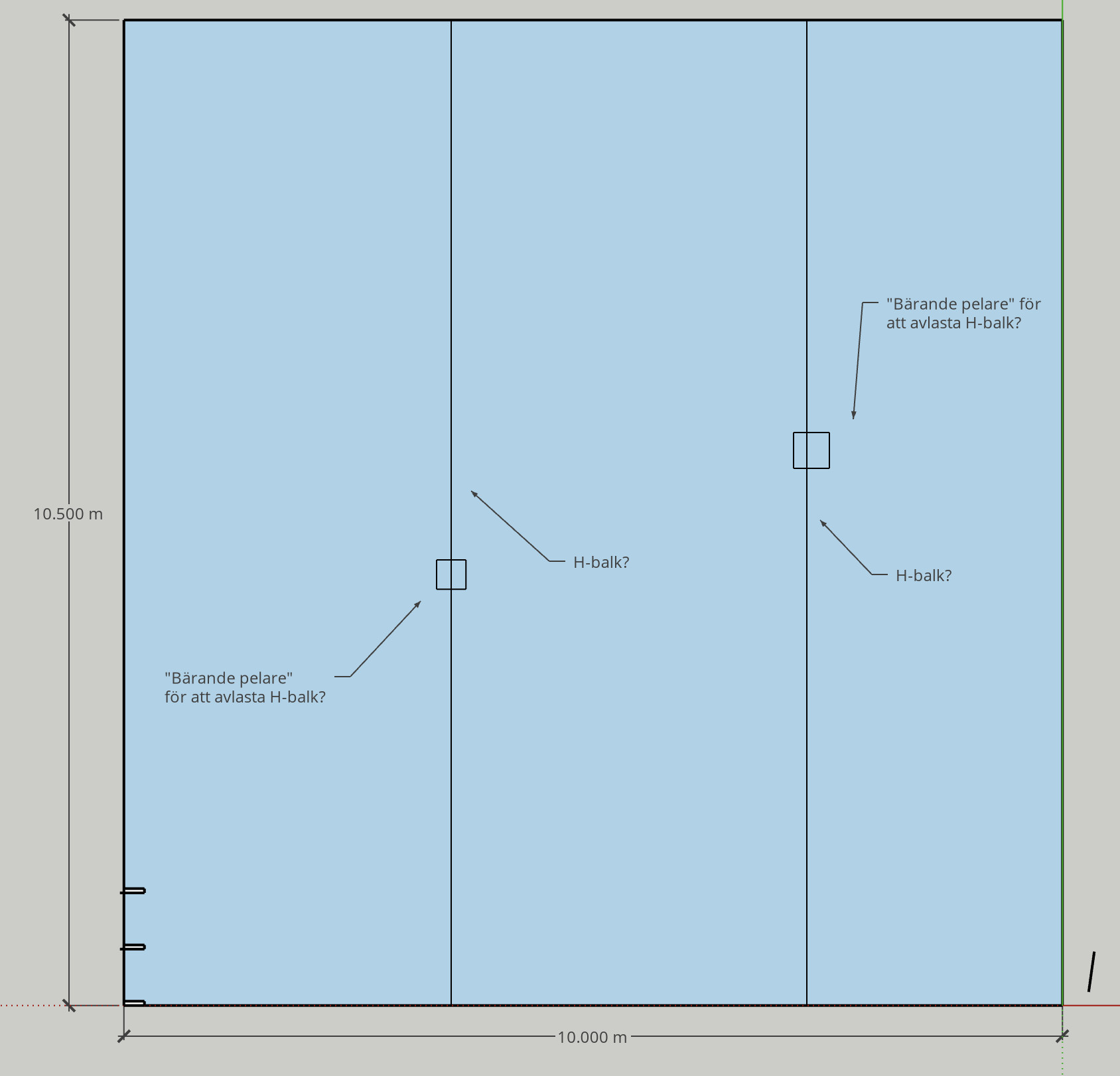
We are sketching a larger house where we require a total span (outer wall) of 10 meters on the short side. Since this span is, as we understand, a bit unusual, we would need some overall sense of dimensioning assumptions before hiring an architect and engineer.
Assumptions:
- Total span of 10 meters on the short side. The long side is 12m+
- Load-bearing partition wall can be placed in the range of about 4.25 - 5.00 - 5.75m within the span along the entire long side except for a length of about 1.8m where a hall connects to a living room.
- An upper floor above + a furnished attic
(- A brick chimney but I assume it doesn't have much impact)
Questions:
1) What dimension of load-bearing floor joists should we use? Is 45x220 sufficient?
2) To estimate the building height, etc., is it enough to count on about 30cm height being lost in the ceiling/floor joists/floor?
3) Will the floor joists be laid in one piece, i.e., 1x10m, in length over the load-bearing interior wall, or as 2x[4-6]m where each joist has one end resting on the interior wall? I assume the latter?
4) How wide does the load-bearing partition wall need to be to handle the load? Can we manage with a total of 20cm, or does it need to be wider?
5) I assume we need some form of beam between the load-bearing interior walls over the 1.8m length mentioned above? How is such a beam constructed?
6) Or is another solution needed to handle the span? Steel beams? If beams are required, does this add extra building height compared to the [30]cm I assumed in 2) above? What do steel beams need to rest on to be load-bearing?
We are looking at building a relatively square house (10x10.5m) and because of this, we need to have great flexibility in designing the room layout. Starting with "normal wooden construction" with load-bearing exterior walls, standard inner floors (45x220) etc., could it be conceivable to replace load-bearing inner walls with the H-beam solution below to maximize the flexibility to create and change the floor plan over time? Is there anything else one should consider?
Either each H-beam would measure 10.5m or they could be divided further into two approximately 4-6m in length each, depending on where a load-bearing column is placed?
On top of the square, a second floor would be built, followed by an attic with a gabled roof spanning 10m.
If you don't want to commit too much when it comes to the choice of flooring material, a realistic span for 45x220 C 24 timber is about 3.2 meters. Longer spans require glulam. If you want to create a floor system with layout freedom in both planes, a primary system with beams and columns (glulam or steel) and a secondary system with crossing beams in construction timber is suitable. In glulam, the primary system can consist of 115x405 mm beams and 115x115 mm columns. In steel, HEA 200 beams. The choice of column dimension is mostly about interaction with the beam.
If you were to use primary and secondary systems, have I understood correctly that with the steel option, you would build a primary system with columns and HEA200 beams, and then attach the secondary system's crossing construction timber beams to the HEA beams, meaning that the secondary system does not add additional height?
In other words: Can you achieve a maximum build height of about 300mm with these assumptions in a primary and secondary system with floor/ceiling etc?
This applies to both glulam and steel alternatives, where you can lower the crossing timber to keep the construction height down. With glulam, you can play more with width versus height. With a column, you should manage with 215x315 beams. It is advantageous if it can be solved with wood. Steel is more expensive, heavier, and more complicated.
By span, you usually mean the free length between supports, I believe (and hope) that's not what you actually mean? Then you'd probably end up with glulam of the fattest caliber.
As I interpret your drawing, and what I think you mean, is that you're looking for a span of 4-6m along the house (H-beams), and these have 3 supports (2 outer walls + 1 pillar). There's a free dimensioning program online, and it suggests that a rather slender glulam should do the job (like 56x225).
It would be interesting to see this floor plan that requires such openness
By span, you usually mean the free length between supports, I believe (and hope) that's not what you actually mean? If so, you'll probably end up with glulam of the fattest caliber
As I interpret your drawing, and what I think you mean, is that you're rather looking for a span of 4-6m along the house (the H-beams), and these have 3 supports (2 outer walls + 1 pillar). There's a free dimensioning program online and it suggests that slightly slender glulam should do the job (like 56x225).
What is important for us is:
a) the gable roof house's outer short side will have a width of 10m (which is longer than the normal 7-8.2m)
b) we will have rooms allowing load-bearing walls and possibly pillars, but in our preliminary room plan, we will need a free "span" of at least 5.75m at the longest
c) we do not want, if possible, to build a higher intermediate floor layer (ceiling, joists, floor) than 30cm
Which online dimensioning program do you recommend?
What is important for us is:
a) the gable roof house's outer short side will have a width of 10m (which is longer than the normal 7-8.2m)
b) we will have rooms that allow for load-bearing walls and maybe pillars, but in our preliminary room plan we will need a free "span" of at least 5.75m at the longest
c) we do not want, if possible, to build a higher mezzanine layer (ceiling, joists, floor) than 30cm
Which design software online do you recommend?
Now I understand a bit better. It sounds more like a traditional larger house model. If the mezzanine layer is to be limited in height as much as possible, it seems that 90x225 laminated wood can handle the span you're looking for. However, I think you'll have a hard time staying under 300 mm in the mezzanine layer including everything unless you go for steel. Just the ceiling and subfloor+floor are about 80 mm at the very least. If you're counting on some leveling compound, underfloor heating, and tiles in a bathroom, it quickly adds up.
If you don't have any restrictions on the total height of the house, then maybe consider allowing for higher joists. It's only an advantage to have a little extra space for installations and playing with floor levels, especially in a new house that will surely have larger ventilation ducts and underfloor heating.
You can quickly check dimensions on a range of constructions HERE
Then I understand a little better. It sounds more like a traditional larger house model. If the floor joists are to be as low in height as possible, it seems that 90x225 glulam can handle the span you are looking for. However, I think you'll have a hard time keeping the total height of the floor joists under 300 mm unless you go for steel. Just the ceiling and subfloor+floor go for about 80 mm at the very lowest. If you then add some levelling compound, underfloor heating and tiles in a bathroom, it quickly escalates.
Thank you! Glulam with shorter cc (e.g. 500) seems to solve my question. Thanks also for the sizing link.
Click here to reply
Vi vill skicka notiser för ämnen du bevakar och händelser som berör dig.