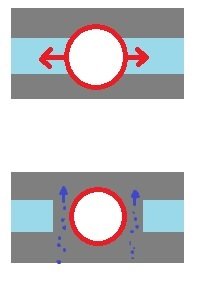
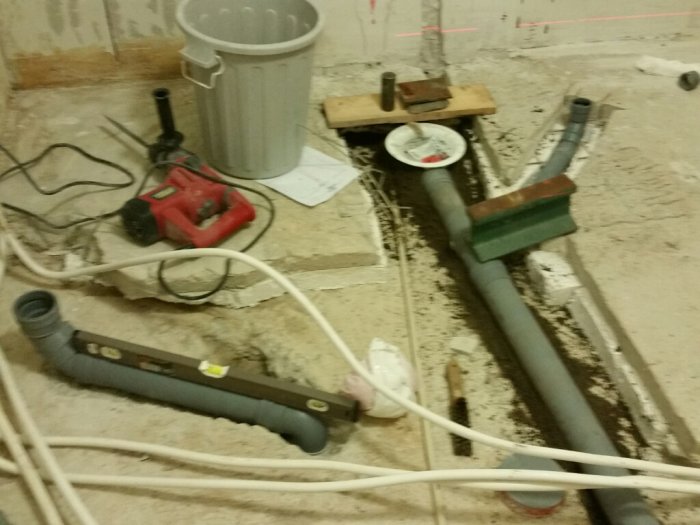
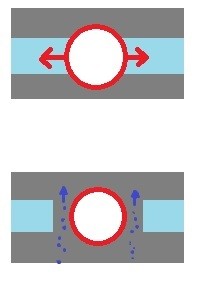
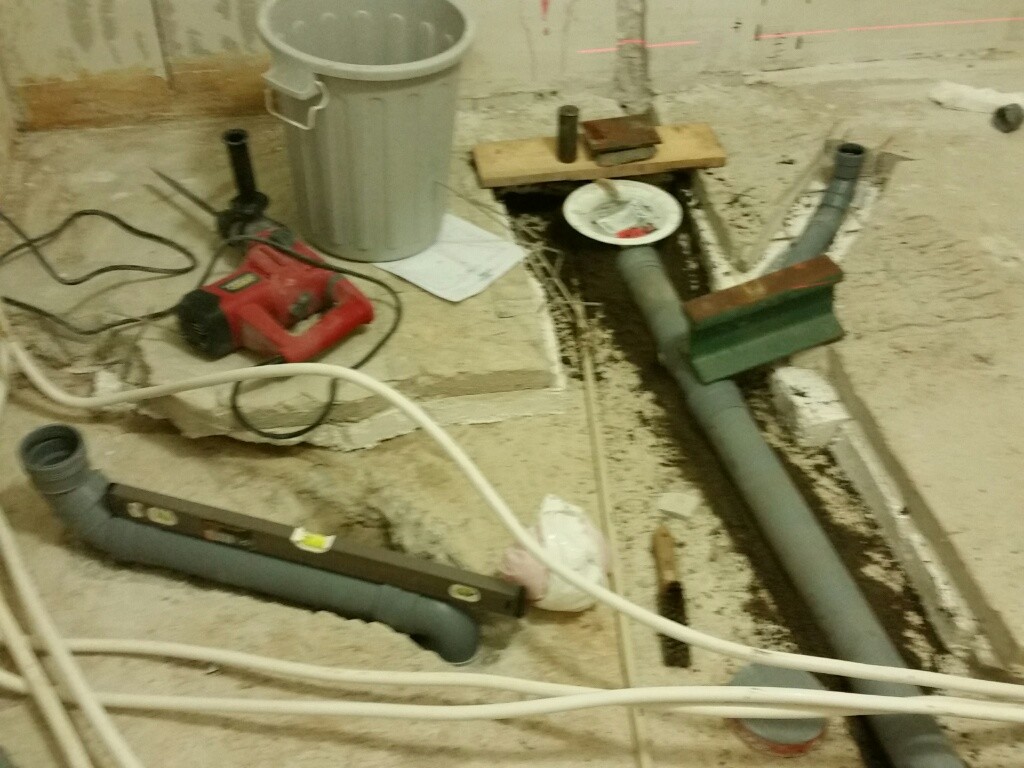
We have a slab with embedded styrofoam that functions as insulation and as a vapor barrier. Now I'm rerouting plumbing in the laundry room, and the new drains go right in the middle of the slab where the styrofoam was.
If I encase the drain pipes in concrete, I assume they will be more stable, but then I won't have a vapor barrier between the ground and the house around the pipe. (There will be a waterproof layer on the floor.) Alternatively, I could lay styrofoam all the way up to the pipe, but then it feels a bit like the drain pipe might risk being compressed. (Perhaps not so likely, right?)
Sorry, I meant "capillary-breaking" so that moisture is not drawn up into the slab.
Addition: It's a slab on grade, not a basement.
Under the foam insulation, you should have a capillary-breaking material; it's not the foam that is capillary-breaking. In the photos, it looks like you have soil under the foam insulation.
The construction is (from the bottom up) about 10 cm of concrete (with macadam), 6 cm of cell foam, and then 4 cm of reinforced concrete on top. Underneath everything is gravel... Placing plastic over it seems smart. I realized there was no layer where the pipes came up before; it was a few cm of concrete all the way around the old drains and floor drain... Not cell foam all the way to the front. Probably to stabilize the floor drain.
The house is from 1975.
The dark part visible in the picture is newly laid ROT-concrete under the pipes.
Under the polystyrene, you should have a capillary-breaking material; the polystyrene itself is not capillary-breaking. In the pictures, it looks like you have soil under the polystyrene.
/N