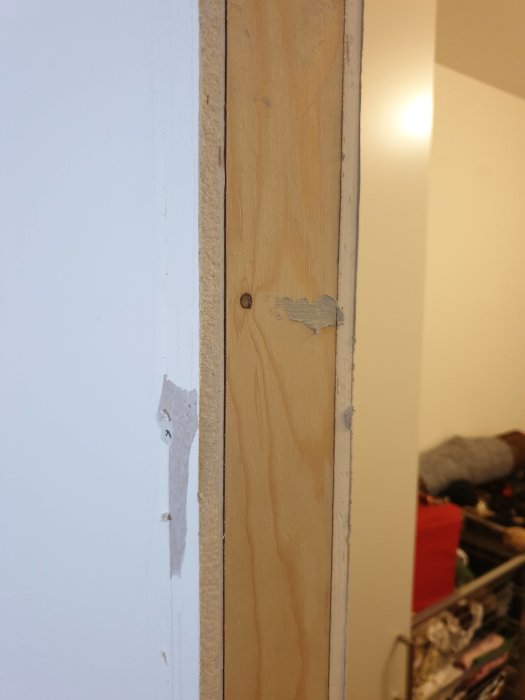
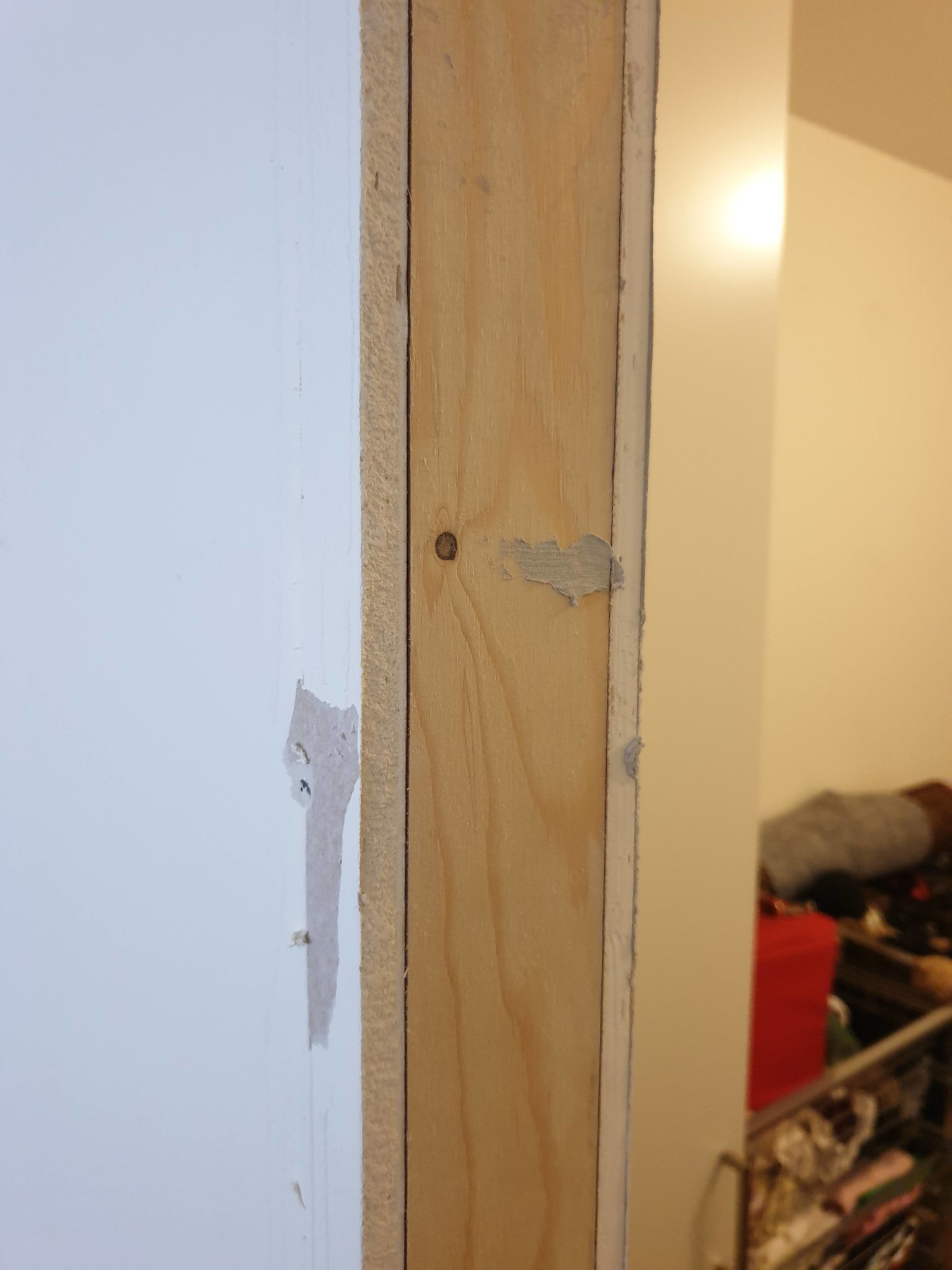
How do I best proceed here to close up where an interior door used to be, in the best way to prevent cracks after painting? The wooden frame is about 69mm wide, so I can't use 70x45 to build the frame, right?
The absolute best is if you saw the panel joint to the middle of the studs, otherwise use a metal stud or well-dried timber
If you saw the gypsum joint to the middle of the stud, do you avoid having to make a frame then? Is it enough with just noggins? What's the best way to cut from the gypsum, circular saw?
If you cut the drywall joint to the middle of the stud, can you avoid making a frame then? Is it enough with only nogging pieces? What's the best way to cut out from the drywall, a circular saw?
It looked like chipboard at first! Drywall can be cut with a drywall knife (utility knife) with a bit of effort, it can be sawed but it creates an absurd amount of dust! A stud on the floor and a post in the middle.
I would, as you are considering, cut 2 cm on each side and then just have cross-beams. Use a regular saw. It creates some dust but it's not too bad.
Then, regarding spreaders, bevel the edges where the drywall meets. Then use paper tape where you first apply joint compound, lay the paper tape, and then finish with more compound. This should really help keep cracks away.
However, I've had pretty good results with regular fiberglass tape (mesh) as well. I don't think that's a spot that moves much. It tends to be corners in houses, etc., that shift with the seasons.
I would, as you are considering, cut 2 cm on each side and then just have kortlingar. Use a regular saw. It creates some dust, but not too bad.
Then, regarding spreading, bevel the edges where the plaster meets. First, apply the paper tape where you spackle, then place the paper tape and finally finish spackling. This should indeed help prevent cracks.
However, I have also had quite good results with regular fiber tape (mesh). I don't think that area moves particularly much. It's usually corners in houses, etc., that move with the seasons.
meant that the circular saw creates dust! Sawing manually against a stud is possible, though not easy
The wall is exactly 95 thick, is it 70x45 noggins and drywall then?
You wrote the inner wood is 69 mm. But it's probably a 45x70 stud, which may have shrunk a bit over time. So buy that as noggins. Then 13 mm drywall on top of that.
You are unlikely to get an exact match to the current wall. That's the purpose of filler.
Fill wide at least 30cm over the joints so the irregularities disappear more.
Click here to reply
Vi vill skicka notiser för ämnen du bevakar och händelser som berör dig.

Johnny Viking said:
I would, as you are considering, cut 2 cm on each side and then just have kortlingar. Use a regular saw. It creates some dust, but not too bad.