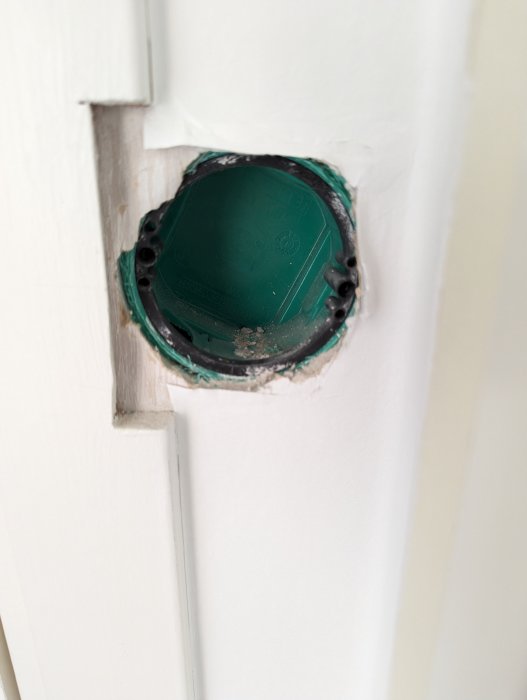
I have removed a previous switch since it was placed very poorly and had to be spliced into a door frame just to fit. There are no cables left, so I don't need to put a cover, but can completely seal it. However, my question is, what's the best way to do this? Should I try to remove the box so I can crudely frame behind and attach new drywalls there? Should I fill the box with drywall pieces until it sticks out far enough so that it can just be plastered over? What is the best way to tackle this?
I have plastered over a few such boxes. I remember filling them with husfix, and then plastering. We had ceiling heating from the 70s before. So there were 3 boxes at the entrance to each room. One for the regular light switch, one for the thermostat for the ceiling heating, and one for a power switch for the ceiling heating, which connected different numbers of loops in the ceiling.
Fill with hobby plaster so that you have a couple of mm left which you then putty. Plaster sets quickly which I like. Make sure you don't need to sand it. Hard as hell!
Fill with hobby plaster so that you have a couple of mm left which you then spackle. Plaster hardens quickly which I like. Make sure you don't need to sand it. Hard as h-ll!
Would it be possible to just use foam filler? I'm thinking it's much more convenient and easier to cut away if there's too much. Or maybe it's not so good to spackle over it?
I wouldn't use filler to fill a hole that large. It will likely collapse and/or crack.
Expanding foam in stages — maybe, but it tends to be quite porous, so there's a risk you might accidentally poke a hole in it later.
My suggestion:
Get a hole saw with the exact same or larger diameter than the hole. (If you can't find the right size, get a larger size and enlarge the existing hole with it.)
Cut out a round plate in a suitable material — wood, thin plywood, masonite, whatever — that fits in the hole.
Secure it in the box with screws that you screw into the mounting holes in the box. Countersink them so they don't protrude on the surface.
Fill the joints with filler and paint/wallpaper.
Done!
Expanding foam seems like a slightly odd choice here. It's possible that it works. As mentioned, drywall mud or something similar is probably the usual choice. Better to use a little too little. In the worst case, you can plaster an extra time.
Gypsum plaster is good here. It doesn't settle and before it hardens you can scrape it down. It's nicer to sand/scrape than house fix and similar products.
Would it be possible to just use foam sealant? I think it would be much smoother and easier to cut away if there's too much. Or maybe it's not so good to plaster over it?
Not my choice. Plastering directly on the foam sealant is too weak. And foam sealant is a nightmare to deal with. Sticks and swells.
It is possible to fill large holes with putty. But you must not be in a hurry. When you apply a lot, it will take time to dry, and in the meantime, it will sink and crack. But if you allow it to do so and apply layer upon layer, it is possible to fill large holes with putty. But I have never filled holes quite that large.
Click here to reply
Vi vill skicka notiser för ämnen du bevakar och händelser som berör dig.



janwide said:
