
6,811 views ·
11 replies
7k views
11 replies
Screw with plug - outdoors - does it exist?
Planning to screw into a wall made of LECA (outdoors)
For these screws to hold well in the LECA, plastic plugs seem like a good option.
That is, I need a screw that does not "rust" (withstands outdoor climate) and a fitting plastic plug.
Products "plug with screw" all seem to be designed for indoor use.
Finding plugs shouldn't be too difficult either. (though a plug with some length might be needed to suit LECA)
But screws...
All good screws for outdoor use seem to have self-drilling tips...
- Does the tip need to be cut off to prevent damaging the plastic plug?
- Is there a special plug for self-drilling screws?
- Should another fastening method be chosen for LECA? (e.g., expansion bolt)
or....?
Which solution is simplest / should I choose to achieve a durable solution?
(Currently, it is a door frame with a larger custom-made door that needs to be attached to the outside of the wall)
For these screws to hold well in the LECA, plastic plugs seem like a good option.
That is, I need a screw that does not "rust" (withstands outdoor climate) and a fitting plastic plug.
Products "plug with screw" all seem to be designed for indoor use.
Finding plugs shouldn't be too difficult either. (though a plug with some length might be needed to suit LECA)
But screws...
All good screws for outdoor use seem to have self-drilling tips...
- Does the tip need to be cut off to prevent damaging the plastic plug?
- Is there a special plug for self-drilling screws?
- Should another fastening method be chosen for LECA? (e.g., expansion bolt)
or....?
Which solution is simplest / should I choose to achieve a durable solution?
(Currently, it is a door frame with a larger custom-made door that needs to be attached to the outside of the wall)
If they are heavier items, it is recommended to use plastic plugs plus lag screws. These are usually hot-dip galvanized, and can also be found in stainless steel.
Thanks for the answers!
https://www.velltra.se/product/lattbetongskruv-8x100mm-50st Probably perfect for a stud. (45mm non-threaded and the rest threaded?)
But to attach a hinge (a couple of mm thick), would it feel better with threads all the way? (or am I wrong?)
I had chosen this hinge .: (86-2901) https://www.biltema.se/bygg/gangjarn/dorrgangjarn/justerbara-dorrgangjarn-2-st-2000024273 But it was out of stock and won't be in for ?? weeks, so the hole size is still uncertain...
(Lightweight concrete screws also don't seem to be available under 8mm)
Then there are quite a few holes to fasten a hinge with (4-5 in the wall...)
Started thinking when I saw "stainless"... Are there other stainless screws to use with plugs?
How would HVAC screws work with plugs? https://www.biltema.se/bygg/fastelement/byggskruvar/vvs-skruv-rostfri-2000034242
or why not stainless sheet metal screws? https://www.biltema.se/bygg/fastelement/platskruvar/platskruv-rostfri-2000021592
or is the screw too finely threaded to work with plastic plugs?
Then looked at plugs e.g. https://www.biltema.se/bygg/fastelement/pluggar/universalplugg-2000022299
Plug dimensions are listed in the text (e.g. Ø 6 x 35 with collar), but not which screw size fits this specific plastic plug...
Then there seem to be lightweight concrete plugs (but that's just for lightweight concrete? not LECA?) e.g. https://www.byggmax.se/lättbetongplugg-p24650#884=14378 (too expensive?.)
or is a special lightweight concrete plug always required? another example https://www.velltra.se/product/lattbetongplugg-10x55-40st (somewhat cheaper)
Would it be a similar screw?C C.Lundin said:
https://www.velltra.se/product/lattbetongskruv-8x100mm-50st Probably perfect for a stud. (45mm non-threaded and the rest threaded?)
But to attach a hinge (a couple of mm thick), would it feel better with threads all the way? (or am I wrong?)
I had chosen this hinge .: (86-2901) https://www.biltema.se/bygg/gangjarn/dorrgangjarn/justerbara-dorrgangjarn-2-st-2000024273 But it was out of stock and won't be in for ?? weeks, so the hole size is still uncertain...
(Lightweight concrete screws also don't seem to be available under 8mm)
Might need a countersunk head since it primarily concerns hinges or a construction angle directly against the leca-wall.? (i.e., thin products)T Thomas_Blekinge said:
Then there are quite a few holes to fasten a hinge with (4-5 in the wall...)
Started thinking when I saw "stainless"... Are there other stainless screws to use with plugs?
How would HVAC screws work with plugs? https://www.biltema.se/bygg/fastelement/byggskruvar/vvs-skruv-rostfri-2000034242
or why not stainless sheet metal screws? https://www.biltema.se/bygg/fastelement/platskruvar/platskruv-rostfri-2000021592
or is the screw too finely threaded to work with plastic plugs?
Then looked at plugs e.g. https://www.biltema.se/bygg/fastelement/pluggar/universalplugg-2000022299
Plug dimensions are listed in the text (e.g. Ø 6 x 35 with collar), but not which screw size fits this specific plastic plug...
Then there seem to be lightweight concrete plugs (but that's just for lightweight concrete? not LECA?) e.g. https://www.byggmax.se/lättbetongplugg-p24650#884=14378 (too expensive?.)
or is a special lightweight concrete plug always required? another example https://www.velltra.se/product/lattbetongplugg-10x55-40st (somewhat cheaper)
There are good systems (screw - plug) that work, they usually cost a bit more than what the "building sheds" often provide, but they stick like rock. For example, screws with accompanying plugs from Hilti hold, there are more suppliers but I have experience with Hilti (not an employee). My bearing line for the deck is secured with hot-dip galvanized screws with matching plastic plugs directly into the lecastenen, the screw bites so well into the plug that it easily presses a square washer into the bearing line. An alternative could be this combination: https://www.hilti.se/c/CLS_FASTENER_7135/CLS_PLASTIC_ANCHORS_7135/r4676 Choose the longer lengths, I would recommend a plug length of at least 90-100 mm (in leca) then you can choose the screw length based on the thickness of what is to be attached. In this "combination" the plug is also secured in what is to be attached. But if you talk to a fastener specialist about what you want to attach, you should get a screw with a plug that holds, don't choose Byggmax, Bauhaus, Hornbach, or similar stores as they know nothing about fastenings. Leca is one of the "most sensitive" materials to fasten into, so no "ordinary" screws are recommended if you want what you are mounting to stay in place for some time. I myself had to supplement the door frame fastening of the garage door where the frame was mounted with 70 mm plugs to frame screws which did not hold. Now there are extra-long frame screws above each previous screw with 140 mm long plugs, and now the frame sits as it should... French timber screw in plastic plug I would not recommend because the hot-dip galvanized screw is so "coarse" in the thread itself that there is a great risk it will "just" twist the plug when it is being threaded because the leca is porous. Attaching a hinge directly into leca I would also not recommend because the fastenings (screw+plug) come close to each other in the leca, which will not hold if you drill several holes close together. It is better to attach a frame or beam into which you then mount the hinges with ordinary wood screws. With the frame/beam solution, you can spread the fastenings so they do not come too close.

I can personally say that you are directly wrong that regular wood screws work in lightweight concrete, not even with gypsum plaster.Rickard.ag said:
Maybe if you're hanging up a small picture, but not if you're mounting electrical outlets or other things that experience tug and pull.
Electrical outlets can be tricky, as they take a beating and are difficult to secure with large screws. In my experience, long and thick screws are necessary; otherwise, it's junk. So, some plastic plugs and possibly glue should be able to solve your problem.
But the lightweight concrete screw is awesome when you can use them; my ~180kg gun cabinet hangs in the air on 2 screws in leca.
Edit. I realize now that I didn't contribute anything, I'll read more carefully in the future. Going to find the embarrassment pillow
But the lightweight concrete screw is awesome when you can use them; my ~180kg gun cabinet hangs in the air on 2 screws in leca.
Edit. I realize now that I didn't contribute anything, I'll read more carefully in the future. Going to find the embarrassment pillow
Last edited:
Good tips! (looked at the Hilti link - But what does Anchor size / Anchor length mean?R roli said:
I don't know what to ask / search for to find good alternatives (e.g., ESSVE or similar) Hilti calls this a universal plug.
I also have that feeling... (hence the question)R roli said:
A good point. The door will be a special door in dimensions (both thickness and size) and will practically lack a frame. (it will be mounted outside the LECA wall to not reduce the opening width)R roli said:
Lightweight concrete screws sometimes work well and are easy to use, but another question arises, is the mortar between the stones more durable than the LECA stone itself? (my LECA blocks are of the old type with 1cm mortar between the stones and 200mm thick with some reinforcement) To hold a guiding board or similar against the LECA wall (not holding something that moves), an ordinary wood screw works well.
Electric outlets are tricky... (It's problematic to fasten small screws in LECA blocks, but this is another challenge...)
It has happened indoors that I've drilled a hole and mixed some Housefix and filled the hole, and then pressed in a plastic plug to fasten in. (and it has worked - but I've always used long, narrow screws)
Have "redrawn" the door a bit to avoid screwing the hinge directly into the LECA stone and instead screw into a double rule.
Some plug & screw can hold the form board (and the angle irons) that the rules are attached to. (will see if I find anything "cheaper" than Hilti - don't really need 50pcs.
). But if not, it will be a Hilti solution (if I manage to figure out what Anchor size / Anchor length is...)Can add a small sketch of the door
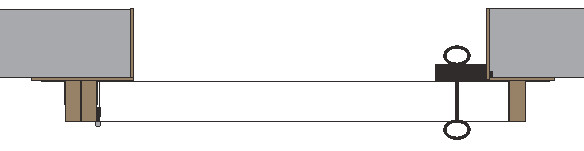
Anchor size = the diameter of the plug = drill dimensionA Albireo said:
Anchor length = the length of the entire plug
See further down the page for "instructions" where there are some interesting details on how to install.
It never reveals how thick the screw is, but maybe it doesn't matter since the plug should go through the construction angle hole. (otherwise, you could have used a smaller hole for the screw - closer to the root of the construction angle, and get more plug in the wall - with a longer screw).
Lättbetongskruv - Byggmax They mean that I should manage without a construction angle on a beam max 45mm with their screws (pull-out force = 150kg in LECA) - Now the beam will be pressure impregnated and maybe be 120mm.
Other suppliers seem to call similar screw joints e.g. ESSVE facade plug
Lättbetongskruv - Byggmax They mean that I should manage without a construction angle on a beam max 45mm with their screws (pull-out force = 150kg in LECA) - Now the beam will be pressure impregnated and maybe be 120mm.
Other suppliers seem to call similar screw joints e.g. ESSVE facade plug
Click here to reply