I need help with the easiest way to screw/attach brackets on a concrete wall. There are two walls (outer walls) with aerated concrete, and two walls (inner walls) with cast concrete. There are a lot of screws needed, so I really want to minimize the work as much as possible.
We have started renovating the basement den. First, it was the wall, and now we will temporarily install new skirting boards. They will stay up for a few years until we change the floor to a mechanically ventilated floor, but the original baseboards were simply too damaged and covered in paint and floor varnish to keep.
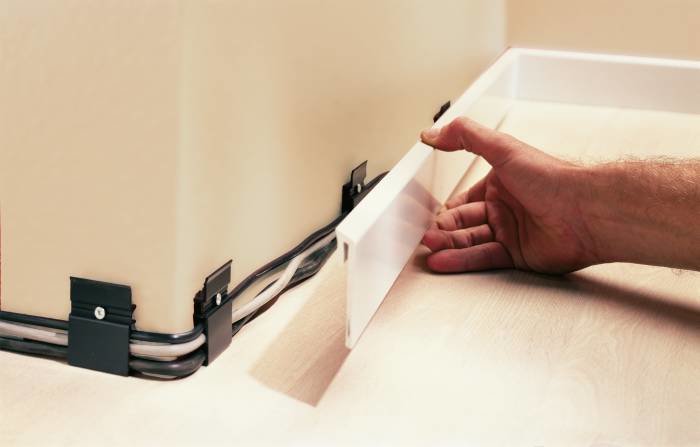
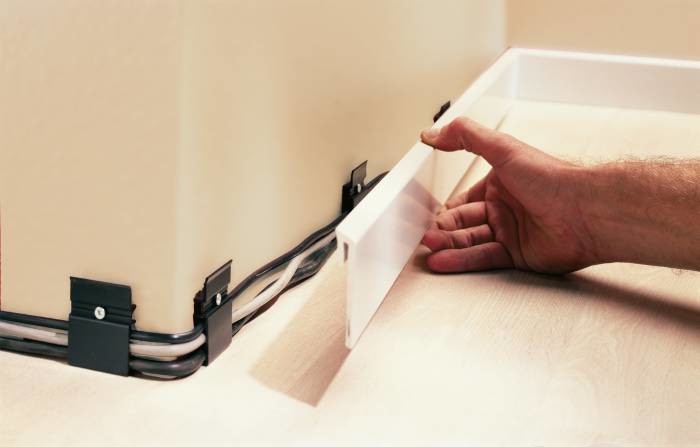
We have bought plastic skirting boards that are to be screwed into the wall, Primo classic, and we intend to "ventilate" them with evenly spaced drill holes.
They need to be fastened approximately every 30-50 cm, but I assume we might get away with every 70 cm. No one will access the panel, the screws just need to hold for us to click on the panel. We have roughly 60 meters of wall.
I'm not particularly handy. I grew up in a concrete house and cursed (along with my parents) every time something needed to be put on the wall; we always managed to damage the wall in some way. A nightmare every time! In our current basement den, the workers (from 1969) left large holes in the concrete when they nailed the old baseboard.
Can someone help me avoid creating new nightmares?
PS If anyone is wondering why we are not renovating everything in the basement den at once: Unfortunately, we don't have the time right now, but the walls were too disgusting, and we needed to clean and paint them. They had 50+ year old dusty burlap laid in cracked wallpaper paste, and a previous water damage on top.
Where the wall is soft enough, you might manage to use concrete screws. Otherwise, using plugs is necessary. To plug properly and ensure it's a good experience and not a struggle for life, you need the following:
1. A good rotary hammer, not some cheap percussion drill from a discount chain.
2. Good plugs, not crappy plugs that are a hassle and spin wildly. For example, this one.
3. Good screws with a Torx head, so you don't have to struggle with the screw.
4. A screwdriver to drive in the screw.
Follow the steps above, and it will go quickly and be as painless as possible. If you cut corners, it will be more frustrating.
It can be convenient to use nail plugs for moldings in concrete/brick. It might not look entirely optimal if you look at your mounts, but it's perfect for regular moldings if you countersink the head. Even if you have to separate the "nail," it might be faster than regular screws.
We've lived in three apartments with brick walls, and you make a mistake if you use a hammer drill, as the holes become too large. You can reduce the diameter or use it without the hammer function. I'm wondering if gasbetong is porous as well?
I can recommend a screw called Walldog that can be used in most materials, but in concrete, you must pre-drill; no plugs needed. Available at Clas brede Ohlsson, among others. A bit more expensive but very good.
That was the first thought, until we received the brackets (the black ones in the picture). They sit on the wall with about two pieces area of 40 mm x 1 mm, I don't think I can get it to stay even in calm weather ...
I agree. If you're not hiding cables in the moldings, it seems like you've chosen an unnecessarily cumbersome solution.
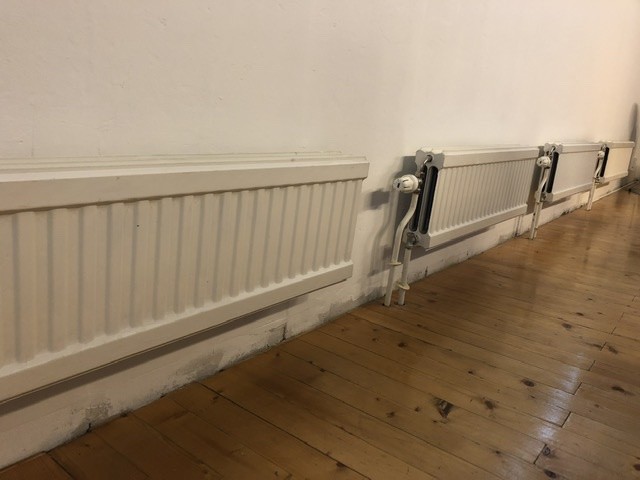
Yes, maybe - but we need to ventilate the floor, meaning we need to have/create small holes in the skirting board and holes behind it. Plus, we also need to install the skirting behind four wall-mounted radiators; the wooden skirting that was there had been installed before the radiators, so we need to be able to bend the skirting slightly to fit it behind the radiators (wall-mounted water radiators where the water comes up from the floor to each radiator). Or saw it into many small pieces. That's why we ended up with the hollow-plastic solution but missed that the mount has such a small area against the wall.
But, we will test the suggestions here, if it becomes too difficult, we'll see what we can do with other skirtings and glue. Grateful for all the responses that have come in!
At the same time, how much strain is there really? If there are a few square centimeters of contact surface per clip and you have one per half meter, it should probably be fine. PL400 adheres to most things...
Click here to reply
Vi vill skicka notiser för ämnen du bevakar och händelser som berör dig.