
10,783 views ·
28 replies
11k views
28 replies
Sagging parquet floor (Kährs 13 mm)
If you have pictures of what's under the kitchen, it's easier to give advice.
Where it gives way, is the floor bulging upwards there, or is it flat? Because if it's bulging upwards, it could also be because the floor has shifted but didn’t have room for it because you placed the kitchen on top of it elsewhere.
It should be possible to drill and fill, but the best thing is to take it up and fix the dip if it is indeed a dip and not because the floor has shifted.
Where it gives way, is the floor bulging upwards there, or is it flat? Because if it's bulging upwards, it could also be because the floor has shifted but didn’t have room for it because you placed the kitchen on top of it elsewhere.
It should be possible to drill and fill, but the best thing is to take it up and fix the dip if it is indeed a dip and not because the floor has shifted.

Hello,Grillen said:
Do you have pictures of what's under the kitchen? It would be easier to give advice with that.
Where it sags, does the floor bulge upwards there or is it flat? If it bulges upwards, it could be because the floor has moved but doesn't have room since you've placed the kitchen elsewhere on top.
It should be possible to drill and fill, but the best thing is to lift it and fix the dip if it's indeed a dip and not because the floor has moved
Thank you very much! I will gladly and gratefully send pictures tonight. I'm at work now.
The parquet floor sags downwards and it feels like the surface underneath is uneven, like a dip as you mentioned.
If one drills and fills the floor, will it be a good long-term solution, or is there a risk that it might cause the floor to become uneven elsewhere?
Have a nice day!
Regards!
If the entire space under the floor is filled, there shouldn't be any problems, but you never know how large the dip is and if you can manage to fill it completely, so you can never guarantee it will be 100%. As for what is best to fill with, I don't know, but a floor installer should be able to answer that.
Whether it's them who laid the floor or you as the customer who has to bear the cost of redoing it depends entirely on how the contract looks or what you have agreed upon. It's not entirely certain that those who laid the floor did wrong by not "seeing" the dip if it's not something you agreed upon, that the underlying floor should be checked, even if one might think it is something that a reputable company should always do.
Whether it's them who laid the floor or you as the customer who has to bear the cost of redoing it depends entirely on how the contract looks or what you have agreed upon. It's not entirely certain that those who laid the floor did wrong by not "seeing" the dip if it's not something you agreed upon, that the underlying floor should be checked, even if one might think it is something that a reputable company should always do.
If you hire a craftsman for a job, you should expect them to follow the manufacturer's recommendations for the material they use.
In this case, a Kärcher floor where tolerances are specified in the installation instructions. It is therefore just a matter of lodging a complaint about the work.
In this case, a Kärcher floor where tolerances are specified in the installation instructions. It is therefore just a matter of lodging a complaint about the work.
Hi,Do you have pictures of what is under the kitchen, it is easier to give advice.
Where it sags, does the floor bulge upwards there or is it flat? Because if it bulges upwards, it may also be because the floor has moved but hasn't had space for it due to placing the kitchen on it in a different place.
It should be possible to drill and fill, but the best is to lift it up and fix the dip if it is a dip and not because the floor has moved
Now I have some pictures. As you see in the pictures, the kitchen is placed along the parquet. Do we still need to saw the floor under the cabinet? I mean, expansion happens mostly in length and not width, right?
One picture shows where it sags. I’ve tried to make an approximate circle around where it bulges.
The other picture shows what it looks like under the cabinet. The legs of the fridge/freezer are a bit further forward than the cabinet legs. Is it possible to saw out anyway in a line that follows the cabinet legs?
Another picture shows where it creaks when you walk. It looks like there is enough space for the floor to move towards the walls.
Have a nice evening!
A big, big thank you for all the advice! It helps us enormously.
Best regards!
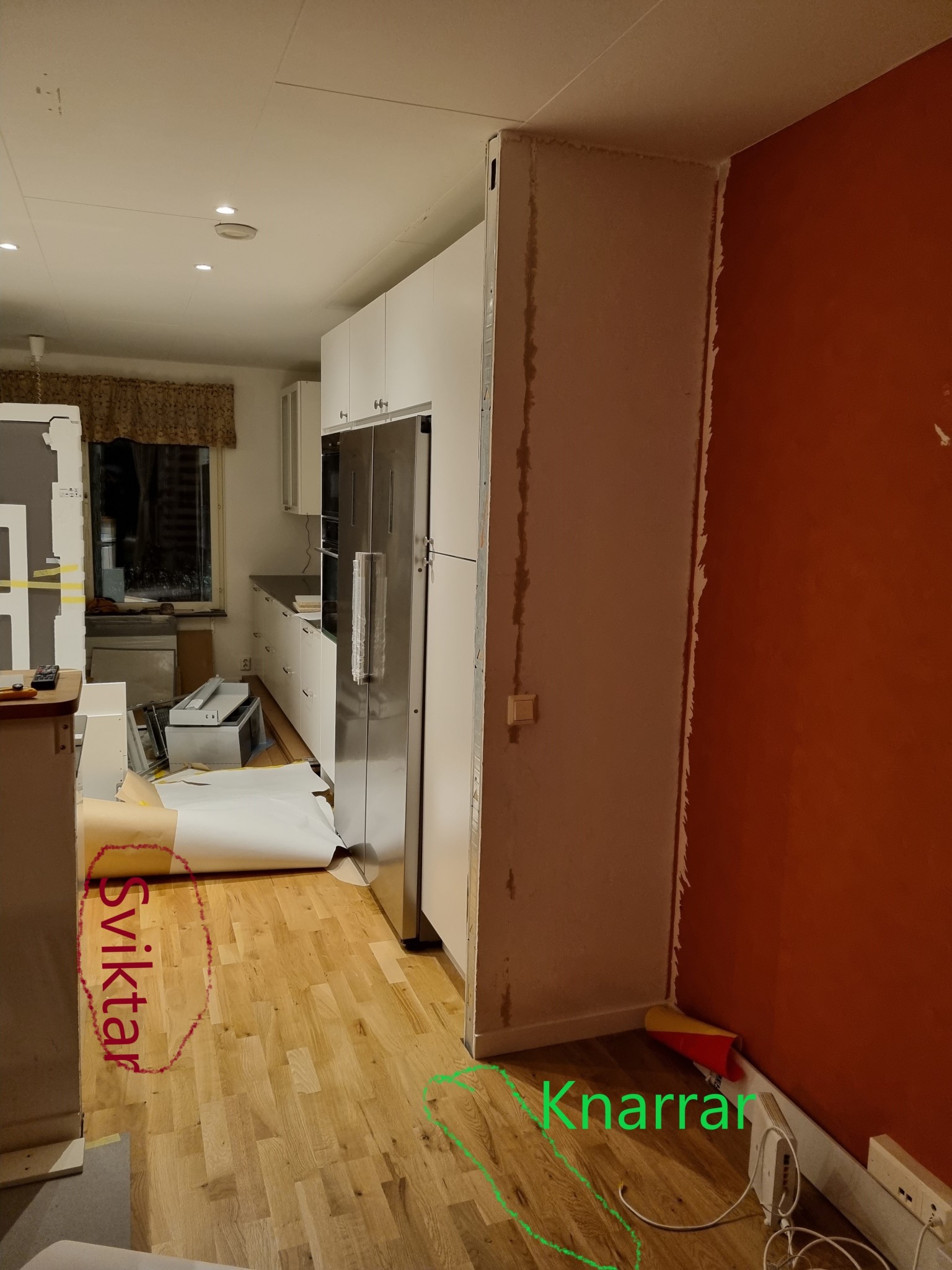
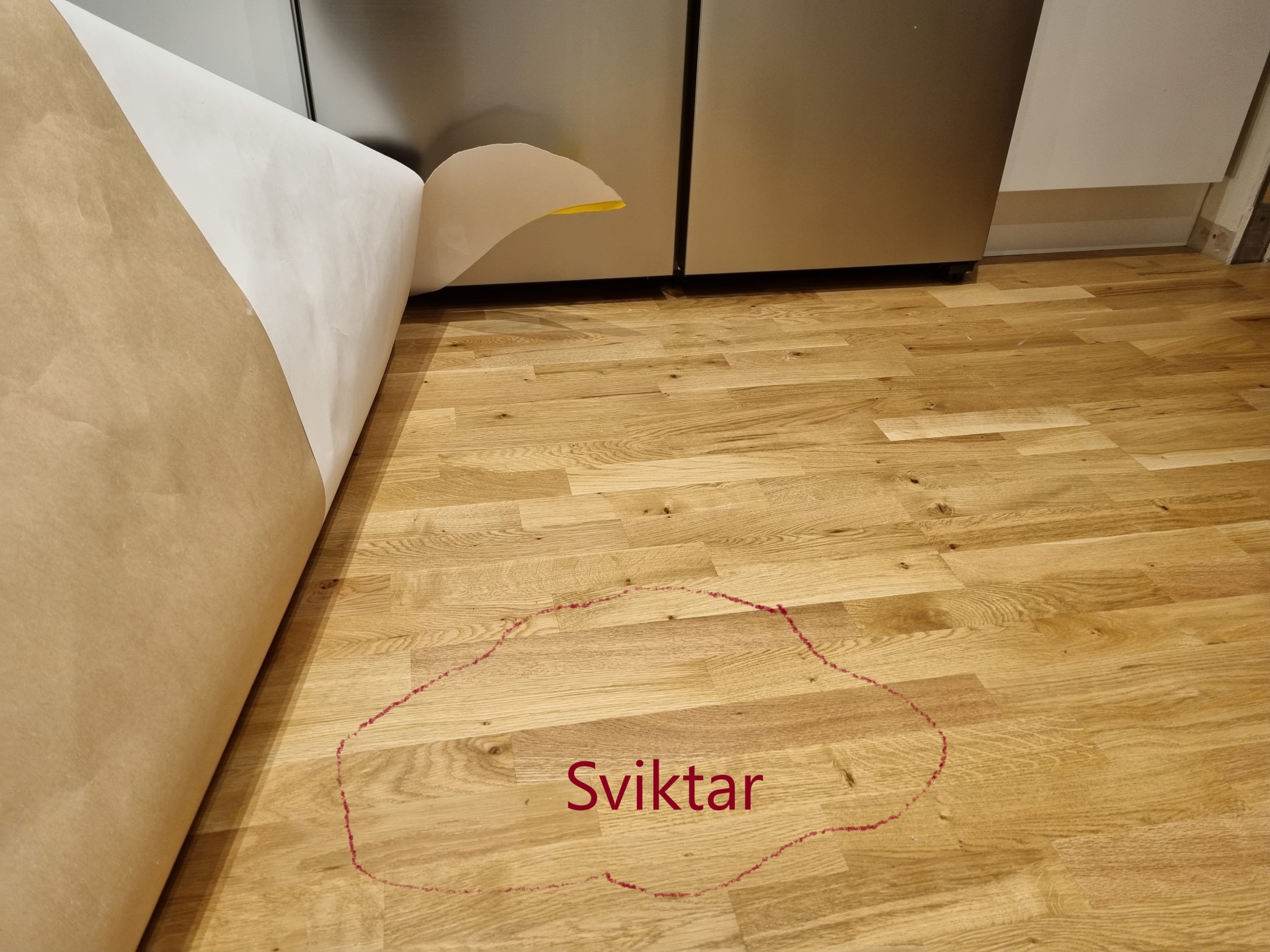
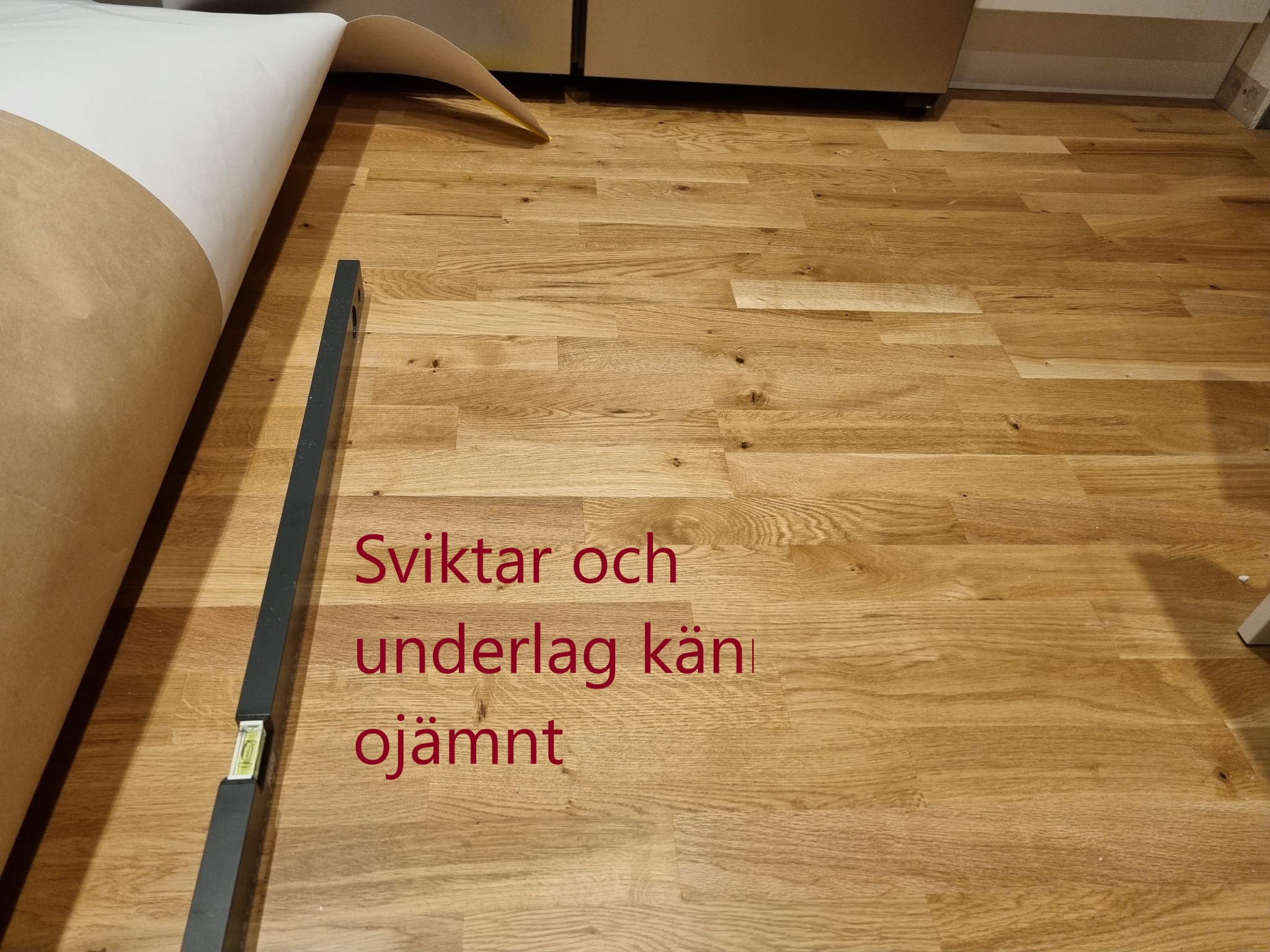
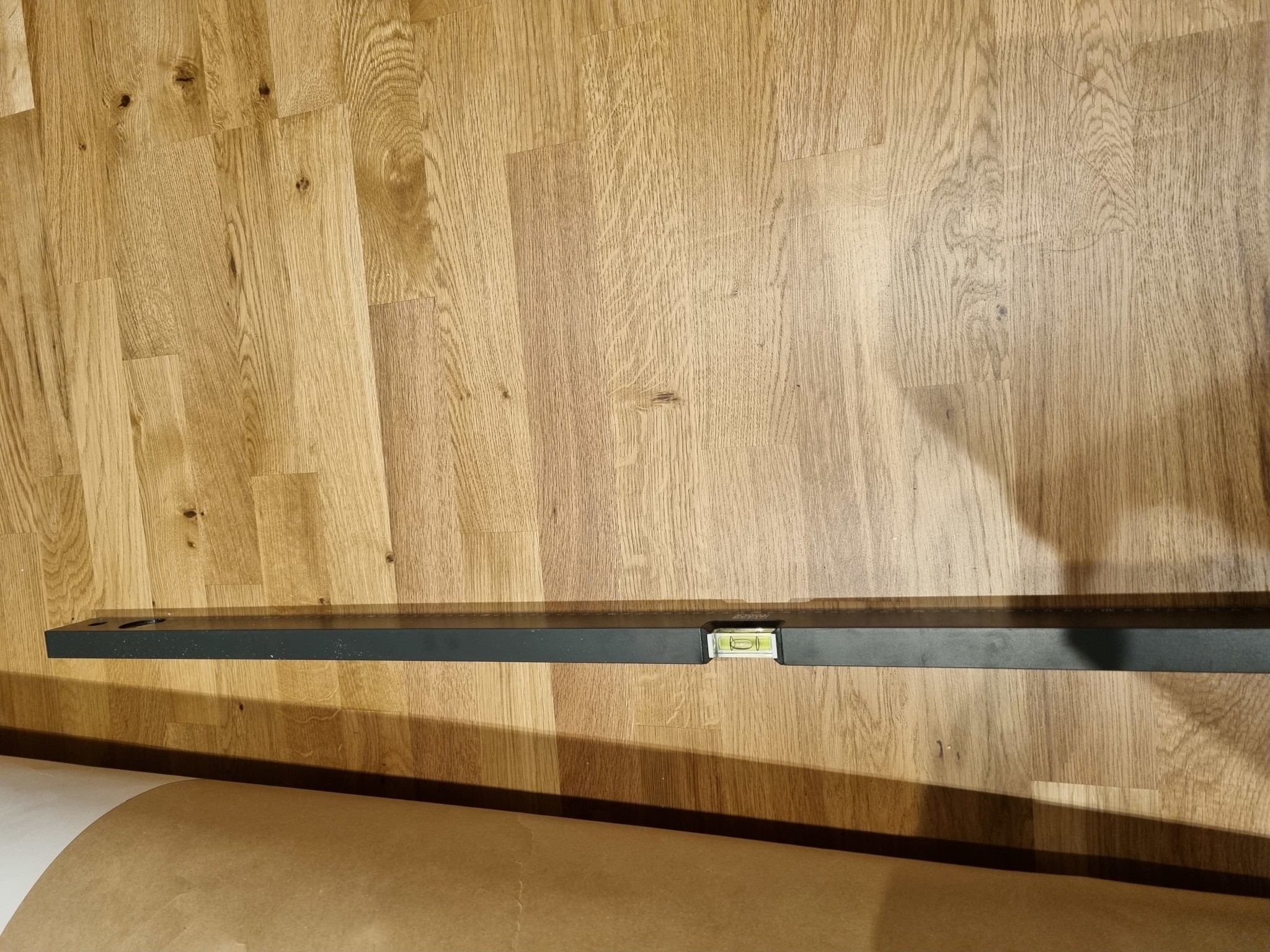
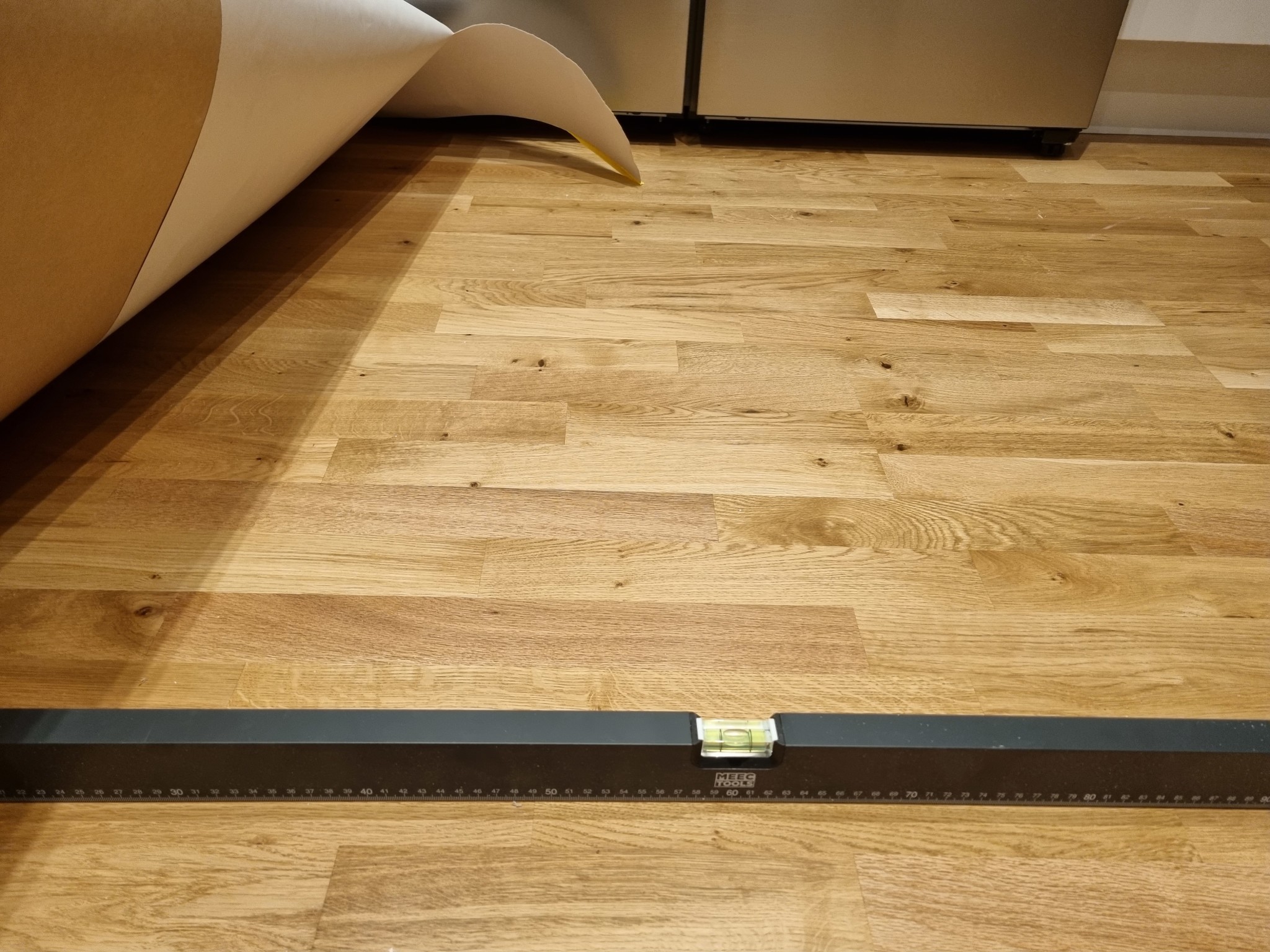
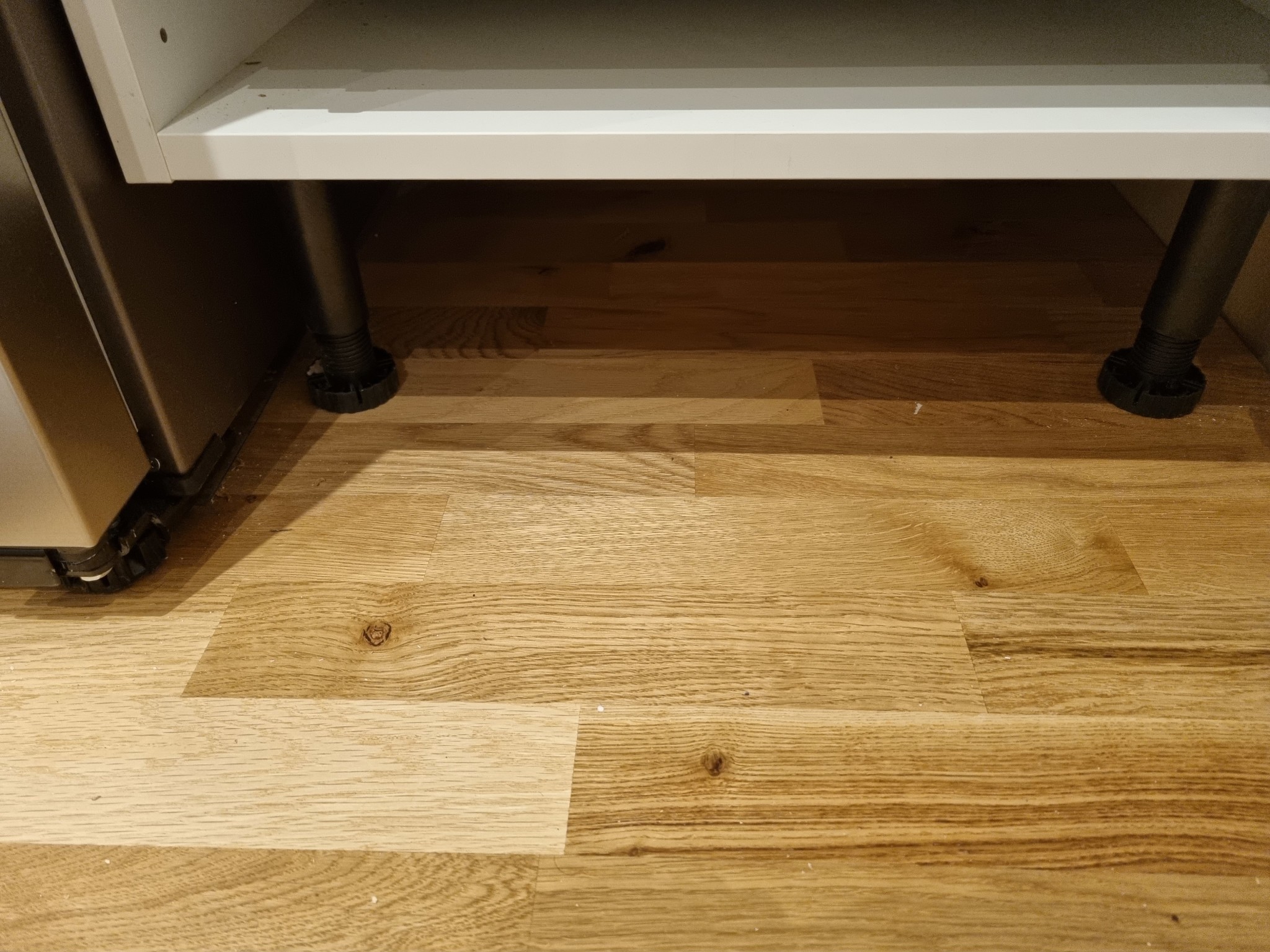
If a movement allowance is cut by the kitchen cabinets and fridge/freezer, it should be easy to pick up the floor and fill in the substrate, which should have been done from the start.
That way, it will be done properly without the risk of other problems later on.
That way, it will be done properly without the risk of other problems later on.
Thanks! Yes, the fridge/freezer can be moved without any problem. Do you mean to cut just outside the cabinet feet?mexitegel said:
If so, is it okay if the back feet of the fridge/freezer are on the "island" and the front feet on the floating floor? This is because the fridge/freezer has feet that are further forward.
Can one level locally with self-leveling compound?
You guys are stars! Really grateful for all the help and advice!
Best regards!
Last edited:
Exactly, the cut is hidden behind the baseboard.
As for the fridge/freezer, it's not a problem as it usually manages without an expansion joint, so you might also be able to wait and see how it turns out.
In your case, it's probably easiest to hand level. For example, using combimix CM840 and smoothing it out with a straightedge will make it smooth and good.
As for the fridge/freezer, it's not a problem as it usually manages without an expansion joint, so you might also be able to wait and see how it turns out.
In your case, it's probably easiest to hand level. For example, using combimix CM840 and smoothing it out with a straightedge will make it smooth and good.
Hi,Exactly, so the cut is hidden behind the baseboard.
As for the fridge/freezer, it is not a problem as it usually manages without an expansion joint, so you might also wait with that and see how it turns out.
In your case, it is probably easiest to hand trowel. For example, with combimix CM840 and use a straightedge to make it smooth and good.
Thank you so much for the tip. It's a slab-on-grade floor. The floor heating coils are in thick ESP-boards. The ESP-boards are on concrete.
Can you trowel there with combimix CM840, for example?
Here's a picture of how the substrate is everywhere and exactly where it gives.
Have a great day!
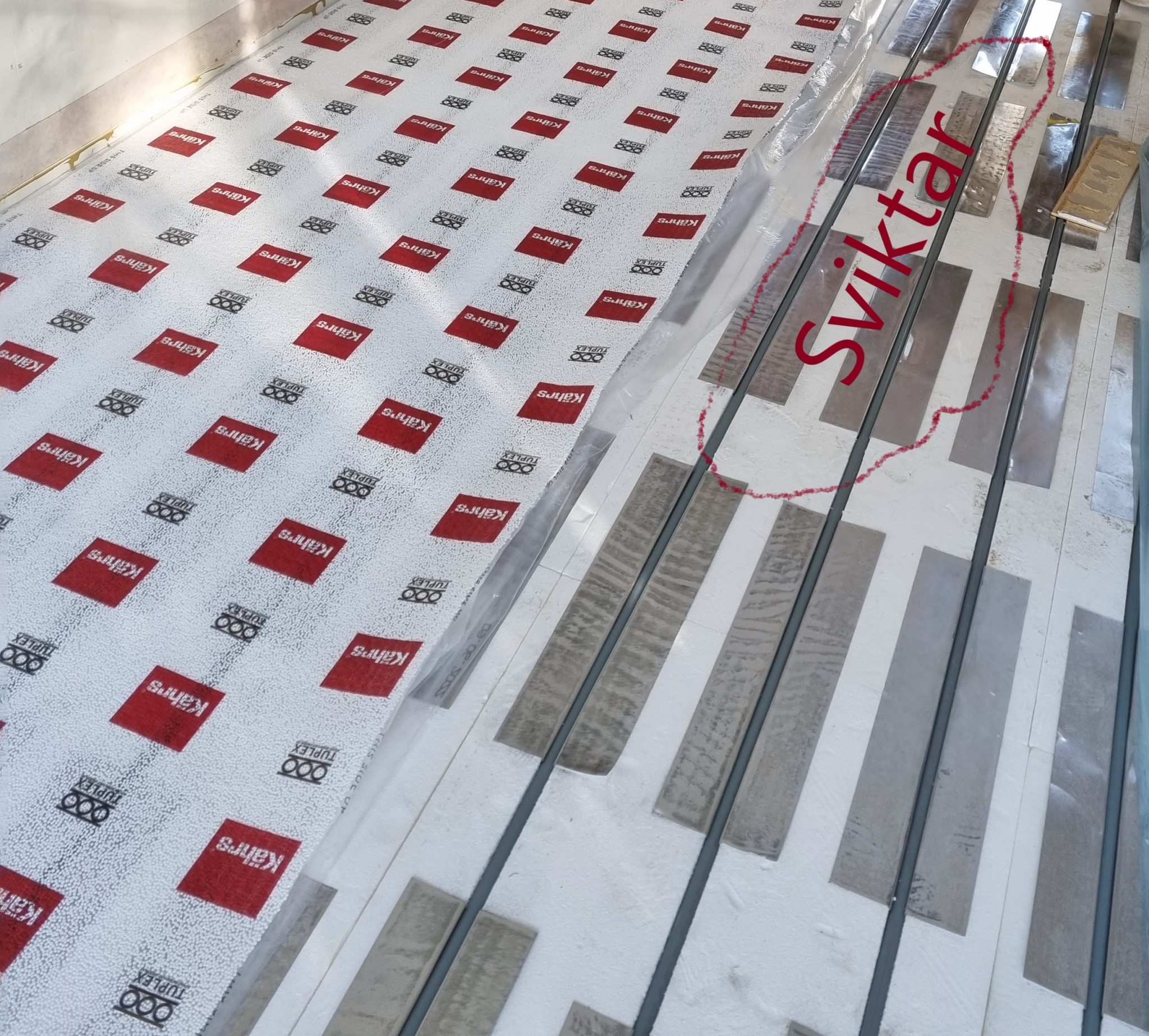
Hi,D densomkanvet said:
Previously it was about the same base: a layer of moisture barrier Styrofoam + 1mm foam for sound insulation.
Now we laid Tuplex (3 mm) which does both.
2 neighbors have changed in exactly the same way.
The only difference is that previously the floor was a bit thicker and it was glued and not clicked.
He did a little self-leveling compound on a small part (it wasn't in the kitchen) where it was a bit shaky.
Last edited:
Thank you for the answer! No, I don't think so. Otherwise, it would be giving way somewhere else too. It's about 54 sqm of floor and it gives way in one spot and creaks in another.
I think that there's an uneven surface underneath where it gives way. And if the craftsman evens it out with some compound (spackle), then it shouldn't give way anymore.
Is there a spackle that can work on top of the heating coils?
Regards!


When it comes to parquet flooring and kitchens, it depends on what type of kitchen it is. Floor manufacturers usually believe that if the kitchen cabinets are mainly wall-mounted and only have support legs, like Ikea's, then it's fine to have the floor under the kitchen cabinets. However, if the kitchen cabinets have their weight mainly on the floor, such as kitchen islands, the floor should not extend under the cabinets. Call Kährs and ask.
Click here to reply