
4,311 views ·
13 replies
4k views
13 replies
Roof with a slope - within tolerance or not?
Hello
I need to consult your expertise regarding my ceiling in the hallway which is sloping.
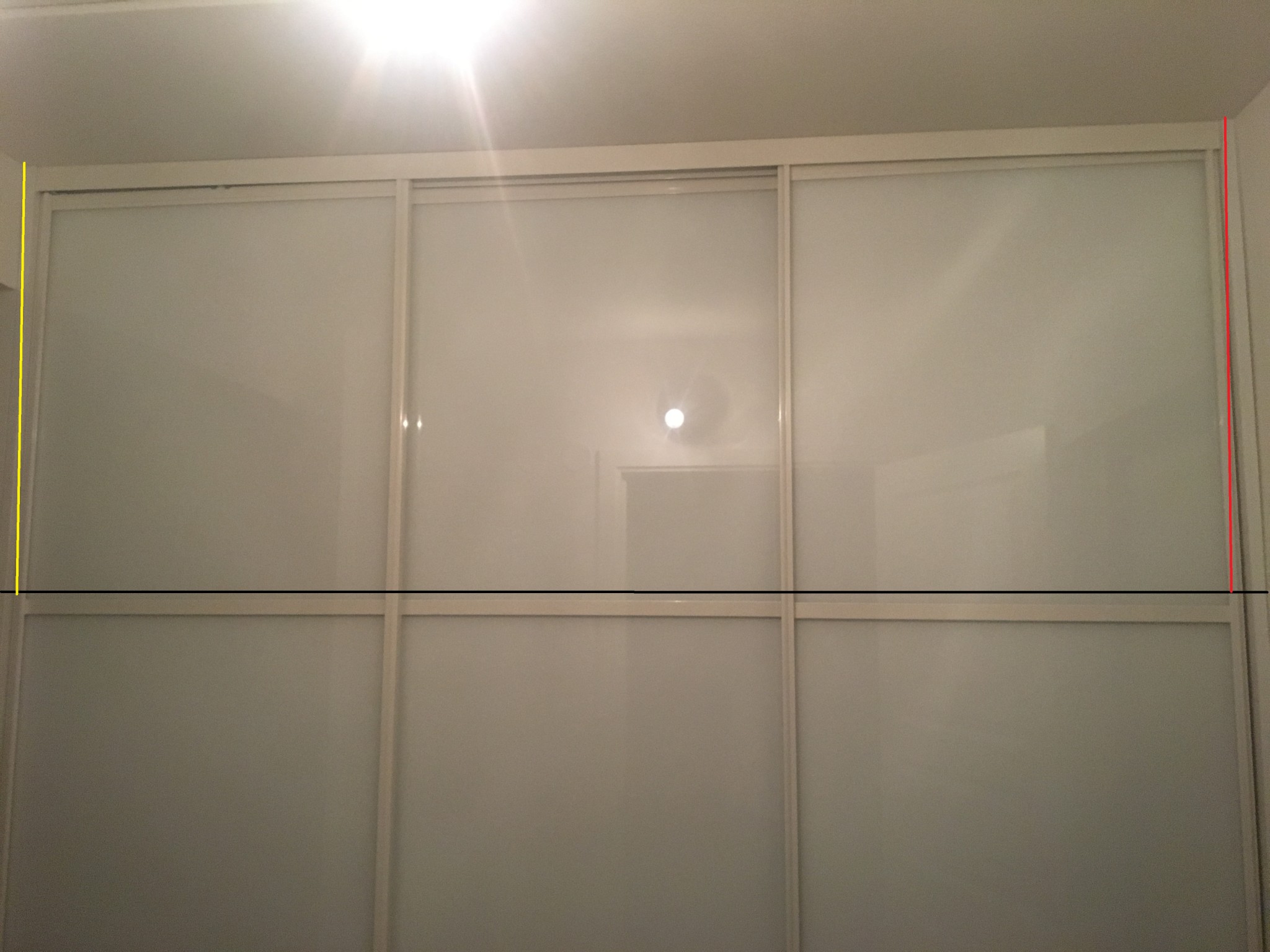
As you can see in the picture, it is sloping quite a bit and it is clearly visible. The measurement length (black line) is 2.25m/2250mm.
The major builder that constructed the apartment, against whom I have filed a complaint about this issue, assesses/claims that this falls within the standard and that as long as the closet functions properly, "everything is as it should be."
When asked what tolerance and industry standards they follow, they refer to AMA table 43.E/-1 where the tolerance for slope is as follows:
The slope at the measurement length (L) can be L/600, but at least ±5 mm and at most ±20 mm
In my case, the measurement length is 2250mm and over this length, my ceiling slopes 20mm (red line on the picture compared to the yellow line) if I read this formula correctly, the maximum tolerance for measurement lengths up to 3 meters is ±5 mm and everything from 3 meters and upwards can slope a max of ±20 mm.
Have I understood correctly that in my case and my measurement length of 2250mm, the ceiling slopes too much? Do you see that I have any chance of getting this complaint accepted if I bring in my own inspector and pursue this legally against the major builder?
Eternally grateful for any help I can get.
/G
I need to consult your expertise regarding my ceiling in the hallway which is sloping.
As you can see in the picture, it is sloping quite a bit and it is clearly visible. The measurement length (black line) is 2.25m/2250mm.
The major builder that constructed the apartment, against whom I have filed a complaint about this issue, assesses/claims that this falls within the standard and that as long as the closet functions properly, "everything is as it should be."
When asked what tolerance and industry standards they follow, they refer to AMA table 43.E/-1 where the tolerance for slope is as follows:
The slope at the measurement length (L) can be L/600, but at least ±5 mm and at most ±20 mm
In my case, the measurement length is 2250mm and over this length, my ceiling slopes 20mm (red line on the picture compared to the yellow line) if I read this formula correctly, the maximum tolerance for measurement lengths up to 3 meters is ±5 mm and everything from 3 meters and upwards can slope a max of ±20 mm.
Have I understood correctly that in my case and my measurement length of 2250mm, the ceiling slopes too much? Do you see that I have any chance of getting this complaint accepted if I bring in my own inspector and pursue this legally against the major builder?
Eternally grateful for any help I can get.
/G

Thank you for the response. It is a new production.E etompau said:
What are the possibilities for fixing this? If that's not possible, can some form of compensation be requested?
In that case, the apartments have probably already been inspected once before moving in.
I'm having a little trouble keeping up here, have you personally ordered a service from a company to install wardrobes in your apartment, and where now these are leaning due to a sloped ceiling?
I'm having a little trouble keeping up here, have you personally ordered a service from a company to install wardrobes in your apartment, and where now these are leaning due to a sloped ceiling?
I might be very conspiratorial, but my feeling both during the inspection before moving in and during the 2-year inspection is that the inspection company is very biased. They didn't even bother to measure this; instead, the measurement was done by a representative from the developer who isn't a certified inspector, and it was the same person who claimed that it can lean 2 cm at this measurement length. The inspector at the 2-year inspection didn't measure but observed this and then turned to the developer's representative who said he had measured and that it is within the tolerances.E etompau said:
No, these wardrobes in the hall were part of the standard setup for all apartments in the building, so it's not an option.
OK then I think I understand. I would say that it's hopeless to fix or get compensation for this. Replacing the roof is such a large cost in relation to the deviation that you simply don't do it.
Perhaps it's possible to conjure with some custom-built moldings to compensate for the slope.
Perhaps it's possible to conjure with some custom-built moldings to compensate for the slope.
no, you weren't unclear, I just saw it in your text.A Analytica said:
Just wondering, it's easier if you're the party against the contractor, so you have some leverage.
but in such a case, the developer and contractor have already settled, so not much to do.
So you can't expect any kind of compensation at all? In other words, just give up all attempts.E etompau said:
Had you been the client yourself, you might have been able to get something small.
When something goes wrong in a construction project, the main principle is "redo and do it right." However, if the cost of correcting the mistake is unreasonably large compared to the value of the error for the client, the contractor can instead choose to compensate financially. That compensation should then be related to the damage the client has due to the unaddressed error.
In this case, that damage is probably close to zero.
When something goes wrong in a construction project, the main principle is "redo and do it right." However, if the cost of correcting the mistake is unreasonably large compared to the value of the error for the client, the contractor can instead choose to compensate financially. That compensation should then be related to the damage the client has due to the unaddressed error.
In this case, that damage is probably close to zero.
I understand. Unfortunately, you rarely are the client yourself, but it is the association (which during construction is controlled by the developer)H hempularen said:Had you been the client yourself, you might have been able to get something small.
When something goes wrong in a construction project, the main principle is "redo and do it right". But if the cost of redoing it is unreasonably large relative to the value of the error for the client, the contractor can instead choose to compensate financially. That compensation should then be related to the damage the client has due to the uncorrected error.
In this case, that damage is probably close to zero.
 . If I understand you correctly, it is also futile to ask the association to pursue this.
Just to be a little picky. The developer is the one who commissions a construction, likely the association in this case.
You could point this out to the association. In some cases of new production, there is a round after a period to address various discovered issues. This can involve both measures and a lump sum for minor deviations to the association. That is, you personally likely won't receive compensation, but it could help your shared finances in the association.
You could point this out to the association. In some cases of new production, there is a round after a period to address various discovered issues. This can involve both measures and a lump sum for minor deviations to the association. That is, you personally likely won't receive compensation, but it could help your shared finances in the association.
Click here to reply