Good detail explanation, it facilitates the discussion! You should not notch a beam on the underside in that way. At the endpoints of beams, it might be OK to notch on the top side. (However, not where the beam continues over a support in the middle of its length) In this case, the underside of the beam should rest on some form of bracket. Perhaps a flat iron that is bent and folded over the "hammarband". Why do you need to notch?
What happens if you notch on the underside can it really become weaker than an unnotched beam of 140 mm or?
I'm a bit slow today. So, the cross bracing is in the way of the suspended ceiling's battens. The need for cross bracing arises because the chosen dimensions of the overlying floor structure do not support the current span without reinforcement, or there might be temporary larger point loads. Therefore, one has to come up with a way to reinforce the floor structure that does not interfere with the ceiling. The solution you've drawn is probably not good enough. The most immediate option is to reinforce each individual floor joist. A relatively simple version is to glue and screw a standard board (22x45) of good wood quality to the underside of the joists. Another option is to glue and screw a larger board (22x220) upright on the side of the joists. However, what should be done cannot be determined without knowing how the space above is used.
smurfen72: Notching a wooden floor beam on the underside weakens the construction. Whether a notched 170 mm beam is weaker than an unnotched 140 mm beam, I wouldn't dare to answer, but I don't think such notching should be recommended on Byggahus without arranging another support for the beam.
Of course, the rule becomes weaker if you unplug it as it becomes lower. I thought there was some factor I missed, but it's probably very rare that the setup is the weakest point as long as there is some span, like here with a 4250 mm span.
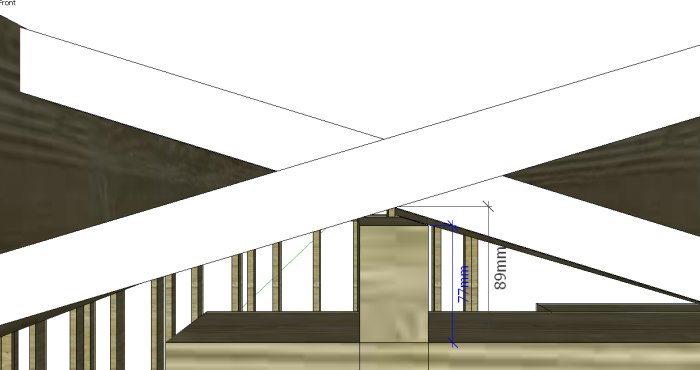
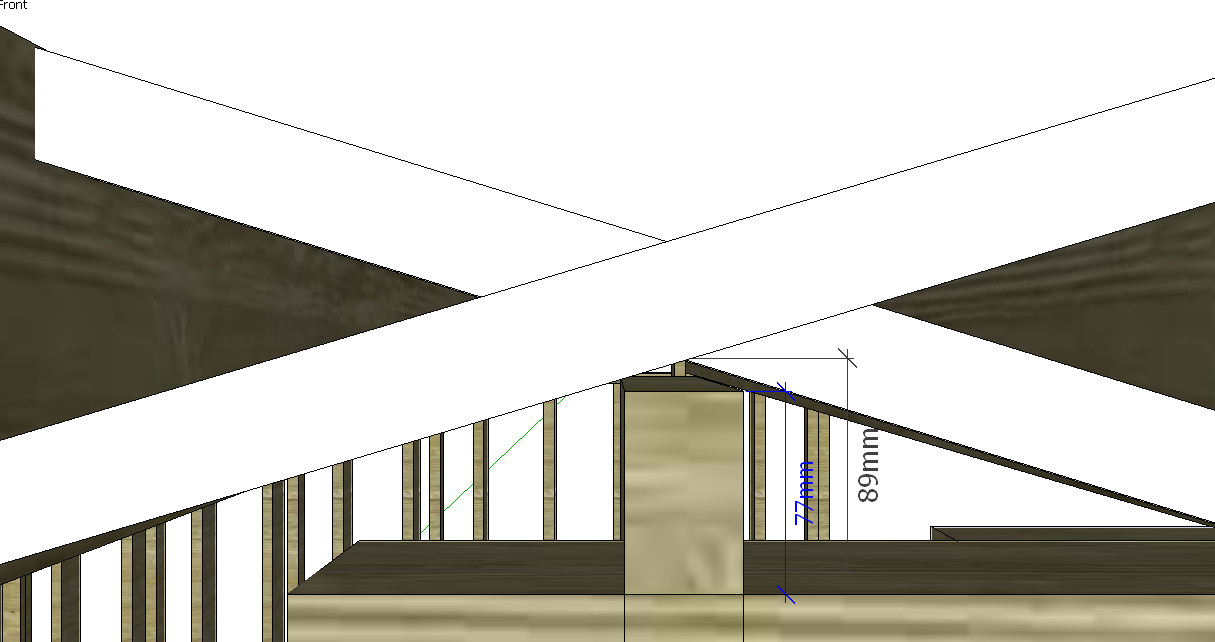
Okay, then I understand that it's not as easy as just removing the crossbracing without further thought. If you keep the crossbracing, I can fit a 45x75-77 mm stud at most without it coming into contact.
If you then screw and glue a 45x45 to the underside, the total becomes about 45x120. I would prefer not to build more than 45 downwards, because then I have to start moving electrical outlets on the wall. But I suppose it's insufficient with 45x120 even if one were to glue and screw a 34x95 stud on the sides?
Otherwise, your idea of rebuilding the crossbracing to my variant and reinforcing existing beams with a glued and screwed one underneath is probably the way to go. If it works with the loads?
Link to the house drawing, above the cinema room there is a bedroom and walk-in closet: https://www.dropbox.com/s/yxznk6xeucdvyio/Husritning.pdf?dl=0
When it comes to the deflection of the ceiling, I can accept a maximum of 2 cm if it makes the calculations easier. But of course, it's good if it's less.
Cross bracing involves distributing loads across more beams, but it does not reinforce the individual beam. If you want to do that, you need to screw glue in some way. As for the ceiling, the deflection is the determining factor. If you use 45x120 C24 at c/c 600, the deflection will be about 1.6 cm. If you can find 45x120 with strength class C30, you can reduce it to 1.3 cm (if I calculated correctly...).
But then it sounds like my best option is to try to find 45x120 C30, but I still have to notch the rule so that the support height is max 75-77 mm, otherwise I won't fit under the bracing. This will weaken the rule at the support, but if you reinforce it with a nail plate on both sides and also notch them in the same way as the rule. Do you think that would work?
If I can only find C24 classified. How much stronger does the rule become if you screw-glue a board on the long sides?
I have estimated a self-weight of 25 kg/m which corresponds to approximately 40 kg/m2. If you use an angle iron to support the underside of the beam, that should be sufficient. If you take two 45x120 C24 and glue-screw them together, the deflection will be about 8 mm. Otherwise, you can certainly find a C30 in a slightly larger dimension and cut it down.
The angle iron is then screwed through gypsum, OSB, and horizontal 45x45 studs before it reaches the wall's top plate (is that what it's called?). But that shouldn't be a problem.
very difficult to obtain C30 classified studs. Could one cut down a glued laminated beam 42x180 to 42x120. Alternatively, a glued laminated beam 56xXXX that I bevel on the top side for clearance to crossbeam.
Will it support the weight?
Glued laminated timber 42x180 works excellently. It can handle a slightly larger load than 45x170 C30, but not much more. However, you cannot cut it down to 42x120.
If I can't cut a glulam down to a height of 120, then it's not an option anyway.
I'm considering whether to go for double screw-laminated 45x120 c24 instead and bevel the top a bit so it fits freely against the cross-beam. Can you double-check that the deflection would then be 8 mm?
Thanks
I find it a bit difficult to understand your thinking. Roof structures are designed with respect to the risk of failure. Floor joists that are walked on are designed with respect to deflection and bounce. The latter method requires larger dimensions. Cross bracing is a method used to reduce bounce and distribute point loads better over more beams. Cross bracing does not mean that the structure can handle larger distributed loads and is therefore not relevant in connection with roof structures. Two screw-glued 45x120 C24 correspond to a 45x170 C24 (when calculating the ultimate limit state), which is not sufficient in your case.
When I encounter a similar situation, where the height space does not allow for an optimal structure, I usually take a step back and consider if I can change any of the basic conditions.
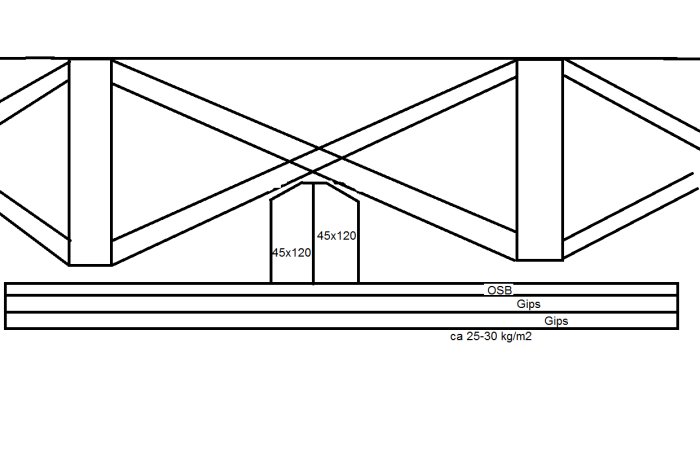
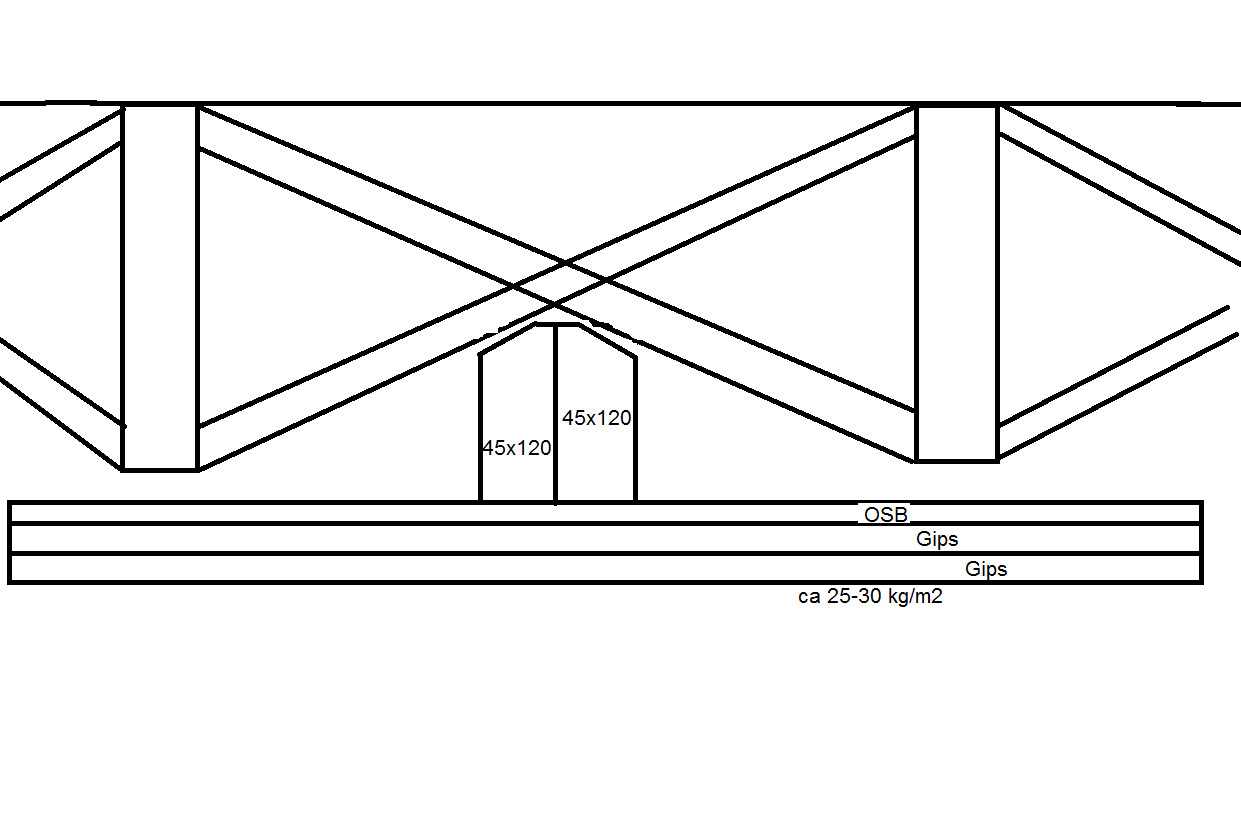
Now I don't understand at all what you're writing. Earlier you said: "If you take two 45x120 C24 and screw glue them together, the deflection becomes about 8 mm." I assume you meant that they should be screwed together side by side so the "new" joist becomes 90x120? That would work if I bevel a bit at the cross bracing, see picture.
Now you write that: "Two screw-glued 45x120 C24 corresponds to a 45x170 C24 (for calculation of fracture limit state) which is not sufficient in your case."
So I no longer understand what you mean??
Vi vill skicka notiser för ämnen du bevakar och händelser som berör dig.