A glulam beam 42x180 that is cut down to 42x120 can support a larger load and deflection than 45x120 C30. To avoid waste, you can split a 42x240 in half.
I apologize for my confused response. I have written several posts in recent days on another thread that also deals with roofs.
But isn't it important to choose the right quality of glulam if it is to be split? I seem to remember that they insert less durable wood in the middle of a glulam beam, but maybe not in such weak dimensions, or?
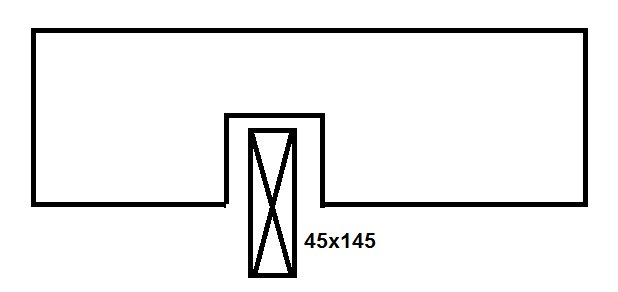
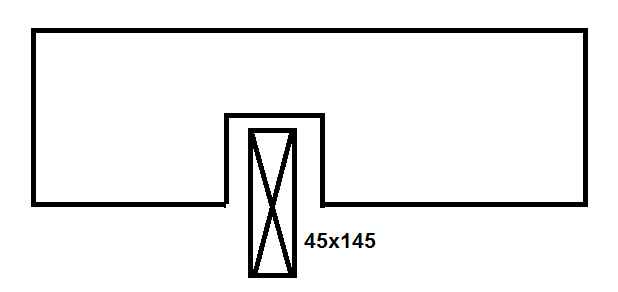
Remove the cross-bracing and place noggins instead. Then notch them, and you'll have space for 45x145 as you originally planned. Sure, a notched noggin will be marginally weaker than the cross-bracing, but it might be manageable.
But isn't it important to choose the right quality of laminated beam if it is to be split? I recall that they insert less durable wood in the middle of a laminated beam, but maybe not with such weak dimensions or.
That's correct, it should not end on c, which stands for Combined, e.g., L40c.
The modulus of elasticity for glued laminated timber class L40s in terms of deformation is 13200, for structural timber class C30, 12000. A clearly relevant difference. Between the different strength classes for structural timber, the difference is 1000. That is, C35 is 13000 and C24 11000.
The modulus of elasticity for glulam class L40s in terms of deformation is 13200, for structural timber class C30, 12000. A clearly relevant difference. Between the different strength classes for structural timber, the difference is 1000. That means C35 is 13000 and C24 11000.
The E modulus differs by about 10% but the timber has a larger area so the difference becomes small.
But the difference in bending resistance is only 7%. The point of my first post was merely to highlight that a glulam beam was at least as good as structural timber in class C30 (which was hard to find), and that was indeed a correct statement.
Well, quite a bit has been written here. I usually get emails when things happen in my threads, but it didn't work this time.
@Finndjävel.
To minimize the work, it's better to keep the cross-pinning and go for a 120mm high stud as long as it can handle the load.
@justusandersson
Unfortunately, 42x240 doesn't seem to be a standard dimension. I've googled but couldn't find a supplier. And as you mentioned, there's a lot of waste if you can't use one beam for two. However, 56x270 is available but much more expensive than the 42 width. Maybe you can reduce the height a bit, like splitting a 56x225?
I also noticed that the standard lengths are 4 m and 6 m, and since I need 4.3 m, I have to go for 6 m. Can a glulam beam be spliced with metal plates? Otherwise, it results in very expensive waste pieces.
A split 56x225 is actually slightly better than a 42x120. I don't believe in splicing glulam lengthwise in this case. The margins are quite small. I think you will need to special order and expect a longer delivery time. Then there will always be some waste...
A split 56x225 is actually slightly better than a 42x120. I don't believe in splicing glued wood on the length in this case. The margins are quite small. I think you'll have to special order and expect a longer delivery time. Then there's always a bit of waste...
Shouldn't be impossible, I'll check with the hardware store.
Good detailed documentation, it facilitates the discussion! One should not notch a beam at the bottom in that way. At the endpoints of beams, it may be okay to notch at the top. (But not where the beam continues over a support in the middle of its length) In this case, the underside of the beam should rest on some form of bracket. Maybe a flat iron that is bent and folded over the "hammarbandet". Why do you need to notch it?
A little anecdote about notching:
In Gothenburg, we lived in a group house area.
All the houses were identical, and all had detached garages on our little street.
The winter of 2009 - 2010 (the last year we lived there) it snowed a lot, and one neighbor after another was up on the garage roof, which was flat and low-sloping, shoveling snow, which was 30 - 40 cm deep.
So did I, just in case.
One of my closest neighbors smiled smugly and wondered why we were doing that, it was unnecessary.
Well, the next day the neighbor was up on his garage roof shoveling like crazy.
A couple of the roof beams had cracked where they were notched and lay over the wall's load-bearing beam,
and the roof sagged significantly.
The neighbor was a professor in building physics in wood and concrete structures at Chalmers
Considering the choice of upright wall studs for the wall that will support the ceiling. I plan to use 45x95 cc600, but do I need C24, or is C14 sufficient? The reason for the question is that, for example, byggmax does not have C24 in their range here in town. The total weight of the ceiling is about 500-600 kg.
When it comes to assessing the load-bearing capacity of posts, the so-called buckling length is an important factor. However, since I assume that the posts will be built into a wall and thus locked laterally, you don't need to think much about this aspect. A single 45x95 stud of C14 class can, with a buckling length of 0.8 meters, handle up to 24 kN, which is about 2400 kg. If the post's buckling length is 2 meters, it can handle 4.8 kN, which is about 480 kg. All assessed in the weakest direction. I mention this primarily for educational reasons. You can safely go with C14.
Vi vill skicka notiser för ämnen du bevakar och händelser som berör dig.