
1,085 views ·
4 replies
1k views
4 replies
Risk-free to carve a channel for piping in an exterior wall?
Hello, I am in the process of installing new pipes for the radiators in the house because they run under the basement floor and I want new fresh ones before the new floor is laid.
The old iron pipes ran in the outer wall (see picture) made of 30 cm siporex elements, the channel seems to be about 10 cm deep. It is "filled" with something resembling the siporex itself, though not quite as porous as the siporex.
Is it just a matter of hacking away the pipes and installing new ones and then sealing with a cement-based filler like Finja's wall repair?
I want to avoid the ground floor coming down to the basement..
/Andreas
The old iron pipes ran in the outer wall (see picture) made of 30 cm siporex elements, the channel seems to be about 10 cm deep. It is "filled" with something resembling the siporex itself, though not quite as porous as the siporex.
Is it just a matter of hacking away the pipes and installing new ones and then sealing with a cement-based filler like Finja's wall repair?
I want to avoid the ground floor coming down to the basement..
/Andreas
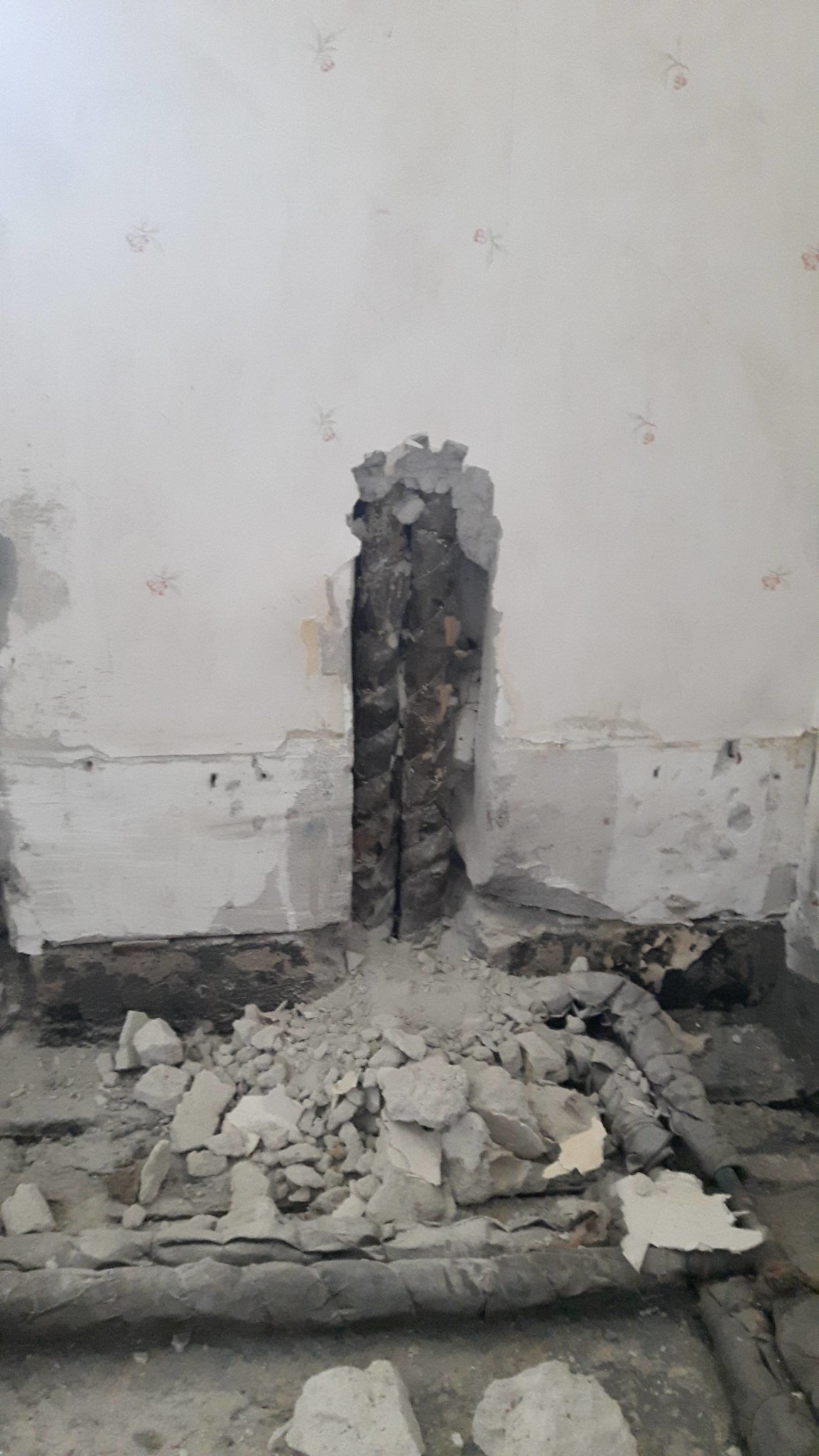
If you follow the old pipes' paths, there's no risk, but then you should have prisol pipes (the ones with white plastic). Copper doesn't do well in contact with cement. Regarding joints in the floor, it's allowed for heating. But it's recommended to hard-solder or soft-solder the joints, no compression fittings or press tools.
I assumed it would be okay. One could assume that the pipes are installed after the floor joists plus outer walls on the entry-level are in place.S skutten11 said:If you follow the paths of the old pipes, there is no risk, but you should have prisolrör (the ones with white plastic) for that. Copper doesn't do well in contact with mortar, and regarding joints in the floor, you can have those for heating. But I recommend hard soldering or soft soldering the joints, no compression fittings or press systems.
I'm going with PEX with protective sleeves, so no hidden joints.
Do you have tips for suitable filler if Finja's repair wall isn't appropriate for this?
/Andreas
You can take what you want and polish with it, when you place them in the wall they will want to go out (there is a memory in all plastic pipes, they want to return as a roll) set some 4-inch galvanized at an angle, a cross will go over the pipe and polish then they will stay in place. Another tip is to heat them by running hot water and plugging the ends (it can be a bit wet when cutting, but they become really manageable then).
S skutten11 said:You can use whatever you want to polish with, when you put them in the wall they will want to come out (there is a memory in all plastic pipes, they want to return to a roll) put some 4 inch galvanized at an angle, a cross becomes over the pipe and polish then they stay in place. Another tip is to warm them up by rinsing in hot water and plugging the ends (it can be a bit wet at the cut, but they become really manageable then
Awesome! Thanks for the help!
/Andreas
Click here to reply