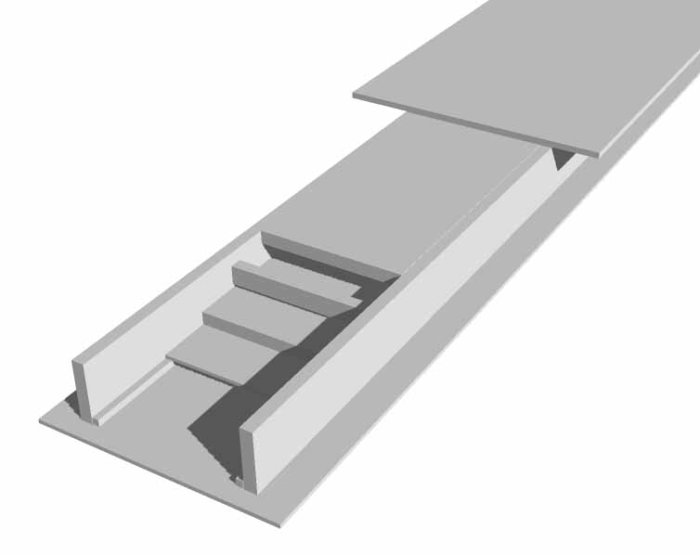
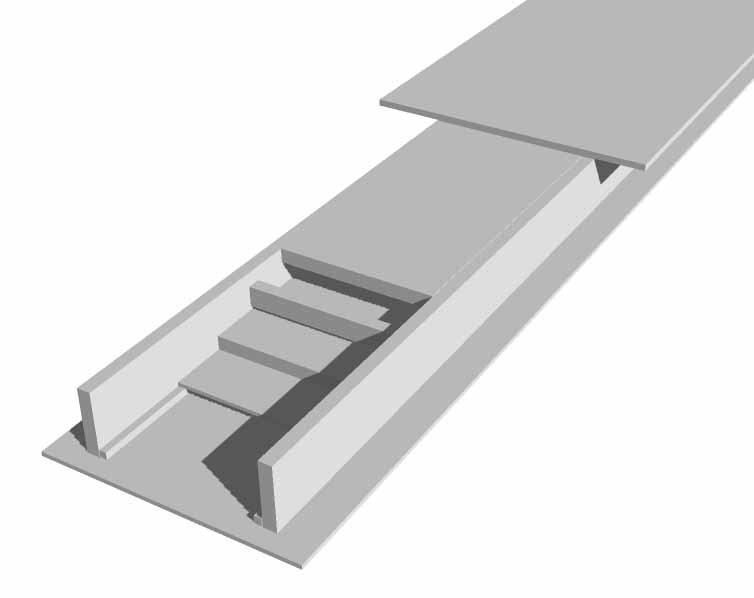
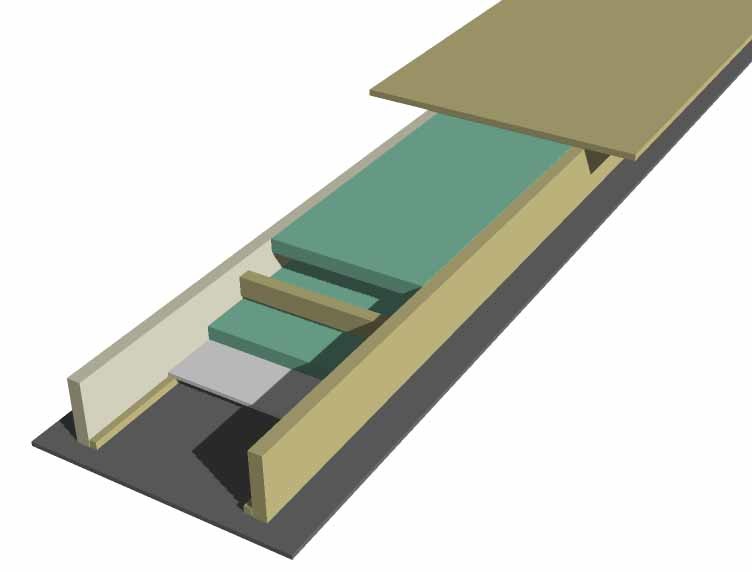
I'll briefly touch on sound insulation here. I won't go into impact sound insulation since it's not relevant in this case.
To improve airborne sound insulation, you need two layers with mass and an air gap in between. Remove the kutterspån as it doesn't absorb sound as well as mineral wool.
To achieve sufficient mass on the underside of the floor structure, you can either use plasterboard on the ceiling of the lower floor or add plasterboard from above inside the stud compartments. It's important to seal carefully regardless of the method. The more layers of plasterboard, the better the sound reduction.
Fill the stud compartments with stone wool, and it should not be compressed.
For the top of the joists, the same principle applies: as much mass as you can fit, ceminwood or chipboard to support, followed by floor plasterboard.
Thank you for all the comments, they help.
Now the Easter celebrations are over and we can focus on construction again
Our flooring is 220x50 mm
The room is 3.5m long (the joint to the next subfloor in the adjacent room is a bit into this room under the closet). Drawing of the room: http://forumbilder.se/H6HCN/sovrum
Then we come to the middle layer.
Under the flooring, there seems to be a felt paper and then 5mm Masonite. [/URL][/IMG] http://forumbilder.se/H6HCN/image1-2
The partition wall stands on nogging and has sawdust under it so I really can't find any void leading to the floor below.
Back to construction:
If we lay gypsum at the bottom of the joists, how do we attach it? (soft sealant, which one??)
It should of course help but it's hard to seal it here because the sawdust disappears under the adjacent room, so it doesn't really seal against the layer below.
If we screw a batten to the side of the joist to countersink the gypsum so it lies flush with the joist, is that also a solution?
(so you don't have to screw through the gypsum to attach the chipboard to the joist)
What should be chosen as a soft sealant between chipboards and the wall?
The most important thing is to get help with how I attach gypsum under the chipboard and which soft sealant should be used to seal properly for soundproofing!
(Yes, we're ONLY talking about airborne sound, we have no problem with structure-borne sound)
When looking at the span and the dimensions of the beams, they are completely OK in terms of deflection. The partition wall, which stands on noggins, is so close to the beam's support that I don't consider it a problem either. However, the chipboard floor needs to be screw-glued directly to the beams for the deflection conditions to be perfect. The paper under the wood shavings is probably a regular AC150 (asphalt paper). It acts as an airtight seal and has some vapor resistance but definitely does no harm there, on the contrary. As I see it, the best way must be to lay the gypsum board on battens screwed to the floor beams. How to seal there, Björn Melander will have to answer since it was his idea.
If there are sparse areas underneath, you either place the plaster against them or, as Justus suggested, against battens. It's a bit of a hassle, but it pays off later.
You do the sealing with a flexible sealant, the more expensive the sealant, the less it shrinks. The budget option is latex, but then you should seal in several rounds, allowing it to dry in between. This is because it shrinks quite a bit. For large gaps, use plaster compound.
Gypsum at the bottom:
I don't know what's between the asphalt felt and the wooden ceiling (super simple sparse panel) on the lower floor, so it feels a bit risky to screw the gypsum into this since if we do anything to the ceiling down there, we might suddenly encounter the screws!
Regarding battens, it will be very difficult to align it with gypsum at the bottom, how did you think there?
Gypsum at the top:
My thought here was battens to countersink the floor gypsum, which also gives me the advantage of reinforcing the chipboards at the turns (but I probably need to put noggings there anyway, unclear how to make it work at the wall since there's air under the partition walls to other rooms, one problem at a time).
Feels like I want the gypsum countersunk on battens against the chipboard in the floor, then we can work on the ceiling of the lower floor if the work on the upper floor wouldn't be enough.
Soft sealant: you are really talking to a house beginner, I don't know what an expensive one is.
Where, for example, does https://www.bauhaus.se/casco-golvfog-s40-ljust-tra.html fall on the scale, is it really cheap, moderate, or expensive? (I assume this is in the upper part of cheap sealants).
I would very much appreciate help with which brand I should look at.
Feels like it's an advantage to buy a few 300ml for a regular gun to simplify the work.
Sure, it gives me a good picture, please add edge lines to the view for better clarity.
As I understand it:
Battens with drywall on top (this creates an air gap to the substrate)
Insulation
Nogging
Insulation (?)
Chipboard on the floor joists
It creates some air gaps that instinctively feel not good but which I've now understood aren't a disadvantage at all.
It's good planning but the risk is that I have to lay the noggings level with the floor joists as the grooved chipboard needs extra support at the turning plates for the heating loops.
I will probably need to go with noggings and drywall on top to make a stable substrate for the chipboard (which is also glued and screwed into the joists)
Addition: Many thanks for all the help, it's really invaluable to have the opportunity to discuss this on the forum!
Yes, I understood correctly, but as I said, I still need noggings for support for the chipboard.
I'm planning the turns in the room to see what position the noggings will need, and I expect to CAD it up by the weekend.
A few follow-up questions:
If we attach battens and drywall, should the cavity created under the drywall be filled or left empty?
(Why one or the other)
You give an example of insulation + studs + insulation, how much difference does it make to lay a thick insulation board without gaps?
(Now we're back to purely sound questions)
I have looked over the room and since the room lacks support at the edges, installing a slotted subfloor with embedded heating becomes too complicated.
We're going with 22mm chipboard, 16mm EPS underfloor heating, and 14mm parquet, we just fit the building height (we have a few mm left for underlays).
This means we can start building the floor before we deal with the underfloor heating.
So far, the project feels fun, it's mostly the flooring joist that's causing some anxiety because once we glue screw the chipboards, it's a bit of a "point of no return." Hence all the thoughts on possible solutions.
I assume that the studs can simply be toenailed since they only need to support the weight of the insulation.
The floor heating still feels good because we get rid of the pipe penetrations in the floor + radiators, and you can see an impact from the hardboard and nails in the exterior wall (since they managed to place a joint right behind the radiator pipes, which of course heats and cools the nails).
Plus, floor heating is incredibly comfortable to walk on
Click here to reply
Vi vill skicka notiser för ämnen du bevakar och händelser som berör dig.


 [/URL][/IMG]