
Hello hello
We are in the process of renovating the house, but have started to ponder a bit over a glulam beam that separates the kitchen and the living room.
Considering extending this beam and shortening a wall that sits as a continuation of the beam.
The beam is currently 310 cm, but we want to install one that is 400 cm.
I know this beam is load-bearing and therefore wonder how I should proceed when removing the old one and installing the new beam!!!
Please, I am in urgent need of an answer.
We are in the process of renovating the house, but have started to ponder a bit over a glulam beam that separates the kitchen and the living room.
Considering extending this beam and shortening a wall that sits as a continuation of the beam.
The beam is currently 310 cm, but we want to install one that is 400 cm.
I know this beam is load-bearing and therefore wonder how I should proceed when removing the old one and installing the new beam!!!
Please, I am in urgent need of an answer.

Assuming that it is a wooden floor resting on this glulam beam, you must support the wooden floor with props on each side of the glulam beam. Thereafter, you can remove the existing glulam beam and replace it with a longer one.
Of course, an expert must examine the conditions and calculate what dimension the new glulam beam should be.
This is what props look like in action:

Of course, an expert must examine the conditions and calculate what dimension the new glulam beam should be.
This is what props look like in action:
Last edited:
Yes, we are clear that some kind of support must be put up, but problem number two is that we preferably do not want to break up the floor and a wall on the upper floor. Is it possible to remove it without doing something like that, or should we perhaps think in other directions regarding this beam?
Thanks for the answer!!!
Thanks for the answer!!!

You most certainly do not need to touch anything on the upper floor. The beam serves as a support instead of a wall that could have stood there. On the beam rests the framework for the upper floor. You need to support according to the picture above, preferably on both sides, but that might be overdoing it. Remove the beam, demolish the wall, install a new one with the correct dimensions, and remove the supports. Wear a helmet for safety's sake.Bias84 said:Yes, we understand that some sort of support needs to be installed, but the second problem is that we preferably do not want to tear up the floor and a wall on the upper floor. Is it possible to remove it without doing that, or should we perhaps consider other options when it comes to this beam?
Thanks for the reply!!!

If the beam becomes too long, it might need to be so thick that it doesn't look good; then you might still need a post to support the beam.
we'll probably let the beam stay in place and glue and screw the longer beam next to the existing one.
Then we'll build a box that will function as an extension of the old one.
And then there will be some plaster work to make everything uniform and nice.
Then we'll build a box that will function as an extension of the old one.
And then there will be some plaster work to make everything uniform and nice.
The new beam will, in other words, be mounted in parallel with a 45 mm offset. Ensure that the framework above will actually lie on the new glulam beam since it is now being shifted slightly. Then you must also check that the load can be taken down at the points that now will be - a couple of inches shifted from earlier...
...and of course, you must support the floor on both sides of the wall you are demolishing. Otherwise, the floor might sag on the side you do not support...unless you leave the load-bearing wall in place until you have completed the operation, as it can serve as a support in the meantime.
...and of course, you must support the floor on both sides of the wall you are demolishing. Otherwise, the floor might sag on the side you do not support...unless you leave the load-bearing wall in place until you have completed the operation, as it can serve as a support in the meantime.
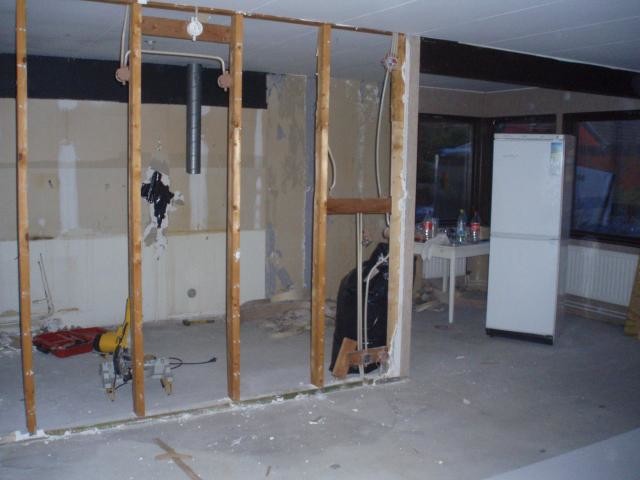
We will let the wall visible in the picture remain while we build the new wall (hjärtväggen).
We have now put up the beam but unfortunately do not have a picture at the moment. But we mounted it parallel to the existing beam, glued them together, and fastened them with 20 screws of 160mm (the width of the beams together is 190mm). There are also some screws into the outer wall beam.
Later, we will probably set a beam that supports the new beam against the outer wall. But we strongly believe this will work.
We have now put up the beam but unfortunately do not have a picture at the moment. But we mounted it parallel to the existing beam, glued them together, and fastened them with 20 screws of 160mm (the width of the beams together is 190mm). There are also some screws into the outer wall beam.
Later, we will probably set a beam that supports the new beam against the outer wall. But we strongly believe this will work.


Click here to reply