Hello,
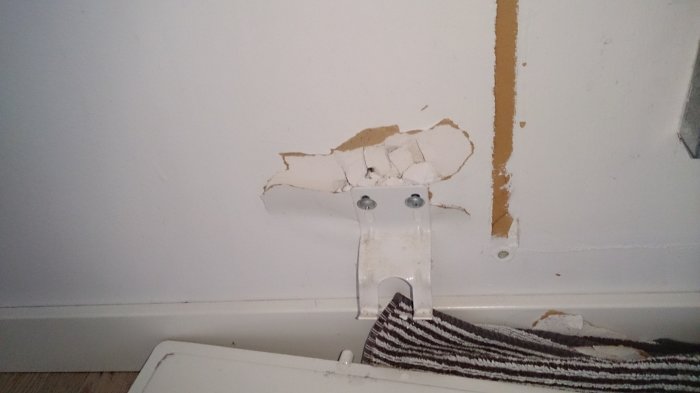
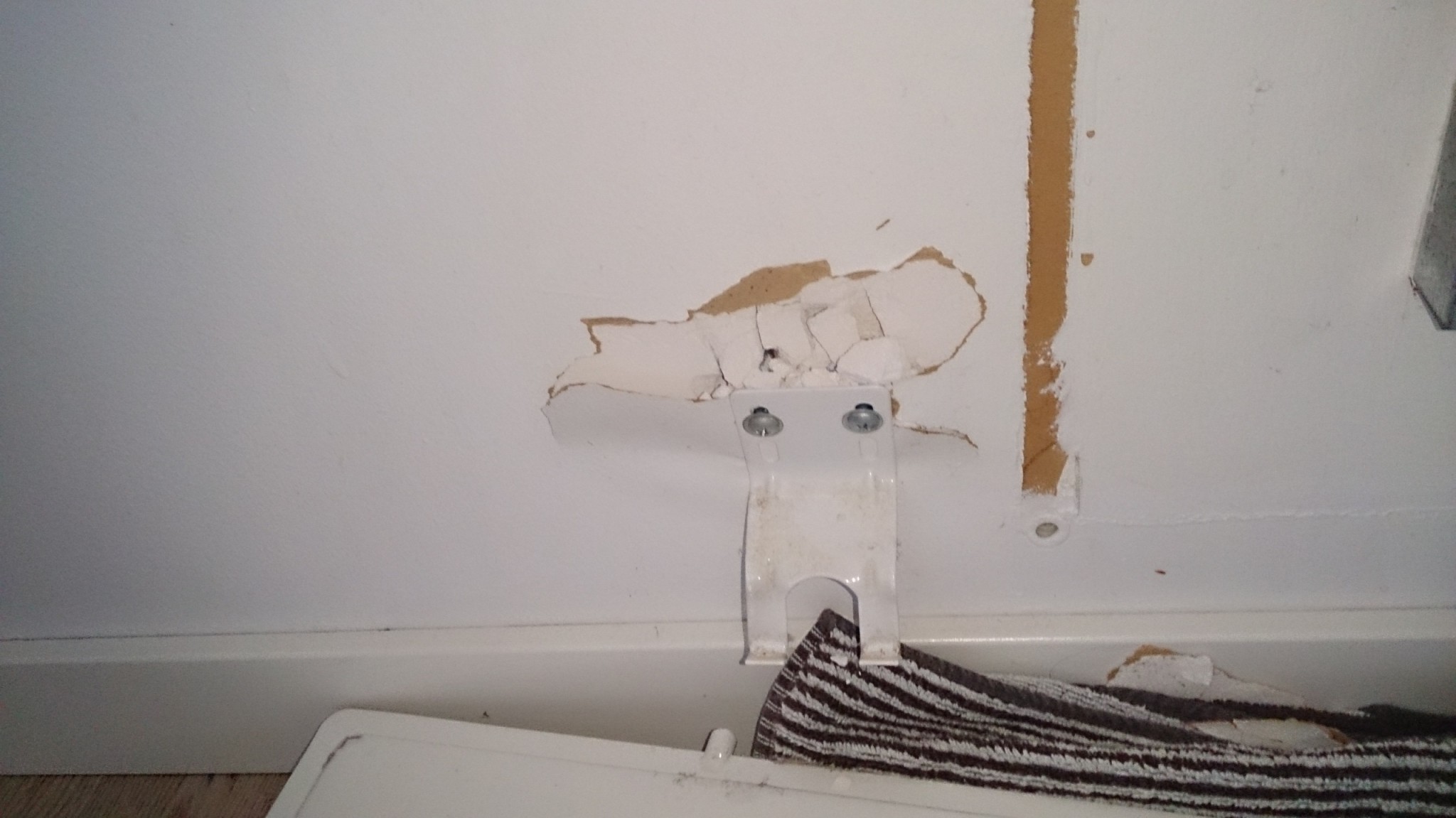
the bracket on the radiator came loose from the drywall. I have read that it can be fixed by screwing wooden/plywood pieces inside a square around it and then a drywall piece within the square.
My question is, if you do that, will it then hold to put the bracket back on?
If I would instead just move the radiator slightly and put the bracket back into the same drywall, how far from the hole do you need to be?
Ordinary drywall screws should do fine. Just make sure the piece of träskiva is as large as possible (as large as you can get through the hole). That will hold well.
If it's a heavy water radiator, I would even try to get a piece of träregel through the hole. So there's something sturdy to screw into.
But then the same maneuver must be done for all the mounts and it looks a bit odd. Much better to place strips of plywood on the inside which the mount is screwed into, I think
Yes, one would wish the studs were a bit closer together than they are ...
It's an electric radiator and not very heavy.
I have a younger family member, no names, who has started slamming the front door as hard as possible when life gets tough. The front door is right outside the kitchen on the same wall as the radiator. I have a feeling that the slamming of the heavy front door may have contributed to this ....
You need to build up with something so you get the same "height" on the wall, otherwise the mount for the radiator won't align with the others. But it doesn't have to be plasterboard, even though it's the most suitable.
So my last comment was a slip in my thinking. I'm still wondering if this is the right way:
1. Insert 2 (not 4, right?) pieces of plywood (6-8 mm) that also stick out over the hole a bit.
2. Fasten with drywall screws
3. Fit drywall piece in the hole. Attach with drywall screws to the plywood??
4. Use Molly bolts to attach the radiator bracket?
If the above is correct, I guess there might be a tight fit for the Molly bolts. But maybe it'll work out fine.
I would probably make sure that the element bracket can also be screwed into the plywood pieces, so you kill two birds with one stone. Of course, cut the hole a bit so that you get good edges to fit against and fit in plywood pieces that protrude over the hole properly.
Om du sågar upp ett fyrkantigt och lite avlångt hål så kan du få in en plywoodbit som är större än hålet. Gärna 12 mm tjock. OSB fungerar också. Den skruvar och eventuellt limmar du i befintligt gips. För att hålla i biten när du skall skruva fast den kan du sätta en skruv mitt i den för att hålla i. Den tar du bort sedan. Sedan skruvar du en bit gips som täcker hålet. När du har så tjock plywood eller OSB bakom behöver du ingen molyplugg utan kan använda träskruv till elementet.
Ok, ONE piece (I just managed two 6-8...). But I think I get it, then the side of the piece is equal to the length of the diagonal of the hole. Sort of. Thanks for the help!
There is no reason to complicate things unnecessarily, two pieces work perfectly well and are probably much easier to fit into the hole. The depth is usually very limited.
Click here to reply
Vi vill skicka notiser för ämnen du bevakar och händelser som berör dig.