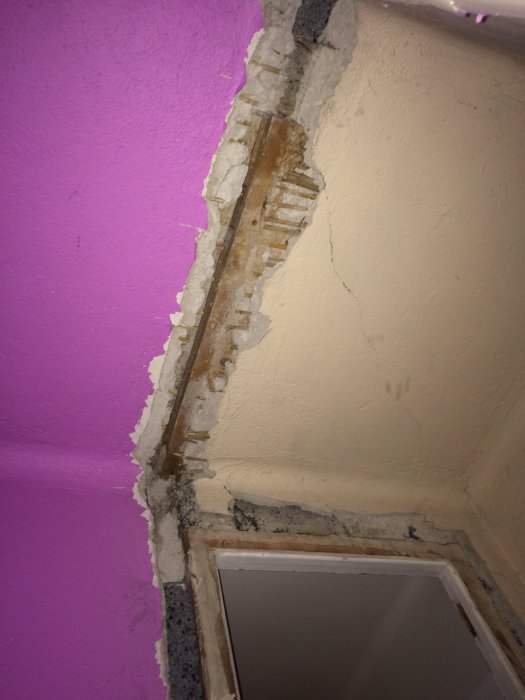
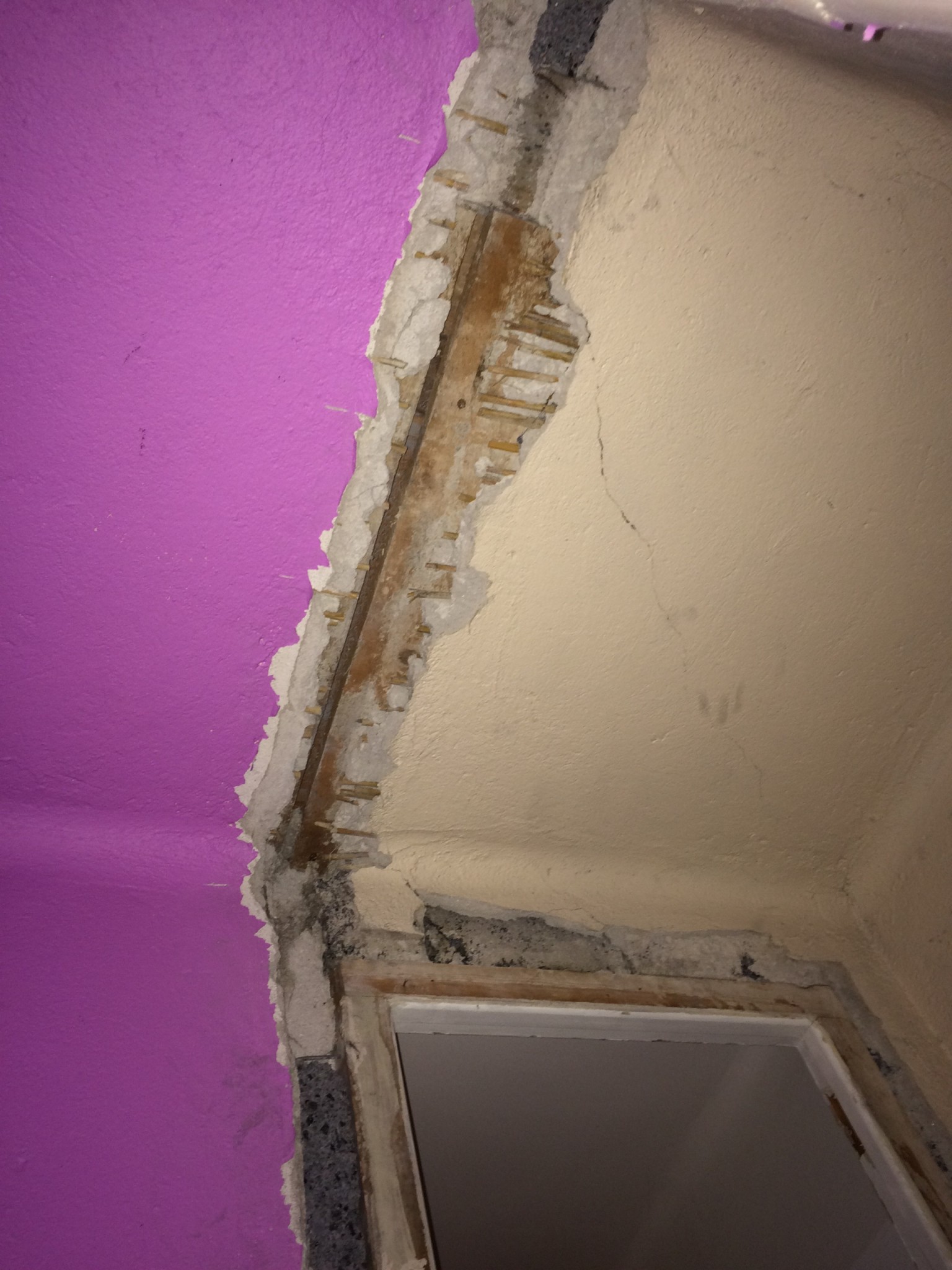
I have just demolished a wall between the pantry and the walk-in closet in an apartment built in 1926. The wall was about 7 cm thick, made of slag and plaster if I understood correctly. The ceiling is made of reeds and plaster.
Now I wonder if anyone has any good tips on how I can fill and even out the "hole" in the wall and ceiling so it doesn't show that the wall was there. What material should one use and is there a smart way to do this?
Thanks in advance!
Below is a picture of how it looks after I have demolished it.
You should be able to use gipsputs. The advantage of it compared to regular sandspackel is that it neither sinks nor cracks. So it turns out well immediately
Gypsum plaster, as mentioned!
Dust thoroughly first and remove everything loose. Apply primer (undiluted) and then just apply the gypsum plaster.
Just be careful not to build out too much, gypsum plaster cannot be sanded down!
Gypsum plaster can be applied in several layers, so better to start cautiously.
I'll purchase and test! Are there many variants of primer and plaster? Thinking so you don't choose the wrong one.
Do you think I need some kind of reinforcement mesh in the open part of the ceiling? Or does the plaster attach directly to the ceiling?
In some places along the wall, there is a groove between 40-66 mm deep, is it preferable to apply multiple layers of plaster in stages? I saw that plaster can handle up to 60 mm layers.
Now I don't know what kind of hardware store you have nearby, but if you buy something from one of the larger building supply stores, the staff there usually have a good grasp. There aren't a ton of manufacturers, but some well-known ones are Finja, Knauf, Combimix, and all of these manufacturers are well-recognized in consumer stores.
Regarding primer, it's probably on the same shelf as the gypsum plaster and from the same manufacturer. (Ask the store staff)
I don't think you'll need any mesh. Gypsum plaster has very good adhesion properties, especially when using primer, and is very sticky. Just make sure to follow the instructions to get the right mix of the plaster!
You should be able to apply the entire depth at once. Alternatively, if you apply just a little less, and I mean millimeters, you can actually apply a layer of filler in the very last millimeters which you can sand at the end to get it perfectly even. Keep in mind, as mentioned earlier, not to apply too thick a layer since it can't be sanded later. So it's better to apply a little less and supplement with some filler if needed, that's the way to go.
Of course, you can also repair around the door with plaster.
The crack in the ceiling is probably more difficult to fix properly without replastering the entire ceiling, which I assume you are not going to do. But try filling it with putty and paint, and if it cracks again in a few years, repeat with putty and paint. That's what I did in an old apartment where it cracked, and it held up until I moved (2-3 years). The crack might be caused by you being rough when dismantling a wall, or it could be natural movement in the house that can't be controlled.
Another solution is to put fabric on the ceiling to cover the cracks and absorb some movement, but that's a completely different job than just puttying and, potentially, filling it again in a few years (probably many years) if necessary.
We expect result pictures
Click here to reply
Vi vill skicka notiser för ämnen du bevakar och händelser som berör dig.